01Facts
The opposite-party company contracted for chartered-flight services, with payments routed to Ava Spa Holidays Pvt. Ltd., whose directors were the petitioners. It paid ₹41,44,700 in advance.
pp. 2–3A scheduled flight was cancelled on grounds of bad weather; the complainant alleged that no adverse weather existed and no flight had been booked, and sought a refund after cancelling the remaining bookings.
pp. 2–3An FIR was registered under Sections 420/120B IPC, and, after investigation, a charge-sheet was filed against the petitioners as directors; the companies were not made accused.
pp. 8–9The Magistrate took cognizance and issued process. The petitioners sought quashing of the proceedings.
pp. 12–1302Issues
i.1. Whether the criminal proceedings under Sections 420/120B IPC could continue against the petitioners as directors when the companies were not arraigned as accused and the complaint did not disclose specific grounds for their criminal liability.
pp. 9–12, 17–18ii.2. Whether the allegations disclosed cheating, rather than a contractual dispute concerning cancellation of flights and non-refund of payments.
pp. 14–16, 18iii.3. Whether the Magistrate’s mechanically recorded cognizance and process order could be sustained.
p. 1603Law Applied
Sections 415 and 420 IPC require deception and fraudulent or dishonest inducement, including dishonest inducement to deliver property; a subsequent breach of contract, without the requisite dishonest intention at the outset, does not by itself establish cheating.
pp. 15–16The Court relied on Maksud Saiyed v. State of Gujarat and S.K. Alagh v. State of U.P. for the principle that the IPC does not generally impose vicarious criminal liability on company directors absent a statutory provision or specific allegations establishing their individual role; Sunil Bharti Mittal v. CBI further requires sufficient incriminating material and criminal intent, or an applicable statutory basis, to prosecute directors.
pp. 10–12, 14–15The Court exercised its inherent power to prevent abuse of process.
p. 17Provisions in the judgment · 2 · Linked ones open on LawLens
Indian Penal Code, 1860 Section 420Section 415
04Reasoning
The Court noted that the agreements and payments related to the companies, neither of which had been made an accused, and that the petitioners were prosecuted as directors. Although the complaint described communications involving the petitioners and alleged that the flights were not provided and the payment was not refunded, the Court found no sufficient specific allegation establishing their individual criminal liability or a basis for imposing vicarious liability under the IPC.
pp. 12–15, 17It treated the alleged cancellation and non-refund, in the circumstances, as insufficient to sustain cheating rather than a contractual dispute, while observing that it could not conduct a mini-trial on the parties’ competing assertions.
pp. 14–16It also found that the Magistrate had mechanically recorded cognizance and issued process without adequate application of judicial mind.
p. 1605Holding
The Court held that the proceedings against the petitioners were not sustainable and that their continuation would amount to abuse of process.
pp. 17–18It allowed the revisional application and quashed the entire proceedings in C.G.R. No. 837 of 2019, arising from Taratala Police Station Case No. 18 of 2019, under Sections 420/120B IPC. No order was made as to costs.
pp. 17–18Original Court PDF
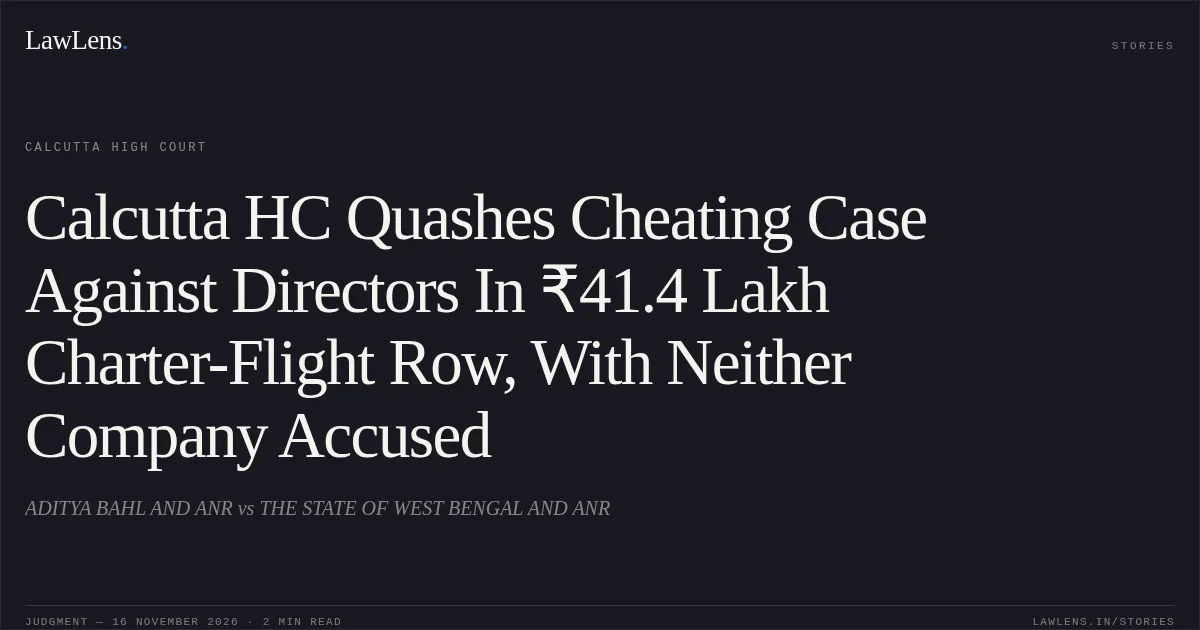
ADITYA BAHL AND ANRvsTHE STATE OF WEST BENGAL AND ANR
Click to open original judgment
Original judgment, available to read, download and summarize on LawLens.in