01Facts
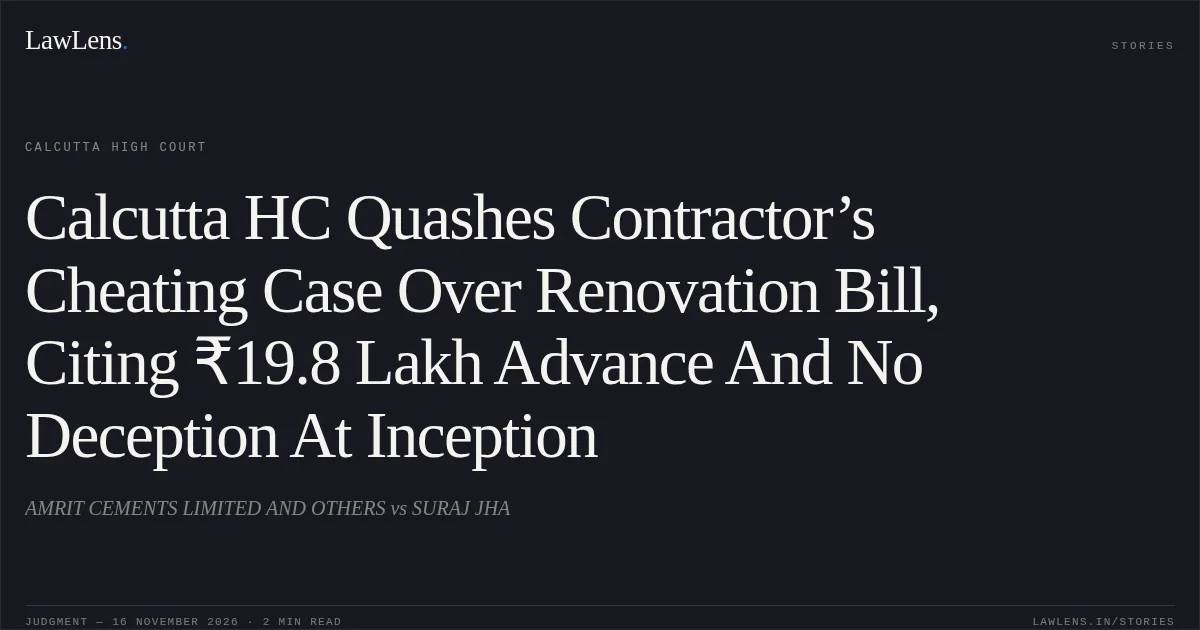
The complainant alleged that the petitioners failed to pay the balance due for renovation work at the company’s head office, despite receiving invoices, and sought to recover an alleged outstanding amount of ₹19,53,941.
¶ 1, 3–8, 11–14, 21–22He filed a complaint alleging offences under Sections 420, 406 and 120B of the Indian Penal Code, 1860 (IPC).
¶ 1, 3–8, 11–14, 21–22The petitioners maintained that the contractor had failed to complete the work within the agreed time, that they had paid ₹19,80,000 in advance, and that they had engaged another contractor to complete the work.
¶ 1, 3–8, 11–14, 21–22The Magistrate issued process, and the petitioners sought quashing under Section 528 of the Bharatiya Nagarik Suraksha Sanhita, 2023 (BNSS).
¶ 1, 3–8, 11–14, 21–2202Issues
i.Whether the allegations of non-payment of the balance for renovation work disclosed the essential ingredients of cheating under Section 420 or criminal breach of trust under Section 406 IPC
¶ 23–24, 26–29ii.Whether the complaint disclosed a prima facie offence of criminal conspiracy under Section 120B IPC
¶ 17, 25iii.Whether the criminal proceeding should be quashed as an abuse of process where the dispute arose from a contract and the alleged offences were not made out
¶ 23, 29–3103Law Applied
Section 420 IPC requires deception and dishonest or fraudulent inducement; a subsequent failure to pay a contractual amount, without dishonest intention at the inception of the transaction, does not by itself constitute cheating.
¶ 24–25, 28Section 406 IPC, read with Section 405 IPC, requires entrustment of property and its dishonest misappropriation or conversion; a dispute over payment of contractual dues does not, without entrustment, satisfy that requirement.
¶ 24–25, 28Section 120B IPC concerns criminal conspiracy, and the Court held that the conspiracy allegation could not stand where the principal offences alleged were not made out.
¶ 24–25, 28The petitioners invoked Section 528 BNSS, corresponding to Section 482 CrPC, for quashing the proceeding to prevent abuse of process.
¶ 1Provisions in the judgment · 7 · Linked ones open on LawLens
Bharatiya Nagarik Suraksha Sanhita, 2023 Section 528
Code of Criminal Procedure, 1973 Section 482Section 202Section 200
Indian Penal Code, 1860 Section 420Section 406Section 405
04Reasoning
The Court treated the parties’ disagreement over completion, quality, payment and any refund as disputed contractual matters for determination by a civil forum, without expressing a view on their merits.
¶ 22The complaint did not allege that the complainant was induced by deception to enter the contract, and the petitioners’ substantial advance payments were inconsistent with the pleaded allegation of dishonest inducement from the outset.
¶ 24, 26–28Nor was there an allegation of entrustment of property to the petitioners; the complaint concerned an unpaid balance under the renovation arrangement.
¶ 24, 26–28Since the ingredients of Sections 420 and 406 IPC were absent, the Court held that the Section 120B allegation also could not sustain the prosecution.
¶ 25It therefore considered continuation of the criminal case an abuse of process.
¶ 2905Holding
The High Court allowed the revision and quashed the proceeding, insofar as the petitioners were concerned, under Sections 420, 406 and 120B IPC.
¶ 30–31It also set aside the orders dated 26 April 2024 and 26 June 2024.
¶ 30–31Original Court PDF
AMRIT CEMENTS LIMITED AND OTHERSvsSURAJ JHA
Click to open original judgment
Original judgment, available to read, download and summarize on LawLens.in