01Facts
The petitioner claims ownership of the subject plot through an exchange deed
¶ 2Third parties to that deed appealed against the mutation of the petitioner's name and of the petitioner's transferee's name, and both appeals were allowed, setting aside both mutations
¶ 3–4The petitioner challenged those appellate decisions in two original applications before the West Bengal Land Reforms and Tenancy Tribunal, which remain pending
¶ 5During pendency, the successful appellants initiated fresh mutation cases, notices of which were served on the petitioner, prompting two stay applications (M.A. 1291 of 2026 in O.A. 2092 of 2025; M.A. 1290 of 2026 in O.A. 2091 of 2025)
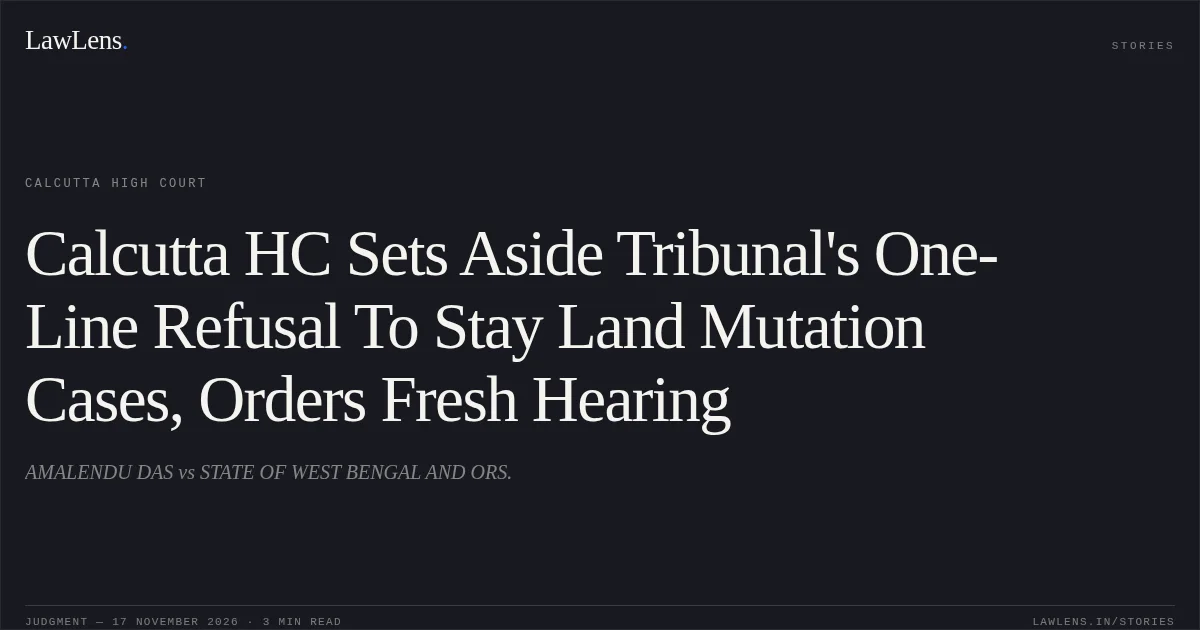
¶ 6The Tribunal dismissed both stay applications by cryptic orders dated 16.09.2026 on the ground that no prima facie case was made out
¶ 7, 15The private respondents did not appear despite service; the State was represented
¶ 8The Tribunal's orders recorded only one-line conclusions and did not refer to the pleadings in the stay or original applications or to the materials on record
¶ 11–1202Issues
i.1. Whether the Tribunal's one-line orders dismissing the stay applications for want of a prima facie case, without reference to the pleadings or materials on record, are sustainable in law.
¶ 10–13ii.2. Whether the impugned orders, being devoid of cogent reasons, must be set aside and the stay applications remanded for fresh consideration.
¶ 14–1603Law Applied
A quasi-judicial or tribunal order must contain cogent reasons showing application of judicial mind, and an order lacking such reasons is vitiated and cannot be sustained.
¶ 13–14Applying this principle, the Tribunal, on reconsideration, must advert to the petitioner's pleadings and the materials on record and afford adequate opportunity of hearing to all parties.
¶ 15The court may direct a time-bound fresh decision, with the Tribunal to pass reasoned orders within two months of communication.
¶ 1604Reasoning
The Tribunal recorded only conclusory one-liners that the petitioner had "failed to make out any case," without identifying the materials relied upon or engaging with the pleadings in either the stay or original applications.
¶ 11–12Applying the requirement of reasoned decision-making, the orders were "utterly devoid of cogent reasons" and reflected non-application of judicial mind, rendering them unsustainable.
¶ 13–14The absence of appearance by the private respondents did not alter this outcome, since the defect lay in the Tribunal's reasoning, not in the contest before the court.
¶ 8The court confined its intervention to the procedural defect and expressly declined to examine the merits of the stay or original applications, leaving the Tribunal free to reach its own findings.
¶ 1705Holding
The one-line orders dated 16.09.2026 are set aside for want of cogent reasons and non-application of judicial mind, and both issues are answered against the sustainability of the impugned orders.
¶ 13–15Both writ petitions are allowed on contest, and M.A. 1291 of 2026 and M.A. 1290 of 2026 are remanded to the Tribunal for fresh hearing on merits, with adverting to the pleadings and materials on record and adequate opportunity to all parties. The Tribunal must pass reasoned orders within two months of communication of the judgment, and the next dates fixed in the matters are to be shifted accordingly. The court expressly made no adjudication on the merits of the parties' contentions. No order as to costs is made.
¶ 15–19Original Court PDF
AMALENDU DASvsSTATE OF WEST BENGAL AND ORS.
Click to open original judgment
Original judgment, available to read, download and summarize on LawLens.in