01Facts
The respondent, Indranath Mukherjee, joined the Bank in a clerical cadre in 1981, served about 32 years, was promoted, and had no antecedents.
¶ 2About one month before his retirement, a charge sheet dated 29 August 2013 was issued to him, which he answered on 6 September 2013.
¶ 2The charge alleged that he approved, upon verification, the modification of the introducer's name using his ID in account no. 02770210000892, an entry made by one Tapas Kumar Banerjee.
¶ 2, 8, 13The charge did not allege connivance or financial loss.
¶ 8, 13The Enquiry Officer (EO) found no mala fide intention, held the mistake to be "in all likeliness unintentional," and noted the transaction was verified "in routine manner".
¶ 12The Disciplinary Authority (DA) imposed punishment on 28 September 2013, and the Appellate Authority (AA) dismissed the statutory appeal on 31 December 2014.
¶ 2The respondent's RTI requests concerning the proceedings against Tapas were unsuccessful, ending with the second appeal's dismissal on 4 July 2016.
¶ 2Following a gratuity claim under the Payment of Gratuity Act, 1972, the Bank paid gratuity pursuant to an order dated 29 September 2017.
¶ 2The writ petition was filed in May 2018.
¶ 2The Bank contended that an alternative remedy lay before the Industrial Tribunal under the bipartite settlement, that the petition was delayed, and that the respondent was not a "workman".
¶ 3, 4The learned Single Judge, by judgment dated 22 July 2025, quashed the charge sheet, EO report, DA punishment order and AA order, and directed payment of terminal benefits as if no proceedings had been initiated.
¶ 1The Single Judge also noted the respondent's promotion to Special Assistant with pay exceeding ₹40,000 per month.
¶ 12The Bank appealed against the judgment of the learned Single Judge.
¶ 102Issues
i.1. Whether the writ petition was maintainable despite the alternative remedy available under the bipartite settlement, and whether it was liable to be dismissed for delay.
¶ 3, 4, 11, 12ii.2. Whether an unintentional verification lapse, committed without mala fide intent or resulting financial loss, constitutes misconduct under Clause 5(j) of the bipartite settlement.
¶ 6, 11, 13iii.3. Whether the findings of the EO and the orders of the DA and AA were perverse or non-speaking, and whether the punishment was so disproportionate as to warrant interference.
¶ 5, 7, 11, 1503Law Applied
Article 226 of the Constitution: the writ court's plenary jurisdiction cannot be fettered by a mechanical refusal to exercise it, and the existence of an alternative remedy under the bipartite settlement is not an absolute bar to a writ petition.
¶ 3, 12Clause 5(j) of the bipartite settlement governs the misconduct alleged; the Single Judge held that an unintentional mistake bereft of ill motive does not amount to misconduct under it.
¶ 6, 13The settled appellate standard: interference is warranted only where the lower court acted without or in excess of jurisdiction, exercised discretion without reasons, or rendered a perverse decision.
¶ 15A judgment is an authority only for what it decides, so precedents must be distinguished on their facts.
¶ 14Union of India v. P. Gunasekaran, (2015) 2 SCC 610, and CISF v. Abrar Ali, Civil Appeal No. 2148 of 2015, relied upon by the Bank for the proposition that disciplinary findings based on admitted lapses need not be disturbed; the Court accepted their principles but held them distinguishable.
¶ 5, 14Union of India v. R. Reddappa, (1993) 4 SCC 269, and Tukaram Kana Joshi v. MIDC, (2013) 1 SCC 353, on delay and alternative remedy, were cited but not separately discussed in the judgment.
¶ 9Provisions in the judgment · 2
Right to Information Act, 2005 Section 2
Bipartite Settlement Section 5
04Reasoning
The Court first upheld the Single Judge's exercise of discretion to entertain the writ petition. The sequence of events, namely the RTI proceedings, the gratuity finding that no wilful omission or loss had been established, and the Bank's admission that the proceedings against the respondent had no connection with those against Tapas, justified condoning the delay and bypassing the alternative remedy.
¶ 12, 13On the merits, the Court held that the charge concerned only a routine verification lapse and did not allege connivance or loss.
¶ 13The EO's own finding of an unintentional mistake undermined the basis of the punishment.
¶ 12The Single Judge rightly rejected the Bank's argument that the respondent had admitted guilt, since an admission of an unintentional error does not establish misconduct under Clause 5(j).
¶ 13The Court found the Single Judge's reasoning specific and reasoned, and the Bank's authorities were distinguishable on facts.
¶ 14, 15Because the Single Judge gave detailed findings on perversity and absence of mala fides, no appellate ground under the Court's own standard was made out. The Court therefore did not reach the Bank's proportionality argument on the merits.
¶ 1505Holding
The writ petition was rightly entertained despite the alternative remedy under the bipartite settlement, and the delay was properly condoned.
¶ 12, 15An unintentional, good-faith verification lapse without mala fide intent or financial loss does not constitute misconduct under Clause 5(j) of the bipartite settlement.
¶ 13The Court declined to interfere with the Single Judge's findings, which were supported by detailed reasons.
¶ 15The appeal and the connected application (CAN 1 of 2025) were dismissed, without order as to costs. The Single Judge's judgment, which quashed the charge sheet, EO report, DA and AA orders and directed payment of terminal benefits as if no proceedings had been initiated, stands affirmed. Urgent certified copies were directed to be granted on compliance with formalities.
¶ 1, 16, 17, 18Original Court PDF
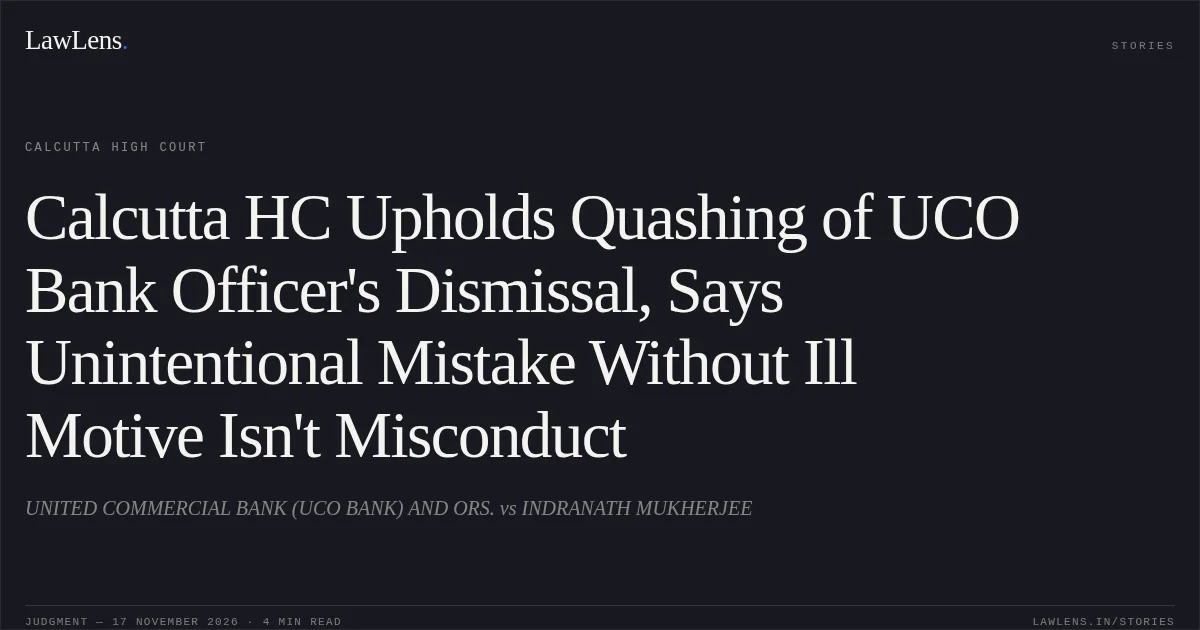
UNITED COMMERCIAL BANK (UCO BANK) AND ORS.vsINDRANATH MUKHERJEE
Click to open original judgment
Original judgment, available to read, download and summarize on LawLens.in