01Facts
UCO Bank advertised Peon positions, requiring candidates to have passed Class VIII but not to be matriculates or higher-qualified; the advertisement also provided for cancellation of appointment if eligibility information was incorrect.
¶ 1, 18–19, 25The appellant had a higher educational qualification but applied stating that he had passed Class VIII. A writ petitioner who had participated in the recruitment challenged the appointments, and the Single Judge directed the Bank to annul appointments of candidates exceeding the educational cap.
¶ 2–3, 25, 27The Division Bench initially allowed the appeals, but the Supreme Court set aside that decision and the review order, permitting revival of the appeals for fresh consideration.
¶ 4–9On rehearing, the appellant challenged the writ petitioner’s standing and disputed the legal basis for the qualification cap, while the Bank and writ petitioner relied on the appellant’s nondisclosure.
¶ 10–2402Issues
i.1. Whether the writ petitioner, an unsuccessful candidate who sought no direct appointment order, had standing to challenge the appointments.
¶ 10–14, 26–28ii.2. Whether the appellant could retain the appointment despite having a higher qualification than permitted and having stated only Class VIII qualification in the application.
¶ 17–25, 29–32iii.3. Whether the qualification cap could be challenged on the ground that the Bank’s communications prescribing it lacked statutory force.
¶ 13, 24, 2903Law Applied
The Court applied the doctrine of approbate and reprobate: a party cannot accept and enjoy the benefit of a process while rejecting its terms, as explained in Union of India v. N. Murugesan, (2022) 2 SCC 25.
¶ 29It also relied on General Manager (HR) v. K. Poovarasan, 2026 SCC OnLine SC 1048, and Employers in Relation to the Management of Bhalgora Area v. Workmen, (2021) 10 SCC 717, in support of refusing the benefit of employment obtained through suppression or false information.
¶ 31–32The recruitment advertisement made the educational cap an eligibility condition and required truthful disclosure, with appointment liable to cancellation for incorrect eligibility information.
¶ 18–19, 25The Court did not determine the statutory validity of the Bank’s communications as a standalone question; it rejected the appellant’s challenge in light of his acceptance of the recruitment terms and his nondisclosure.
¶ 29Provisions in the judgment · 3 · Linked ones open on LawLens
Banking Regulation Act, 1949 Section 52Section 19
Reserve Bank of India Act, 1934 Section 49
04Reasoning
The writ petitioner had participated in the selection process and therefore had a prospective interest in its outcome; the Court rejected the standing objection, noting also that it had not been raised before the Single Judge.
¶ 26–28The appellant knew, or was expected to know, his higher qualification, yet stated only Class VIII in an application containing a declaration that the information was true and that appointment could be cancelled for false information.
¶ 25, 30The Court found that the employment-exchange record did not excuse the failure to correct the information in the application.
¶ 30Having accepted appointment under the advertised terms, the appellant could not retain its benefit while disputing the qualification cap; the Court accordingly found no basis to permit continuation in an appointment secured through suppression.
¶ 29–3205Holding
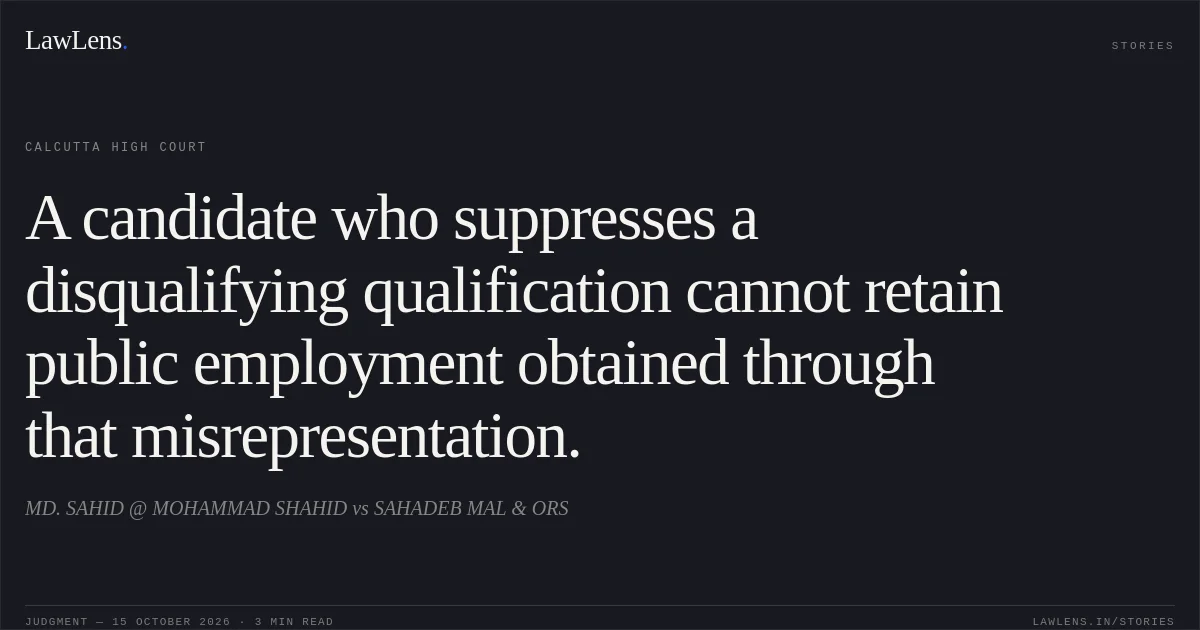
The Court held that the writ petitioner had standing and that the appellant could not retain an appointment obtained after failing to disclose a disqualifying higher qualification.
¶ 33–34The appeals were dismissed, leaving undisturbed the Single Judge’s order directing annulment of appointments made contrary to the advertised educational cap.
¶ 33–34Original Court PDF
MD. SAHID @ MOHAMMAD SHAHIDvsSAHADEB MAL & ORS
Click to open original judgment
Original judgment, available to read, download and summarize on LawLens.in