01Facts
The petitioner, a Central Reserve Police Force (CRPF) employee, was arrested in a criminal case registered at Dibrugarh Police Station and was subjected to a disciplinary proceeding under Section 11(1) of the CRPF Act, 1949.
¶ 2–3The Commandant, 171 Battalion, removed the petitioner from service on 24 December 2008.
¶ 4The petitioner's appeal, dismissed on 2 January 2010, and his revision under Rule 29 of the CRPF Rules, 1955, dismissed on 3 July 2010, failed.
¶ 5–7The Sub-Divisional Judicial Magistrate, Dibrugarh, acquitted the petitioner ("not guilty") on 30 January 2017 in GR Case No. 1118 of 2008.
¶ 8A Single Bench dismissed the petitioner's writ petition on 22 June 2017; on appeal, a Division Bench set aside that order on 31 August 2023 and remanded the matter to the revisional authority.
¶ 9–12On 8 November 2023, the Inspector General, CRPF, found the petitioner guilty of misconduct but held the punishment of removal harsh and disproportionate. He set aside the removal and the appellate and revisional orders, reinstated the petitioner with "stoppage of annual increment for 01 year" (non-cumulative), and treated the intervening period as "not spent on duty" under FR 54(5) with no pay.
¶ 13The break in service was condoned for pension purposes, and the suspension period beyond 90 days was treated as duty.
¶ 13The petitioner sought a mandamus directing that the intervening period be treated as duty with full back wages, and a writ of certiorari for production of records.
¶ 14The petitioner's counsel relied on FR 54(2), FR 54(4), FR 54(5), Rule 16(4) of the CCS (Conduct) Rules, 1964, and Mithilesh Kumar Pathak v. Union of India (Supreme Court, Civil Appeal No. 4411 of 2011).
¶ 15–17The respondents contended that no back wages were payable under FR 54(4) and that the 8 November 2023 order was free from procedural infirmity.
¶ 1802Issues
i.1. Whether the petitioner, who was found guilty of misconduct and whose punishment has attained finality, is entitled to full pay and allowances for the intervening period under FR 54(2).
¶ 20–21ii.2. Whether the proviso to Rule 16(4) of the CCS (Conduct) Rules, 1964 applies so as to entitle the petitioner to back wages, given that the 8 November 2023 order has not been challenged.
¶ 22iii.3. Whether the respondent authority's denial of back wages under FR 54(4) and FR 54(5) is vitiated by procedural impropriety or perversity, warranting interference in writ jurisdiction.
¶ 23iv.4. Whether the Supreme Court decision in Mithilesh Kumar Pathak applies to the present facts.
¶ 2403Law Applied
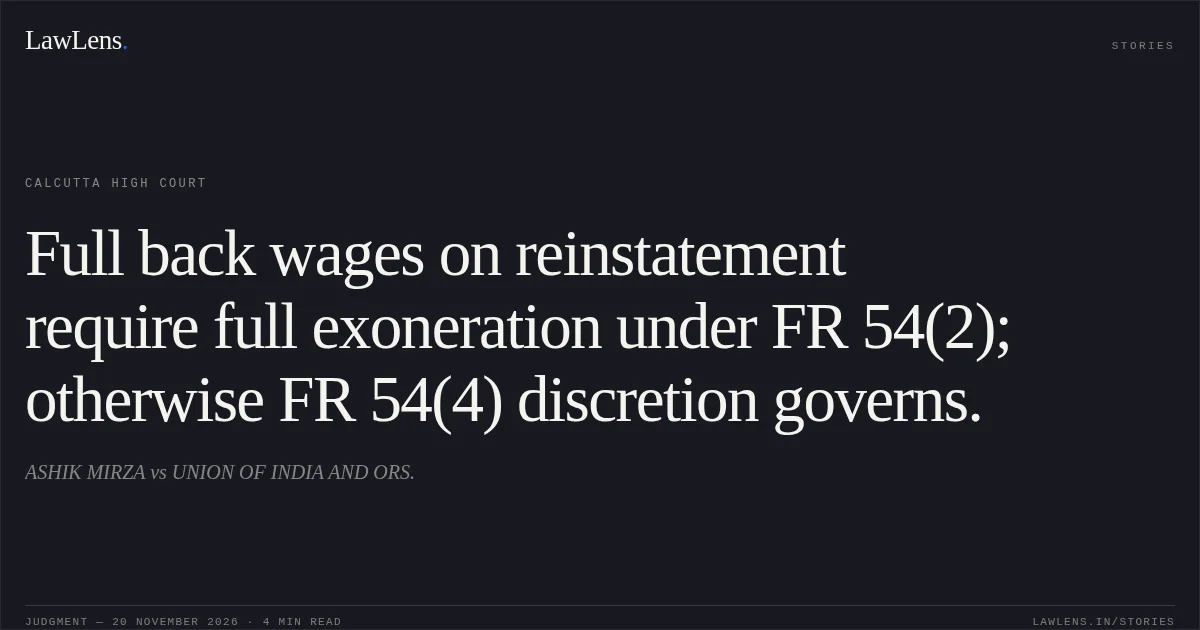
FR 54(2) entitles a government servant to full pay and allowances only where he has been "fully exonerated" on reinstatement.
¶ 15, 20Cases not covered by FR 54(2) fall under FR 54(4), which permits the competent authority to award such amount "(not being the whole)" of pay and allowances as it determines, after notice and representation.
¶ 15, 20Under FR 54(5), the period of absence, including preceding suspension, is not treated as duty unless the competent authority specifically so directs.
¶ 15The proviso to Rule 16(4) of the CCS (Conduct) Rules, 1964, relied upon by the petitioner, was held inapplicable where the adverse finding is not under challenge. The judgment does not quote the text of the proviso.
¶ 16, 22A finality-attained order is binding on the party and cannot be reopened on merits in writ proceedings.
¶ 21–22A discretionary determination is reviewable only if perverse or vitiated by procedural impropriety.
¶ 23Mithilesh Kumar Pathak v. Union of India (Supreme Court, Civil Appeal No. 4411 of 2011) was distinguished on facts.
¶ 24Provisions in the judgment · 1 · Linked ones open on LawLens
Central Reserve Police Force Act, 1949 Section 11
04Reasoning
FR 54(2) was not triggered because the petitioner was not "fully exonerated." The Inspector General had found him guilty of misconduct, and that finding and the reduced punishment were not challenged, so they had attained finality and bound the petitioner. Because the precondition of full exoneration was absent, the matter fell under FR 54(4) and FR 54(5), which vest discretion in the competent authority to fix a partial payment and to decide whether the intervening period counts as duty.
¶ 20–21The proviso to Rule 16(4) could not be applied in this writ, since the petitioner had not challenged the 8 November 2023 order and the Court could not reopen the merits of that finding. On the exercise of discretion, no procedural impropriety was alleged and the authority had acted within FR 54(4) and FR 54(5); the decision was therefore not found perverse. Mithilesh Kumar Pathak was held inapplicable because the petitioner's case lacked exoneration and the impugned determination was a lawful exercise of statutory discretion, not an arbitrary or procedurally defective one.
¶ 22–2405Holding
The petitioner is not entitled to full back wages under FR 54(2), since he was not fully exonerated and the adverse finding and punishment have attained finality. The proviso to Rule 16(4) of the CCS (Conduct) Rules cannot be invoked to reopen the 8 November 2023 order in these proceedings. The denial of back wages and the treatment of the intervening period as not spent on duty under FR 54(4)–(5) was a valid, non-perverse exercise of discretion, free from procedural infirmity. Mithilesh Kumar Pathak is inapplicable.
¶ 21–24The writ petition, WPA 16926 of 2024, is dismissed without costs, and the parties are to act on the server copy of the order.
¶ 25–26Original Court PDF
ASHIK MIRZAvsUNION OF INDIA AND ORS.
Click to open original judgment
Original judgment, available to read, download and summarize on LawLens.in