01Facts
The petitioner's name was recorded in the RS records of rights on the strength of a civil court decree, but was removed from the LR records of rights.
¶ 3–4The petitioner applied to the Revenue Officer to correct the records by incorporating his name. The Revenue Officer refused, and the Appellate Authority affirmed.
¶ 2The petitioner relied on a certificate from the Junior Land Reforms Officer, Namkhana, referring to Title Suit No. 311 of 1983, in which a compromise (solenama) decree was passed admitting the petitioner's title. The predecessors-in-interest of the private respondents were allegedly impleaded as defendants.
¶ 5–6The petitioner challenged the Revenue Officer's and Appellate Authority's orders before the West Bengal Land Reforms and Tenancy Tribunal (O.A. 911 of 2015).
¶ 7The Tribunal dismissed the application solely on the ground that the claimed adoption by the original owner, Sudhir Chandra Barui, was not proved.
¶ 7The private respondents disputed that their predecessor was a party to the suit.
¶ 9The decree was specifically relied upon before the Appellate Authority and formed part of the record.
¶ 10The Tribunal did not consider the effect of the decree.
¶ 11The Tribunal's impugned judgment is dated 11.03.2025.
¶ 1302Issues
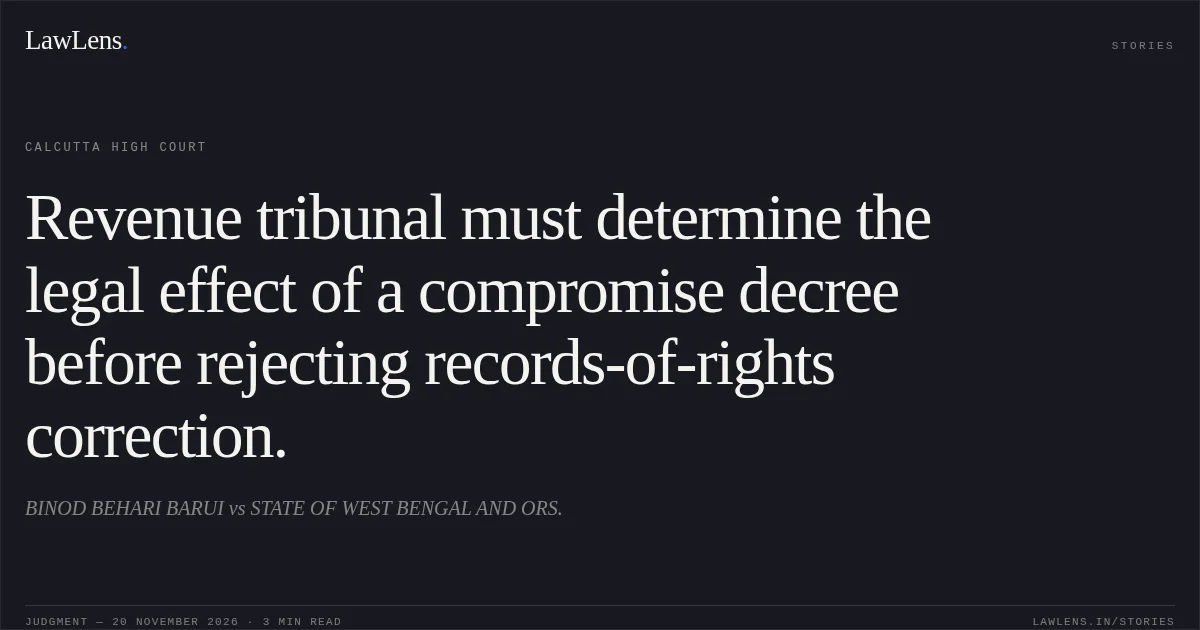
i.1. Whether the Tribunal erred in failing to consider and decide the legal effect of the compromise decree in Title Suit No. 311 of 1983 before rejecting the petitioner's challenge.
¶ 10–12ii.2. Whether the private respondents, as successors of some of the defendants in the suit, are bound by the said decree, having stepped into the shoes of such defendants.
¶ 12–13iii.3. Whether, after the civil decree attained finality, the Revenue Authorities had jurisdiction to go behind the decree and remove the petitioner's name from the records of rights.
¶ 803Law Applied
No statute, rule, or precedent is cited in the judgment.
A decree of a civil court, including a compromise (solenama) decree, that has attained finality and that is part of the record must be given legal effect in proceedings concerning entries in the records of rights.
¶ 8, 10, 12A decree binds the parties to it and their successors-in-interest, so whether successors are bound depends on whether they stepped into the shoes of the original defendants.
¶ 12–13The petitioner's argument that revenue authorities cannot go behind a final decree is recorded but not adjudicated.
¶ 804Reasoning
The compromise decree in Title Suit No. 311 of 1983 was specifically relied upon before the Appellate Authority and was part of the record.
¶ 10The Tribunal rejected the petitioner's challenge only on the failure to prove adoption, without addressing the decree.
¶ 7, 11The Court held that two questions were "germane" and had to be decided on merits before any conclusion could be reached: the legal effect of the solenama decree, and whether the private respondents, as successors of some defendants, are bound by it.
¶ 12The Court did not decide the merits of either question, did not rule on whether the Revenue Authorities could alter records contrary to a final decree, and did not resolve the disputed fact of whether the respondents' predecessor was a party to the suit, leaving these matters for the Tribunal.
¶ 9, 12Because the Tribunal's omission was a failure to consider material evidence on record, the appropriate remedy was remand rather than substitution of the Court's own findings.
¶ 11–1305Holding
The Tribunal failed to consider the legal effect of the compromise decree and whether the private respondents are bound by it.
¶ 11–13The writ petition was allowed on contest. The impugned Tribunal judgment dated 11.03.2025 in O.A. 911 of 2015 was set aside, and the matter was remanded for fresh adjudication on merits after affording both parties adequate hearing. The Tribunal must specifically decide (i) the legal effect of the decree in Title Suit No. 311 of 1983 and (ii) whether the private respondents are successors of, and bound by, the decree. The Tribunal was directed to complete the adjudication preferably within eight months of communication of the judgment. The parties must maintain status quo over the subject property until the Tribunal decides the matter. No order as to costs.
¶ 13–16Original Court PDF
BINOD BEHARI BARUIvsSTATE OF WEST BENGAL AND ORS.
Click to open original judgment
Original judgment, available to read, download and summarize on LawLens.in