01Facts
The petitioner breeds over 150 species of exotic birds and six species of primates, some listed under CITES, at Sunshine Bird World Avian Breeding and Research Centre.
¶ 1Under the Ministry of Environment, Forest and Climate Change Advisory dated 11 June 2020, holders of exotic live species were given six months for voluntary disclosure through the PARIVESH Portal.
¶ 2The petitioner declared his stock on 14 December 2020.
¶ 3 · ¶ 10Physical verification was conducted by the respondent no. 4's office.
¶ 3On 31 October 2023, the status of the proposal was approved except for three species (Common Marmosets, Cotton Top Tamarins and Sugar Gliders), which were marked "Rejected" with the remark: "To prevent zoonotic pathogens, unconventional agents that can spread human or native species. May cause threat to native wildlife population".
¶ 3Approval came roughly two years, ten months and 17 days after declaration, against a mandated period of six months.
¶ 10The petitioner applied on 26 July 2024 under the Living Animal Species (Reporting and Registration) Rules, 2024, but the application remained "Pending to fill Part-2".
¶ 5 · ¶ 6The respondents contended that the licence covers CITES Appendix-I species, which receive protection equivalent to Schedule-I species.
¶ 7 · ¶ 802Issues
i.1. Whether the Chief Wild Life Warden (CWLW) has power under the Voluntary Disclosure Scheme/Advisory and the PARIVESH Rules, 2020 to reject a declaration of exotic live species on the ground of zoonotic risk or threat to native biodiversity.
¶ 4 · ¶ 11 · ¶ 15ii.2. Whether the rejection of the three species dated 31 October 2023 is supported by any provision of law or the Scheme and is therefore sustainable.
¶ 12 · ¶ 14iii.3. Whether the petitioner is entitled to acceptance of its declaration of the three species under the Scheme.
¶ 13 · ¶ 1603Law Applied
Clause I of the Advisory (PARIVESH Rules, 2020) defines "exotic live species" as CITES-listed animals, fixes the six-month voluntary disclosure window, and sets out the CWLW's functions: physical verification, registration and acknowledgment (sub-clauses (a)–(g)), the required content of the register (sub-clause (h)), and action for violation of procedure (sub-clause (j)).
¶ 9In Sukanta Mallick v. Union of India, 2023 SCC OnLine Cal 5438, the Coordinate Bench held that at the declaration stage the CWLW is a "mere post-office" with no power to accept, reject or adjudicate on a declaration, and that any action under sub-clause (j) requires a violation of the procedure.
¶ 11, quoting Sukanta Mallick paras. 34–37The Advisory is a voluntary disclosure scheme providing amnesty, not a penal provision, as observed in Swetab Kumar (as referred to in Sukanta Mallick, para. 37).
¶ 11The Wild Life (Protection) Amendment Act, 2022 and the Living Animal Species Rules, 2024 were referred to only as background.
¶ 5 · ¶ 6Provisions in the judgment · 1
Johannesburg Declaration On Sustainable Development I
04Reasoning
The respondents produced no evidence or legal provision empowering the CWLW to reject the three species, and the reasons for rejection do not appear in the PARIVESH Rules, 2020.
¶ 12Applying Sukanta Mallick, the CWLW has no power to accept or reject a declaration at this stage.
¶ 13The petitioner had furnished the particulars required by Clause I(h), namely species, number, and address of holding.
¶ 13The CWLW's disciplinary power under Clause I(j) is available only for violation of the prescribed procedures, but the stated reason, zoonotic and biodiversity risk, is not a procedural violation under Clauses I(a)–(j).
¶ 14The CWLW therefore acted beyond jurisdiction.
¶ 15The court did not address the respondents' CITES Appendix-I and Schedule-IV submissions, the petitioner's pending application under the 2024 Rules, or the delay in approval, as these were not necessary to the decision on the rejection.
¶ 6 · ¶ 7 · ¶ 8 · ¶ 1005Holding
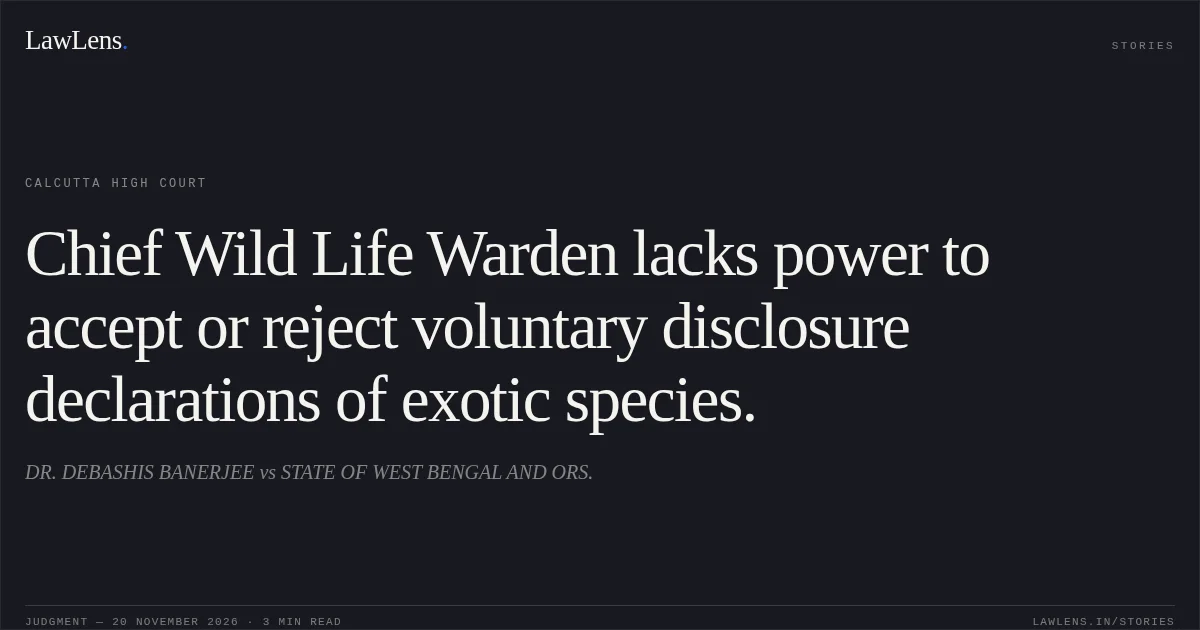
The CWLW exceeded its jurisdiction in rejecting the declaration of Common Marmosets, Cotton Top Tamarins and Sugar Gliders.
¶ 15The rejection orders dated 31 October 2023 in respect of these three species are set aside and quashed. The respondent authorities are directed to accept the petitioner's declaration of stock of live exotic species under the Voluntary Disclosure Scheme within four weeks from receipt of the order. The writ petition is disposed of.
¶ 15 · ¶ 16 · ¶ 17Original Court PDF
DR. DEBASHIS BANERJEEvsSTATE OF WEST BENGAL AND ORS.
Click to open original judgment
Original judgment, available to read, download and summarize on LawLens.in