01Facts
The petitioners are mechanics and conductors of the North Bengal State Transport Corporation ("NBSTC"). By notification dated 14 February 2014, NBSTC appointed them in contractual service along with drivers.
¶ 4The Transport Department of the Government of West Bengal recently enhanced the pay of drivers, but the petitioners were excluded.
¶ 5The petitioners contend that the recruitment notifications dated 13 February 2015 and 29 December 2015 fixed the same initial pay for drivers, mechanics and conductors.
¶ 6Notifications dated 3 March 2025 and 13 March 2025 did not extend the enhancement to them.
¶ 6The State filed an affidavit stating that NBSTC appoints contractual employees, that the Transport Department depends on prior approval and notifications of the Finance Department, and that the Finance Department is therefore the appropriate authority on payments.
¶ 7The petitioners relied on paragraph 4 of the 14 February 2014 notification, under which 75% of the consolidated pay of contractual employees is paid by the Finance Department.
¶ 8The petitioners had made representations to NBSTC authorities.
¶ 9The deficit court fee was paid and the receipt taken on record.
¶ 202Issues
i.1. Whether the petitioners (mechanics and conductors), who were appointed on the same initial pay as drivers, are entitled to the pay enhancement granted to drivers under the notifications dated 3 and 13 March 2025.
¶ 5, 6, 10ii.2. Whether the Finance Department of the Government of West Bengal, rather than the Transport Department or NBSTC, is the appropriate authority to decide the petitioners' grievance regarding pay enhancement.
¶ 7, 8, 11, 1203Law Applied
The court did not cite any statute or precedent. It relied on the terms of the notification dated 14 February 2014, paragraph 4 of which provides that 75% of the total consolidated pay of contractual employees is paid by the Finance Department, indicating a continuing role for that department in pay determination.
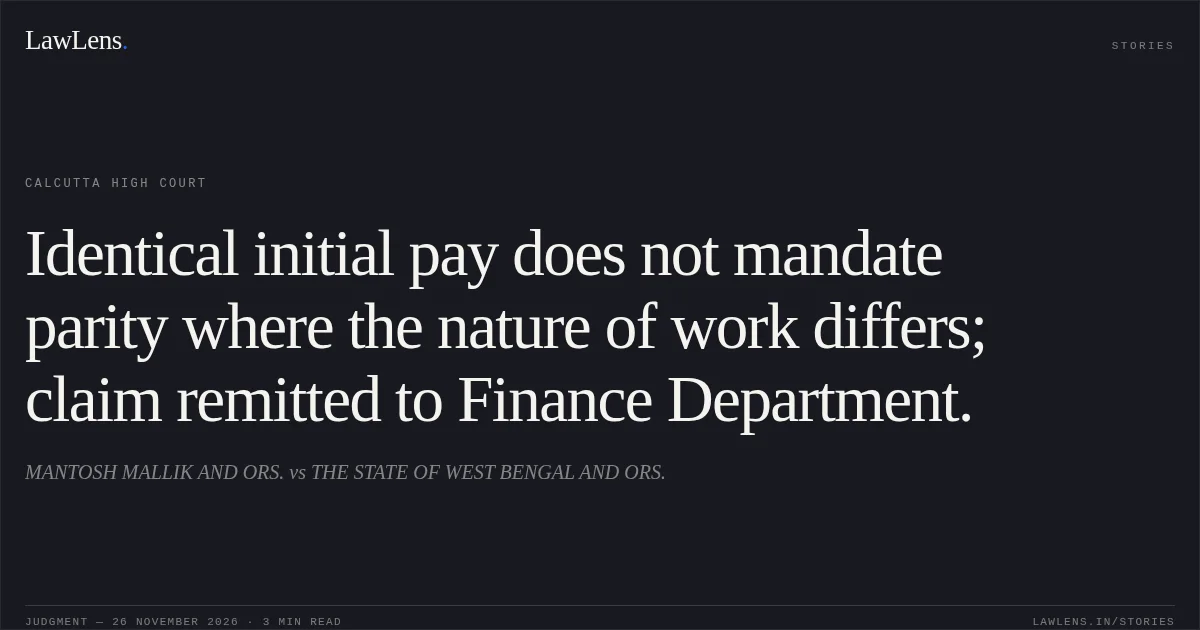
¶ 8The court proceeded on the principle that equal initial pay does not by itself establish parity where the nature of work differs; it held that the nature of work of drivers, mechanics and conductors is different.
¶ 10The court relied on the procedural principle that a writ petition may be disposed of by directing the petitioners to make a representation to the competent authority and by prescribing timelines for its consideration and a reasoned decision.
¶ 11–13No precedent citation.
04Reasoning
The court accepted that the petitioners and drivers were appointed under the same notification at the same initial pay. It nonetheless held that the differing nature of work of the two categories meant that parity in pay enhancement could not be presumed.
¶ 10On the second issue, the court accepted the State's position that the Transport Department and NBSTC act on the approval of the Finance Department, and it found that paragraph 4 of the 2014 notification gives the Finance Department a substantial funding role (75% of consolidated pay).
¶ 7, 8Because the Finance Department is the authority that controls the financial decision, the court held that the grievance should be addressed to it, while recognising that NBSTC and the Transport Department retain a stake in the matter.
¶ 8, 11, 12The court did not adjudicate the merits of the claim for parity. Instead, it channelled the grievance into a fresh, composite representation and prescribed a hearing process that includes the NBSTC Chairman and the Transport Department.
¶ 11, 1205Holding
The court did not decide whether the petitioners are entitled to the enhanced pay. It held that the Finance Department, not the Transport Department or NBSTC, is the competent authority to consider the grievance.
¶ 7, 8, 11, 12The writ petition was disposed of with the following directions: (i) the petitioners shall file a fresh composite representation to the Principal Secretary, Finance Department, within two weeks; (ii) the Principal Secretary, or an officer not below the rank of Joint Secretary, shall consider the representation after hearing the petitioners, the Secretary or representative of the Transport Department, and the Chairman of NBSTC, within six weeks of its submission; (iii) a reasoned order shall be passed within two weeks of the conclusion of hearing; (iv) the petitioners may produce documents at the hearing. No order as to costs was made, and parties are to act on the server copy of the judgment.
¶ 11, 12, 13, 14, 16, 17Original Court PDF
MANTOSH MALLIK AND ORS.vsTHE STATE OF WEST BENGAL AND ORS.
Click to open original judgment
Original judgment, available to read, download and summarize on LawLens.in