01Facts
The victim, a girl aged about five years and ten months, went missing from her neighbourhood on 24 November 2024. Neighbours found her naked and seriously injured in the appellant’s room; she was taken to hospital and declared dead.
pp. 2–9 · ¶ 2–30The post-mortem attributed death to intracranial haemorrhage and recorded recent forceful penetration of the vagina and anus. Forensic testing identified the appellant’s DNA in swabs from the victim’s genital area and in semen stains on seized items.
pp. 30–33 · ¶ 60–64 · pp. 38–40 · ¶ 73–75The Trial Court convicted the appellant and imposed a death sentence. The High Court heard the State’s death reference and the appellant’s connected appeal.
pp. 2–3 · ¶ 1, 5–702Issues
i.1. Whether the circumstantial evidence—including the victim being last seen with the appellant, her recovery from his room, the forensic evidence, and his failure to explain her presence there—proved guilt beyond reasonable doubt
pp. 13–16 · ¶ 34–40 · pp. 33–34 · ¶ 62–64 · pp. 53–54 · ¶ 107ii.2. Whether the crime met the “rarest of rare” threshold for the death penalty, having regard to aggravating and mitigating circumstances and the possibility of the appellant’s reformation or rehabilitation
pp. 17–20 · ¶ 41–44 · pp. 24–28 · ¶ 51–57 · pp. 43–47 · ¶ 81–9203Law Applied
The Court applied the circumstantial-evidence principles in Sharad Birdhichand Sarda v. State of Maharashtra and related authorities: the circumstances must form a complete chain consistent with guilt and exclude reasonable hypotheses consistent with innocence.
pp. 10–11 · ¶ 32It also relied on Section 106 of the Evidence Act, 1872, concerning facts especially within an accused’s knowledge, in considering the appellant’s failure to explain the victim’s presence in his room.
p. 54 · ¶ 107For sentencing, Bachan Singh v. State of Punjab establishes that life imprisonment is the rule and death the exception; death may be imposed only in the “rarest of rare” cases, after weighing circumstances of both the offence and the offender, and when the alternative is unquestionably foreclosed.
pp. 24–28 · ¶ 51–57The Court further considered the capital-sentencing framework in Manoj v. State of Madhya Pradesh, including the need to assess mitigating material and reformation prospects, and the alternative sentence recognised in Swamy Shraddananda (2) v. State of Karnataka.
pp. 17–19 · ¶ 42–43 · pp. 40–43 · ¶ 76–82The judgment records convictions under provisions of the Bharatiya Nyaya Sanhita, 2023 and Section 6(1) of the POCSO Act, 2012; the judgment’s references to the specific BNS sections are not consistent throughout.
p. 2, 52 · ¶ 1, 100Provisions in the judgment · 20 · Linked ones open on LawLens
Bharatiya Nyaya Sanhita, 2023 Section 64Section 65Section 66Section 103Section 163
Protection of Children from Sexual Offences Act, 2012 Section 6Section 29Section 30
Bharatiya Nagarik Suraksha Sanhita, 2023 Section 64Section 103Section 183Section 351Section 393
Code of Criminal Procedure, 1973 Section 43Section 161Section 162Section 164Section 235Section 313Section 354
04Reasoning
The Court found the prosecution evidence sufficient notwithstanding the defence’s challenge to the reliability of the last-seen witness: the victim was recovered from the appellant’s room, forensic evidence connected him to the victim, and he offered no credible explanation for her presence there. The medical evidence established fatal head injuries associated with sexual assault.
pp. 30–34 · ¶ 60–64 · pp. 53–54 · ¶ 107On sentence, the Court treated the victim’s age and vulnerability, the breach of trust, the sexual assault and fatal injuries as grave aggravating circumstances. It considered the appellant’s personal and psychological material, including reports obtained following Manoj, but concluded that the material did not establish a prospect of reformation sufficient to justify commutation; it therefore rejected both life imprisonment for the remainder of his natural life and the death sentence’s commutation.
pp. 40–47 · ¶ 76–92 · pp. 55–56 · ¶ 110–114 · pp. 70–71 · ¶ 116–12005Holding
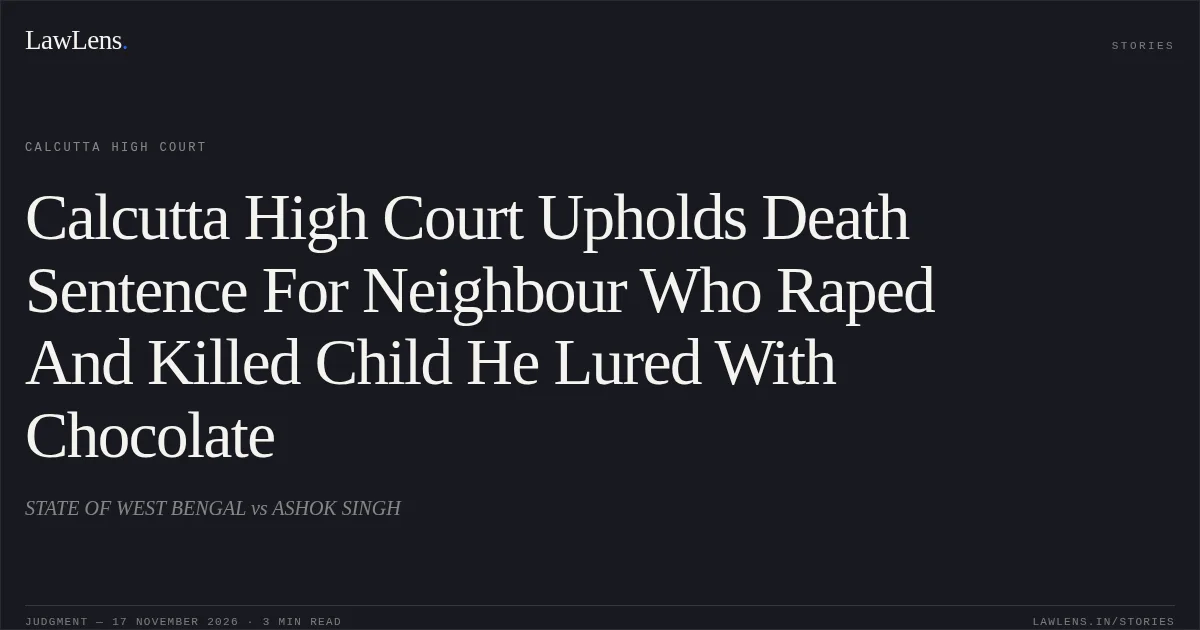
The High Court affirmed the conviction and death sentence, confirmed the death reference, and dismissed the appellant’s appeal.
pp. 51–52 · ¶ 100–101It directed the State to enhance victim compensation from ₹10 lakh to ₹15 lakh and pay it to the victim’s parents within two months, with a compliance report due by 30 January 2027.
p. 52 · ¶ 102After pronouncement, the Court stayed operation of its judgment for three months to permit the appellant to approach the Supreme Court.
p. 72, “Later”Original Court PDF
STATE OF WEST BENGALvsASHOK SINGH
Click to open original judgment
Original judgment, available to read, download and summarize on LawLens.in