Facts
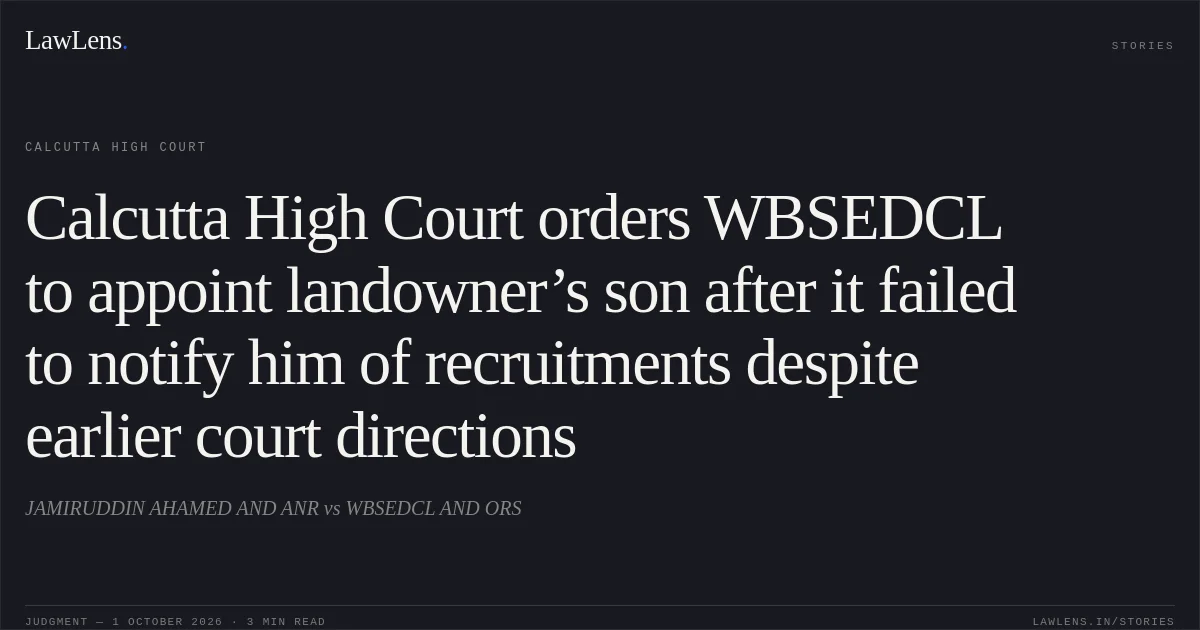
The petitioner’s father transferred land to WBSEDCL for a sub-station project in the context of a 29 November 1995 resolution recording that a member of the affected family would be considered for employment; the resolution itself was not produced, but the underlying fact was treated as undisputed
Source reference: paras. 1–2, 11; pp. 1, 5In 2016, the High Court directed WBSEDCL to notify the petitioner of the next recruitment for which he might be eligible and to consider his candidature with the specified weightage and maximum permissible concession.
Source reference: para. 12; pp. 6–7Further orders in 2023 reaffirmed the obligation and directed consideration of his claim.
Source reference: paras. 15–16; p. 8WBSEDCL’s 30 January 2024 order declined consideration for then-conducted recruitments, while indicating possible future consideration for a Technical Support Hand (Trainee) post.
Source reference: para. 17; pp. 9–11The petitioner challenged that order, relying in part on the respondent’s Class-III recruitments in 2017 and 2018, of which he had not been informed.
Source reference: paras. 5, 14; pp. 3, 7Issues
1. Whether WBSEDCL’s failure to inform the petitioner of the 2017 and 2018 Class-III recruitments breached the binding judicial directions governing consideration of his candidature.
Source reference: paras. 20–22; pp. 13–162. Whether, in light of that breach, the Court could grant appointment rather than direct consideration in a future recruitment.
Source reference: paras. 27–31; pp. 20–24Law Applied
Under Article 226, the High Court may issue mandamus to enforce a public duty corresponding to an established legal right and may mould relief to prevent a public authority from benefiting from its own breach of a binding judicial direction.
Source reference: paras. 28–30; pp. 22–24State instrumentalities are subject to Article 14’s requirements of fairness and non-arbitrariness; public action cannot be insulated from review merely because it arises in a contractual or executive setting (Mahabir Auto Stores v. Indian Oil Corporation Ltd., (1990) 3 SCC 752; Kumari Shrilekha Vidyarthi v. State of U.P., (1991) 1 SCC 212).
Source reference: para. 23; p. 18Promissory estoppel may bind the Government where a promise was intended to be acted upon and the promisee altered position in reliance on it, subject to law and overriding public interest (Motilal Padampat Sugar Mills Co. Ltd. v. State of Uttar Pradesh, (1979) 2 SCC 409).
Source reference: para. 24; p. 18The Court’s earlier final directions required the petitioner to receive notice of relevant recruitment and consideration with the stipulated weightage and maximum permissible concession.
Source reference: paras. 12, 20, 22; pp. 6–7, 13–16Reasoning
The Court treated the 2016 order, as reinforced by the 2023 orders, as a binding direction requiring WBSEDCL to notify the petitioner of relevant recruitment and consider his candidature under the specified conditions.
Source reference: paras. 20, 22; pp. 13–16WBSEDCL had conducted Class-III recruitment in 2017 and 2018 but neither informed nor considered him; its 2024 order also omitted those recruitments while asserting that no suitable recruitment had occurred.
Source reference: paras. 21–22; pp. 14–16The Court found the omission material because the petitioner was qualified for the relevant Class-III recruitment and had lost the opportunity through the respondent’s non-compliance.
Source reference: paras. 26–27; pp. 19–21In those exceptional circumstances, a direction merely to await future recruitment would perpetuate the consequences of the breach; appointment was therefore considered necessary to give effective relief, rather than to create a general exception to public-recruitment requirements.
Source reference: paras. 28–30; pp. 21–24Holding
The Court set aside WBSEDCL’s order dated 30 January 2024 and allowed the writ petition.
It directed WBSEDCL to appoint the petitioner immediately to an appropriate Class-III or other subordinate post, subject to verification of identity, original qualifications, and other formal requirements consistent with the earlier judicial orders. Compliance was directed within three weeks of communication of the judgment.
Source reference: para. 32; p. 25Original Court PDF
JAMIRUDDIN AHAMED AND ANRvsWBSEDCL AND ORS
Click to open original judgment
Original judgment, available to read, download and summarize on LawLens.in