Facts
Himangshu Nag was the owner of premises no. 42/139/1, New Ballygunge Road, Kolkata.
Source reference: paras. 2(a)–(d)After the death of his only daughter in 2009, he and his wife allegedly executed a registered Deed of Trust on 18 August 2010 in favour of “Anindita Trust” for charitable activities.
Source reference: paras. 2(a)–(d)The complainant, Himangshu Nag’s niece, alleged that the accused had manipulated and induced the couple to execute the deed with the object of grabbing the property and that no charitable activities were subsequently undertaken.
Source reference: paras. 2(a)–(d)The complainant further alleged that, when Himangshu Nag sought revocation of the trust deed, the accused threatened him with dire consequences on 7 May 2018.
Source reference: para. 2(e)A complaint was filed in 2018 under Sections 420, 465, 471, 120B, 506 and 34 of the IPC.
Source reference: para. 2(e)The learned Magistrate took cognizance, examined the complainant under Section 200 Cr.P.C., and issued summons to the petitioner and Dr. Tapas Kumar Banerjee.
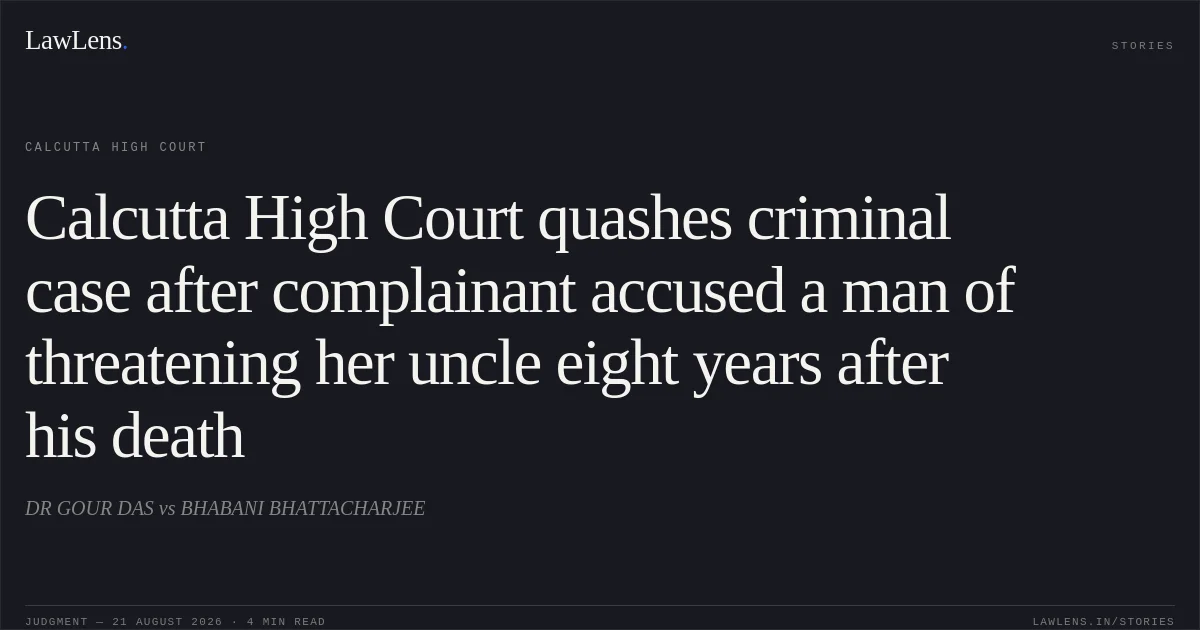
Source reference: para. 2(e)The petitioner sought quashing under Section 482 Cr.P.C., contending that the complaint was filed after an unexplained delay of approximately eight years, that Dr. Banerjee had died in 2010 and therefore could not have issued the alleged threat in 2018, that the dispute was substantially civil in nature and was also the subject matter of a pending title suit, and that the Magistrate had failed to conduct the mandatory inquiry under Section 202 Cr.P.C. despite the petitioner residing outside the Court’s territorial jurisdiction.
Source reference: paras. 3–9Dr. Banerjee had admittedly died on 22 September 2010.
Source reference: paras. 6–7, 11(b)Issues
Whether the allegations in the complaint, including the attribution of a 7 May 2018 threat to an accused who had died in 2010, were so inherently improbable that continuation of the criminal proceeding would amount to an abuse of process
Source reference: paras. 11(b), 12, 16Whether the Magistrate’s failure to conduct an inquiry under Section 202 Cr.P.C. before issuing process against a person residing beyond its territorial jurisdiction vitiated the proceeding
Source reference: paras. 9, 11(d), 13, 16Whether the criminal complaint was an abuse of process because the dispute essentially concerned the validity and revocability of a trust deed and was already the subject of a civil suit
Source reference: paras. 8, 11(e), 13, 16Whether the High Court should exercise its inherent jurisdiction under Section 482 Cr.P.C. to quash the proceeding insofar as it concerned the petitioner
Source reference: paras. 14–17Law Applied
The Court exercised the High Court’s inherent jurisdiction under Section 482 Cr.P.C. to prevent abuse of the process of the Court and secure the ends of justice.
Source reference: paras. 14, 18–19It applied the principles in State of Haryana v. Bhajan Lal, AIR 1992 SC 604, particularly the categories permitting quashing where the allegations, even if accepted in their entirety, do not disclose an offence; where the allegations are absurd or inherently improbable; where continuation is barred by law or suffers from a fundamental procedural defect; and where the proceeding is manifestly mala fide or instituted with an ulterior motive.
Source reference: para. 15The Court treated the inquiry contemplated by Section 202 Cr.P.C. as a mandatory safeguard before issuance of process where the accused resides beyond the territorial jurisdiction of the Magistrate.
Source reference: paras. 11(d), 13, 16It also recognised that criminal proceedings should not be used to give a criminal colour to a dispute that is essentially civil in nature.
Source reference: para. 13Reasoning
The Court found that the complaint was lodged approximately eight years after execution and registration of the trust deed, without any satisfactory explanation, supporting an inference of afterthought.
Source reference: paras. 11(a), 12The allegation that Dr. Banerjee participated in threatening Himangshu Nag on 7 May 2018 was legally and factually impossible because he had died on 22 September 2010; the complainant’s failure to disclose his death during her Section 200 examination further undermined the bona fides of the complaint.
Source reference: paras. 11(b), 12–13The registered deed had been executed in the presence of witnesses and registered before the Additional Registrar of Assurances, which weakened the allegation of forgery on the face of the record.
Source reference: para. 11(c)Independently, the Magistrate had failed to comply with Section 202 Cr.P.C. before issuing process against the petitioner, who resided outside the Court’s territorial jurisdiction.
Source reference: paras. 11(d), 13Since the same trust-deed dispute was pending in a civil suit, the Court concluded that the criminal case was being used to exert pressure in an essentially civil dispute and fell within the Bhajan Lal categories warranting quashing.
Source reference: paras. 13, 16–17Holding
The High Court allowed the criminal revision under Section 482 Cr.P.C. and held that the proceeding constituted an abuse of process, falling within Categories (1), (5), (6) and (7) of Bhajan Lal.
Complaint Case No. 856 of 2018 under Sections 420, 465, 471, 120B, 506 and 34 IPC was quashed insofar as the petitioner, Dr. Gour Das, was concerned.
Source reference: para. 19Any connected pending application was disposed of, and a copy of the judgment was directed to be sent to the Court below.
Source reference: paras. 18, 20Acts & Sections Cited
10 provisions across 2 statutes referred to in this judgment. Each provision opens on LawLens.
Code of Criminal Procedure, 19735
Indian Penal Code, 18605
Original Court PDF
DR GOUR DASvsBHABANI BHATTACHARJEE
Click to open original judgment
Original judgment, available to read, download and summarize on LawLens.in