Facts
Twenty-eight members were elected to Jalalpur Gram Panchayat in the 2023 Panchayat elections.
Source reference: para. 7Fifteen members submitted a motion of no confidence under Section 12(2) of the West Bengal Panchayat Act, 1973, against Tafijul Hoque, the Pradhan, on 22 May 2026.
Source reference: para. 8The Prescribed Authority fixed the meeting for 9 June 2026, but postponed it indefinitely on 8 June 2026 because the Inspector-in-Charge reported that adequate police force was unavailable.
Source reference: paras. 9–10The Pradhan separately sought consideration of the alleged disqualification of two members for absence from three consecutive Panchayat meetings; the learned Single Judge directed the Sub-Divisional Officer to decide that representation after hearing all concerned.
Source reference: para. 11In a connected writ petition, the learned Single Judge directed the Prescribed Authority to convene the no-confidence meeting within ten days of communication of the order dated 22 June 2026.
Source reference: paras. 5–6, 12The meeting was consequently held on 3 July 2026, forty-two days after receipt of the motion.
Source reference: para. 13Issues
1. Whether the time limit under Section 12(4) of the West Bengal Panchayat Act, 1973, requiring the no-confidence meeting to be held no later than fifteen working days from receipt of the motion, is mandatory and could be extended by the writ court.
Source reference: paras. 16, 18, 22–322. Whether non-availability of adequate police force constituted a reason “beyond control of the prescribed authority” under the latter part of Section 12(4), justifying postponement of the meeting.
Source reference: paras. 16, 33–35, 47–513. Whether the meeting held on 3 July 2026 and the consequential election of a new Pradhan could be sustained after the statutory period had expired.
Source reference: para. 54Law Applied
Section 12(3) requires the Prescribed Authority to convene the meeting within five working days of receiving a valid motion, while Section 12(4) mandates that the meeting be held on a working day not later than fifteen working days from receipt of the motion and permits adjournment or cancellation only pursuant to a court order or for a reason beyond the Prescribed Authority’s control.
Source reference: pp. 8–10; para. 17Section 12(10) requires the entire process, from submission of the motion to final action, to be completed within thirty days.
Source reference: p. 10; para. 26Applying Dhampur Sugar Mills Ltd. v. State of U.P., (2007) 8 SCC 338, and State (NCT of Delhi) v. Sanjay, (2014) 9 SCC 772, the Court held that whether a statutory provision is mandatory depends on legislative intent, purpose, scheme and consequences, not merely the use of “shall”.
Source reference: paras. 19–21Relying on M. Pentiah v. Muddala Veeramalappa, [1961] 2 SCR 295, Lachmi Narain v. Union of India, AIR 1976 SC 714, and Nasiruddin v. Sita Ram Agarwal, (2003) 2 SCC 577, it held that negative and prohibitory language ordinarily indicates a mandatory requirement.
Source reference: paras. 27–30The Court also applied the doctrine of malice in law, as explained in Kalabharati Advertising v. Hemant Vimalnath Narichania, (2010) 9 SCC 437, and the judicial-review principle in State of U.P. v. Johri Mal, (2004) 4 SCC 714, that administrative discretion may be interfered with where its exercise is perverse or illegal.
Source reference: paras. 37, 53It followed the coordinate Bench decision in Pradhan, Nurpur Gram Panchayat v. Gobinda Ghosh, 2026 SCC OnLine Cal 8718, concerning the mandatory nature of the statutory timeline and the insufficiency of unsupported police-related grounds.
Source reference: para. 40Reasoning
The Court held that the expression “shall not be later than fifteen working days” in Section 12(4), read with the thirty-day outer limit in Section 12(10), reflected a mandatory legislative intention.
Source reference: paras. 23–27, 31–32The time limit protected both the Pradhan, whose office was under challenge, and the requisitionists, whose statutory democratic right to test the Pradhan’s majority could be frustrated by delay; it also served the interests of effective Panchayat administration.
Source reference: paras. 23–27, 31–32The learned Single Judge therefore had no power to extend the statutory period by directing that the meeting be held within ten days from communication of the order.
Source reference: paras. 42–43The postponement notice merely relied on the police authority’s inability to provide adequate force and did not record any specific apprehension of violence, law-and-order material, or circumstances demonstrating that the meeting could not safely be held.
Source reference: paras. 39, 47–50Police assistance was not a statutory precondition for convening the meeting.
Source reference: paras. 48–51The exception for a reason beyond the Prescribed Authority’s control was confined to genuine and exceptional circumstances—such as natural calamity, pandemic, or demonstrable violence—and could not be invoked casually or indefinitely.
Source reference: paras. 48–51Since the postponement was unsupported and undertaken for an unauthorised purpose, it was illegal and amounted to an impermissible disregard of the requisitionists’ statutory rights.
Source reference: paras. 36–38, 50–54Holding
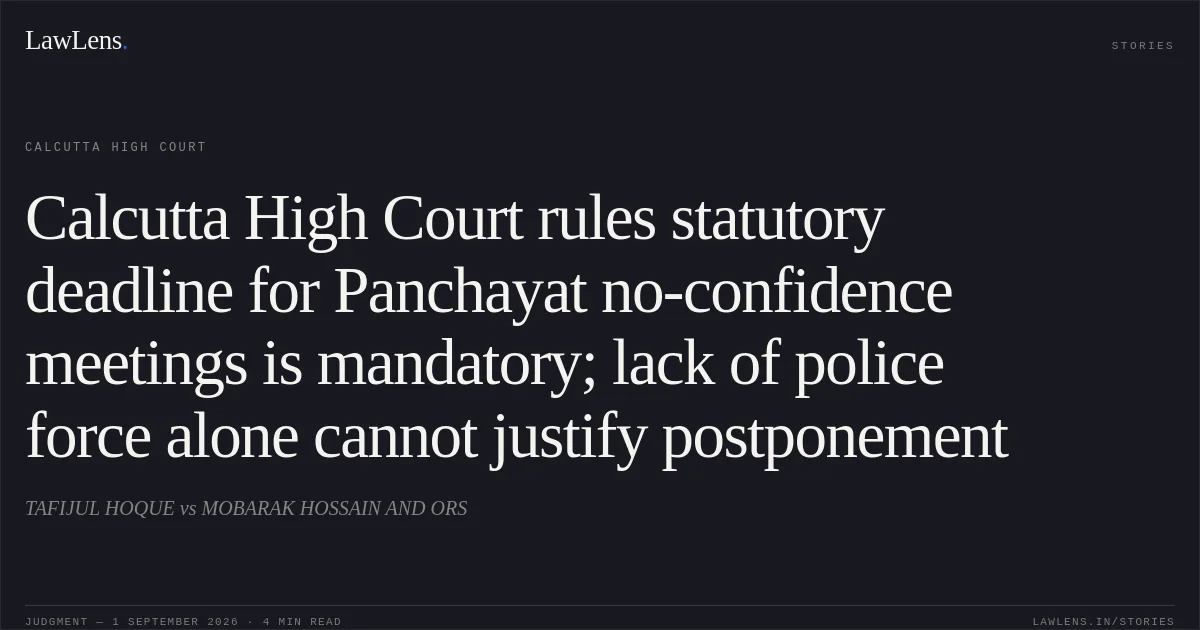
The Court answered the first issue in the affirmative: the fifteen-working-day limit under Section 12(4), read with the thirty-day completion requirement under Section 12(10), is mandatory unless one of the statutory exceptions genuinely applies.
It answered the second issue in the negative: mere non-availability of police force, without corroborative material demonstrating an uncontrollable law-and-order situation, does not justify postponement or cancellation.
Source reference: paras. 48–51Accordingly, the postponement notice dated 8 June 2026 was quashed; the learned Single Judge’s order and all consequential steps taken pursuant to it were set aside.
Source reference: para. 54The election of the new Pradhan was annulled and Tafijul Hoque was directed to be reinstated as Pradhan.
Source reference: para. 54The requisitionists were granted liberty to submit a fresh motion in accordance with law, and the Prescribed Authority was directed to strictly comply with the statutory timelines.
Source reference: para. 55The appeals were disposed of without costs.
Source reference: paras. 57–58Acts & Sections Cited
4 provisions across 1 statute referred to in this judgment. Each provision opens on LawLens.
West Bengal Panchayat Act, 19734
Original Court PDF
TAFIJUL HOQUEvsMOBARAK HOSSAIN AND ORS
Click to open original judgment
Original judgment, available to read, download and summarize on LawLens.in