Facts
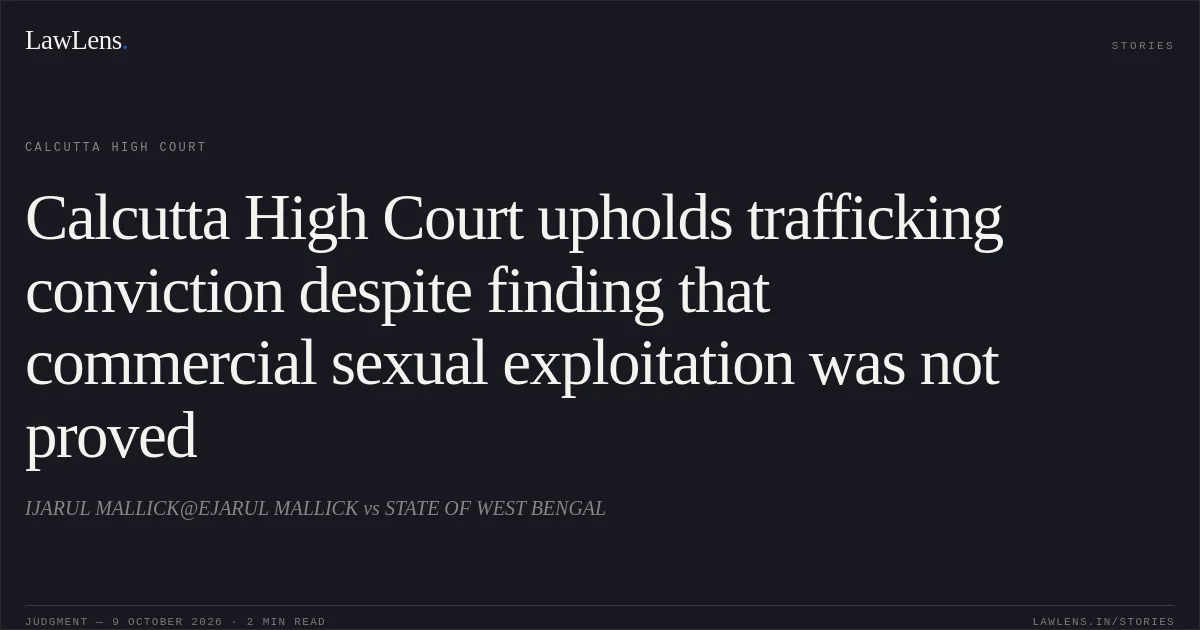
The appellant was convicted by the Additional District and Sessions Judge, Mekhliganj, under Sections 370(2) and 370A(2) of the Indian Penal Code (IPC) for trafficking the adult victim and sexually exploiting her.
Source reference: para. 1The prosecution alleged that he induced her to accompany him, took her to various places, and brought her to rented premises in Chyangrabandha, a red-light area, where he sought to compel her into prostitution.
Source reference: paras. 10–11The victim testified to the exploitation; the landlady (PW 3) testified that customers entered the victim’s room while the appellant remained outside. The victim declined examination of her private parts.
Source reference: paras. 12, 18–20Issues
Whether the evidence established beyond reasonable doubt that the appellant trafficked the victim for the purpose of commercial sexual exploitation, contrary to Section 370(2) IPC
Source reference: paras. 36–37, 42Whether the evidence established beyond reasonable doubt that the appellant engaged the victim in sexual exploitation, contrary to Section 370A(2) IPC
Source reference: paras. 18–25, 41Whether omissions, contradictions, the victim’s refusal of medical examination, and the manner of her examination under Section 313 CrPC undermined the prosecution case
Source reference: paras. 18–25, 29–35, 40Law Applied
Section 370 IPC addresses trafficking for exploitation; the victim’s consent is immaterial to establishing trafficking.
Source reference: para. 14Section 370A(2) IPC concerns the use of a trafficked person for sexual exploitation.
Source reference: paras. 1, 41The court applied Section 114, Illustration (g), of the Evidence Act to draw an adverse inference from the victim’s refusal to undergo a medical examination, and considered omissions in the FIR relevant to assessing the prosecution’s account.
Source reference: paras. 19, 31–32It also applied the principle that a victim’s testimony may alone sustain a conviction if wholly reliable, while material contradictions or omissions may undermine it; minor variations do not necessarily discredit testimony; *Nirmal Premkumar v. State*, *Sunil Kumar Sambhudayal Gupta v. State of Maharashtra*.
Source reference: paras. 26, 29–30The prosecution must prove guilt beyond reasonable doubt; *Rang Bahadur Singh v. State of Uttar Pradesh*.
Source reference: para. 34Reasoning
The court found that the appellant had induced and transported the victim to Chyangrabandha and housed her in premises in a red-light area; it considered the location, the circumstances of the journey, and the evidence of PW 3 sufficient to establish the appellant’s purpose of engaging her in commercial sexual exploitation, notwithstanding the absence of proof that customers actually exploited her.
Source reference: paras. 36–37By contrast, the victim’s refusal of a medical examination, the weaknesses identified in PW 3’s evidence, and the evidentiary deficiencies concerning actual sexual exploitation created reasonable doubt as to whether the appellant had succeeded in engaging her with customers. The court therefore distinguished proof of trafficking purpose from proof of completed exploitation.
Source reference: paras. 19–25, 37, 41It held that the deficiencies in the Section 313 CrPC examination caused no prejudice to the appellant.
Source reference: para. 40Holding
The conviction and sentence under Section 370(2) IPC were affirmed.
The conviction and five-year sentence under Section 370A(2) IPC, together with the fine of ₹5,000 and default sentence, were set aside, and the appellant was acquitted of that charge.
Source reference: para. 41The appeal was dismissed in part. The appellant was directed to surrender within 30 days to serve the remaining sentence; the suspension of sentence was cancelled.
Source reference: paras. 42–44Acts & Sections Cited
5 provisions across 2 statutes referred to in this judgment. Each provision opens on LawLens.
Indian Penal Code, 18603
Code of Criminal Procedure, 19732
Original Court PDF
IJARUL MALLICK@EJARUL MALLICKvsSTATE OF WEST BENGAL
Click to open original judgment
Original judgment, available to read, download and summarize on LawLens.in