Facts
The petitioner was awarded a work order on 19.05.2023 for a renovation scheme.
Source reference: para. 3Before the agreement was executed, a dispute arose involving a forged Memorandum of Association (MOA) produced by a third party, M/s Yuvraj Engicon Pvt. Ltd., claiming a merger with the petitioner.
Source reference: para. 3–4Following a prior High Court direction in CWJC No. 1320 of 2024 to verify the MOA, the Chief Engineer confirmed the MOA was forged.
Source reference: para. 4Subsequently, on 04.02.2025, the respondents cancelled the Notice Inviting Tender (NIT), directed re-tendering, and initiated blacklisting proceedings against the petitioner on the grounds that the petitioner had submitted forged "Tools & Plants" documents.
Source reference: para. 5, 16The petitioner challenged these actions, alleging a violation of natural justice as no prior notice or hearing was provided before the adverse findings of forgery were recorded.
Source reference: para. 6Issues
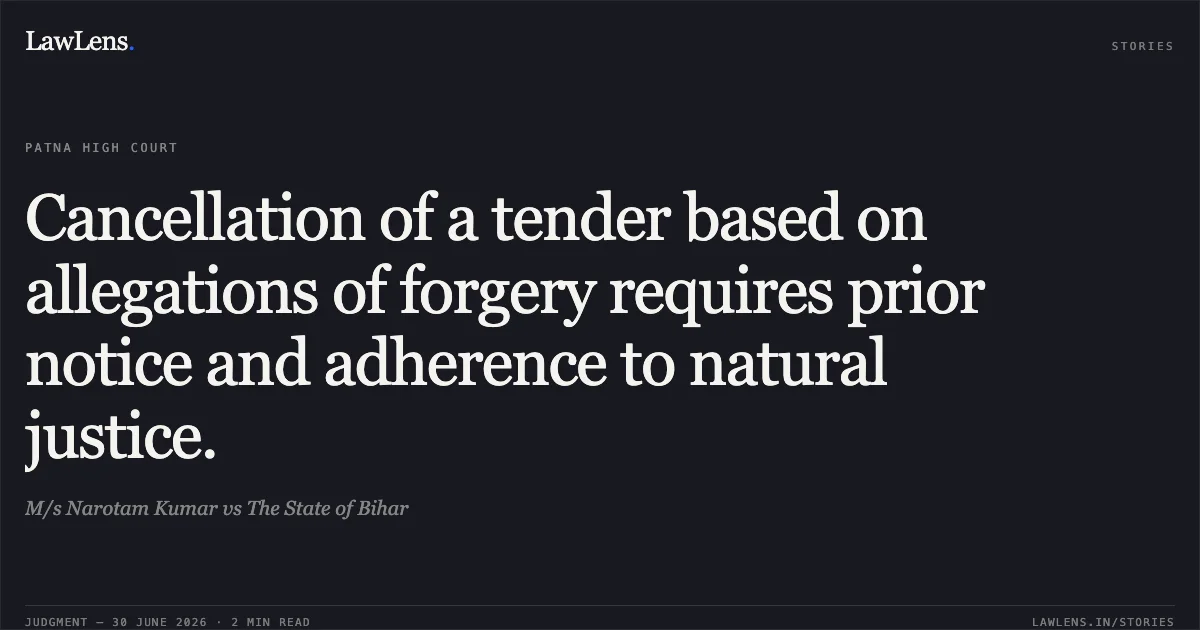
Whether the respondents could record findings of misconduct/forgery and direct consequential departmental action against the petitioner without affording a prior opportunity of hearing, notwithstanding a clause in the NIT allowing cancellation without assigning reasons.
Source reference: para. 11, 15Law Applied
The fundamental principle of Audi Alteram Partem (natural justice), stating that any action entailing civil consequences or "civil death" must be preceded by a show-cause notice.
Source reference: para. 19Gorkha Security Services v. Government (NCT of Delhi) (2014) 9 SCC 105, which establishes that blacklisting is stigmatic and requires a fair hearing.
Source reference: para. 19UMC Technologies Pvt. Ltd. v. Food Corporation of India (2021) 2 SCC 551, holding that a notice must specify grounds and proposed penalties to enable a meaningful defense.
Source reference: para. 20The distinction between the exercise of purely contractual power (cancelling a tender) and the exercise of administrative power that imputes misconduct.
Source reference: para. 18, 21Reasoning
The court reasoned that while Clause 39 of the NIT may grant the employer the power to cancel the tender process at any stage without reasons, this power does not extend to recording findings of forgery or misconduct without procedural fairness.
Source reference: para. 14, 21The minutes of the meeting dated 04.02.2025 clearly showed that the cancellation was not a standalone administrative decision but was "intrinsically founded upon allegations of misconduct".
Source reference: para. 17Since these findings carry a stigma and affect the petitioner’s future ability to participate in public contracts, they constitute adverse civil consequences.
Source reference: para. 22The court found that because no notice was issued prior to recording the finding of forgery, the decision-making process was vitiated by a violation of natural justice.
Source reference: para. 22–24Holding
The court held that while the state may cancel a tender purely under contractual terms (Clause 39), it cannot return findings of forgery or direct blacklisting without a show-cause notice.
The court allowed the writ petition, set aside the impugned proceedings dated 04.02.2025, and remitted the matter to the competent authority with the direction that if they intend to proceed based on allegations of misconduct, they must issue a specific show-cause notice and provide a reasonable opportunity to respond.
Source reference: para. 25, 26, 29Original Court PDF
M/s Narotam KumarvsThe State of Bihar
Click to open original judgment
Original judgment, available to read, download and summarize on LawLens.in