Facts
The petitioners, B.A.M.S.-qualified Ayurvedic doctors, took part in the selection process under Advertisement No. 05/2025 for contractual Ayush Medical Officer posts.
Source reference: p. 2–5; paras. 2–7They alleged that the computer-based test contained erroneous questions, answers and translations, and sought relaxation of the qualifying marks.
Source reference: p. 2–5; paras. 2–7Although they had submitted a representation to the State Health Society, they did not object to the answer key during the prescribed window.
Source reference: p. 2–5; paras. 2–7The Society published the results and shortlisted candidates for document verification/counselling; the petitioners then raised their objections and sought relief under Article 226.
Source reference: p. 2–5; paras. 2–7The matters were referred to the Division Bench by a Single Judge.
Source reference: p. 2–5; paras. 2–7Issues
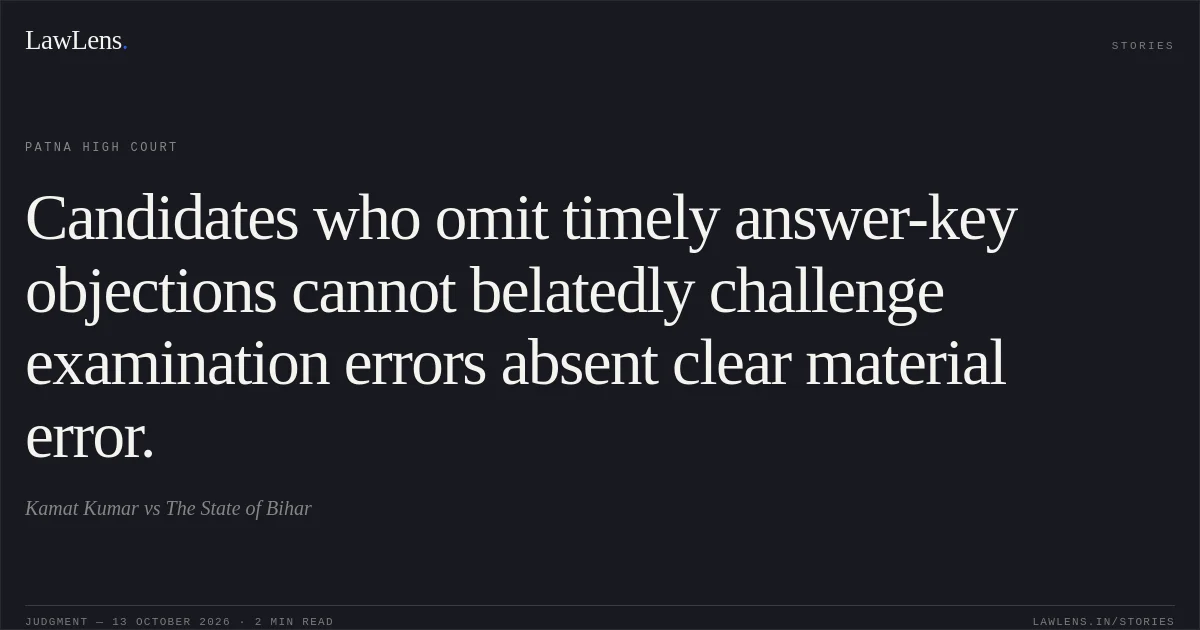
1. Whether candidates who did not challenge the answer key within the prescribed objection period could subsequently seek judicial intervention based on alleged errors in the examination.
Source reference: p. 5–6; paras. 8–102. Whether the Court could direct relaxation of the advertised qualifying marks in the circumstances alleged by the petitioners.
Source reference: p. 6–8; paras. 11–15Law Applied
Under Ran Vijay Singh v. State of Uttar Pradesh, (2018) 2 SCC 357, judicial re-evaluation or scrutiny of examination answers is permissible only in rare or exceptional cases where a material error is clearly demonstrated, without inferential reasoning or rationalisation; courts should defer to examination authorities and academic expertise, and, in case of doubt, presume the answer key is correct.
Source reference: p. 6; para. 12Under Suresh Kumar Lalit Kumar Patel v. State of Gujarat, (2023) 19 SCC 596, reducing qualifying marks to provide employment to a particular category may offend Article 14 where other candidates have already acquired rights.
Source reference: p. 7; para. 13Advertisement terms governing selection bind the parties unless contrary to a statute or rule; a change must be made by amendment and remains subject to Article 14.
Source reference: p. 7–8; para. 14Reasoning
The petitioners admitted that they had not objected to the answer key during the Society’s objection window and raised their challenge only after publication of the final results.
Source reference: p. 5–6; paras. 9–10The Court held that belated objections could not justify intervention under Article 226 absent a clearly established material error, which had not been shown.
Source reference: p. 5–6; paras. 9–10It also considered that relaxing the qualifying marks after the selection process could undermine finality and prejudice candidates who had acquired rights under the advertised criteria.
Source reference: p. 6–8; paras. 11–14The advertisement’s terms could not be altered to secure a particular outcome without a lawful amendment consistent with Article 14.
Source reference: p. 6–8; paras. 11–14Holding
The Court found no merit in either writ petition and declined to direct re-examination of the alleged errors or relaxation of the qualifying marks.
Both writ petitions were dismissed.
Source reference: p. 8; paras. 15–16Original Court PDF
Kamat KumarvsThe State of Bihar
Click to open original judgment
Original judgment, available to read, download and summarize on LawLens.in