Facts
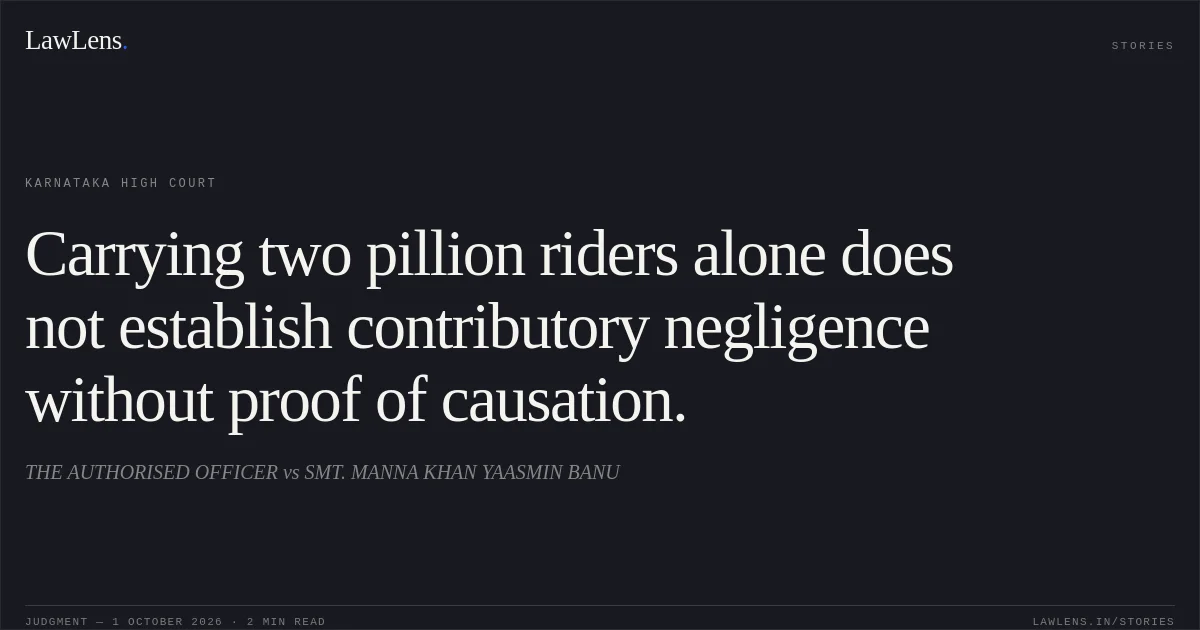
The appeals arose from a collision between a motorcycle carrying its rider and two pillion riders and an insured jeep.
Source reference: p. 6The rider died, and the pillion riders sustained injuries.
Source reference: p. 6The Tribunal awarded compensation in three connected claim petitions and held the insurer liable.
Source reference: p. 6The insurer appealed, arguing that carrying two pillion riders in breach of Section 128 of the Motor Vehicles Act, 1988, established negligence and relieved it of liability.
Source reference: p. 6–10The High Court noted that the insurer’s challenge concerned liability alone.
Source reference: p. 6–10Issues
Whether carrying two pillion riders, in breach of Section 128 of the Motor Vehicles Act, by itself established contributory negligence or otherwise displaced the insurer’s liability.
Source reference: p. 9–10Whether the Tribunal erred in holding the insurer liable to pay compensation.
Source reference: p. 9Law Applied
Section 128 of the Motor Vehicles Act, 1988, restricts a motorcycle driver from carrying more than one person in addition to the driver.
Source reference: p. 12–13However, as held in Mohammed Siddique v. National Insurance Company Ltd., (2020) 3 SCC 57, breach of that restriction does not, by itself, establish contributory negligence; a causal connection must be shown between the breach and the accident or the nature or extent of the resulting injuries.
Source reference: p. 12–13Syed Sadiq v. United India Insurance Co. Ltd., (2014) 2 SCC 735, establishes that contributory negligence cannot be inferred merely from an alleged accident location, absent evidence proving the claimant’s contribution.
Source reference: p. 11–12The Court also referred to Dinesh Kumar v. National Insurance Co. Ltd., (2018) 1 SCC 750, and Saraswati Palariya v. New India Assurance Co. Ltd., 2018 SCC OnLine SC 3988, in relation to the contention that negligence could be inferred from absence of a driving licence.
Source reference: p. 13Reasoning
The prosecution records implicated the jeep’s driver, while the insurer produced no evidence establishing that the motorcycle’s carrying two pillion riders caused the collision or increased the impact of the accident.
Source reference: p. 10–14The eyewitness denied the suggestion that the additional pillion rider impaired the motorcycle’s balance.
Source reference: p. 10–14The admitted head-on collision and the alleged accident location did not, without supporting evidence, prove contributory negligence.
Source reference: p. 10–14Applying Mohammed Siddique, the Court held that the statutory breach alone was insufficient to establish the required causal link; the insurer’s reliance on the rider’s lack of a driving licence likewise did not establish negligence on the record.
Source reference: p. 10–14Holding
The Court answered the issue against the insurer and held that the Tribunal had not erred in holding it liable to pay compensation.
All three appeals were dismissed, and the amount in deposit was directed to be transmitted to the Tribunal for payment.
Source reference: p. 14Acts & Sections Cited
5 provisions across 2 statutes referred to in this judgment. Each provision opens on LawLens.
Motor Vehicles Act, 19883
Indian Penal Code, 18602
Original Court PDF
THE AUTHORISED OFFICERvsSMT. MANNA KHAN YAASMIN BANU
Click to open original judgment
Original judgment, available to read, download and summarize on LawLens.in