Facts
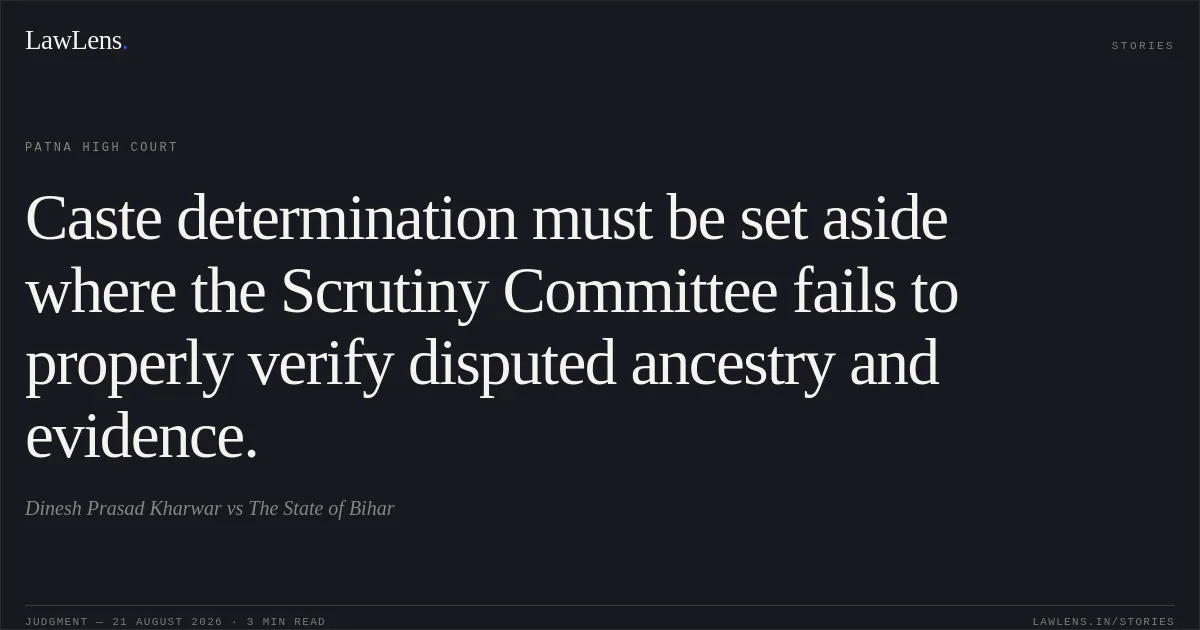
The petitioner challenged Memo No. 11/S.T.-01/2023GA 11711 dated 20 June 2023, by which the Caste Scrutiny Committee rejected his claim to belong to the “Kharwar” Scheduled Tribe and recorded him as belonging to the “Kamkar” Extremely Backward Class category.
Source reference: p.2, para. 2; p.3, para. 4The petitioner asserted that his family had earlier resided in Palamu, presently in Jharkhand, and that his prior caste certificates and other records consistently described him as “Kharwar”.
Source reference: p.2–3, paras. 3–5The adverse proceedings arose following complaints and an enquiry which relied substantially on revenue records recording one Parahu Kamkar’s caste as “Kamkar.”
Source reference: p.3–4, paras. 5–7The petitioner disputed that Parahu Kamkar was his ancestor, stating that his grandfather was Sipahi Kharwar and that the relevant land had been acquired by his father through Ram Nath Kahar and Suraj Kahar, who had earlier purchased it from Parahu Kamkar.
Source reference: p.3–4, paras. 5–7The Court found that the Committee had not properly investigated the relationship between the petitioner and Parahu Kamkar or adequately considered the competing statements and caste certificates.
Source reference: p.4–5, paras. 8–9Issues
1. Whether the Caste Scrutiny Committee properly determined whether the petitioner belonged to the “Kamkar” Extremely Backward Class category or the “Kharwar” Scheduled Tribe category, particularly in view of his family’s migration from Palamu to Bihar?
Source reference: p.4–5, para. 8(i)2. Whether the Committee erred by relying on revenue records concerning Parahu Kamkar without determining whether Parahu Kamkar was in fact the petitioner’s grandfather or ancestor?
Source reference: p.5, paras. 8(ii)–(iii), 93. Whether the Committee’s order dated 20 June 2023 required judicial interference for failure to conduct a proper and comprehensive enquiry?
Source reference: p.5–6, paras. 10–11Law Applied
The Court applied the principle that a caste scrutiny authority must conduct a proper, comprehensive, and factually reliable enquiry before determining a person’s caste status, particularly where documentary evidence and witness statements are conflicting.
Source reference: p.5–6, paras. 8–11The authority must consider all relevant materials, establish the genealogical connection between disputed revenue records and the claimant, and afford a meaningful determination in accordance with law.
Source reference: p.5–6, paras. 8–11Although no specific statutory provision or judicial precedent was cited, the Court exercised judicial review over the Committee’s decision for failure to undertake the necessary enquiry and for reaching a conclusion without resolving material factual disputes.
Source reference: p.5–6, paras. 8–11Reasoning
The Court held that the Committee had relied on revenue records showing that Parahu Kamkar was recorded as belonging to the “Kamkar” caste, but had failed to determine whether that person was actually the petitioner’s grandfather or ancestor.
Source reference: p.4–5, paras. 6–8This omission was material because the petitioner expressly denied any ancestral relationship with Parahu Kamkar and relied on an alternative chain of land transactions, prior caste certificates, and statements of local residents and family members supporting his claim of being “Kharwar”.
Source reference: p.4, paras. 7–9Since the Committee did not reconcile these competing materials or conduct the required enquiry into the petitioner’s family history and migration from Palamu, its conclusion that the petitioner belonged to the “Kamkar” caste was procedurally and factually unsustainable.
Source reference: p.5, para. 10Holding
The Court answered the issues in favour of the petitioner to the extent that the Caste Scrutiny Committee had failed to conduct a proper enquiry into his caste status and genealogical connection with Parahu Kamkar.
The Committee’s order contained in Memo No. 11711 dated 20 June 2023 was set aside.
Source reference: p.6, para. 11The authorities were granted liberty to initiate the proceedings afresh against the petitioner or his family members in accordance with law and to determine, after a proper enquiry, whether the petitioner belonged to the “Kamkar” or “Kharwar” caste.
Source reference: p.5–6, paras. 10–12The writ petition was accordingly disposed of.
Source reference: no citationOriginal Court PDF
Dinesh Prasad KharwarvsThe State of Bihar
Click to open original judgment
Original judgment, available to read, download and summarize on LawLens.in