Facts
The Petitioner filed an RTI application on 30.05.2022 seeking information regarding an aircraft accident involving a Boeing 737-800 that occurred on 11.10.2018 at Trichy.
Source reference: para. 1-2The Central Public Information Officer (CPIO) rejected the request under Section 8(1)(h) of the RTI Act.
Source reference: para. 3On appeal, the First Appellate Authority (FAA) upheld the rejection, adding that the information was also protected under Rule 17(g) of the Aircraft (Investigation of Accidents and Incidents) Rules, 2017.
Source reference: para. 4The Petitioner filed a second appeal before the Central Information Commission (CIC), which dismissed the appeal via a brief order stating that an "appropriate response" had been provided.
Source reference: para. 5, 8The Petitioner challenged this dismissal in the Delhi High Court.
Source reference: para. 1Issues
1. Whether the Central Information Commission (CIC) discharged its obligation as an appellate authority by passing a non-speaking and mechanical order.
Source reference: para. 92. Whether the CIC was required to address the additional grounds for denial of information raised by the FAA.
Source reference: para. 7, 9Law Applied
Court applied Section 8(1)(h) of the Right to Information Act, 2005, which exempts disclosure of information that would impede investigation or prosecution.
Source reference: para. 3The principle that quasi-judicial authorities must pass "reasoned orders" to ensure transparency and minimize arbitrariness, as established in S.N. Mukherjee v. Union of India which held that reasons are an essential requirement of the rule of law.
Source reference: para. 11Rani Lakshmi Bai Kshetriya Gramin Bank v. Jagdish Sharan Varshney, clarifying that even an order of affirmation must contain brief reasons.
Source reference: para. 11SR Dass v. CPIO, where cryptic CIC orders were previously set aside.
Source reference: para. 10Reasoning
The Court observed that the CIC's impugned order was "mechanical" and failed to assign any specific reasons for upholding the FAA’s decision.
Source reference: para. 9Specifically, the Court noted that while the FAA had introduced a new ground for denial—Rule 17(g) of the Aircraft Rules, 2017—the CIC failed to deal with this additional ground entirely.
Source reference: para. 7, 9The Court reasoned that an appellate authority under the RTI Act must satisfactorily discharge its obligations by applying its mind to the grounds taken by lower authorities.
Source reference: para. 9Citing Supreme Court precedents, the Court emphasized that while an affirming order need not be as elaborate as the original order, it cannot be a "one-line order" simply stating agreement, as this undermines public confidence in judicial processes.
Source reference: para. 11Holding
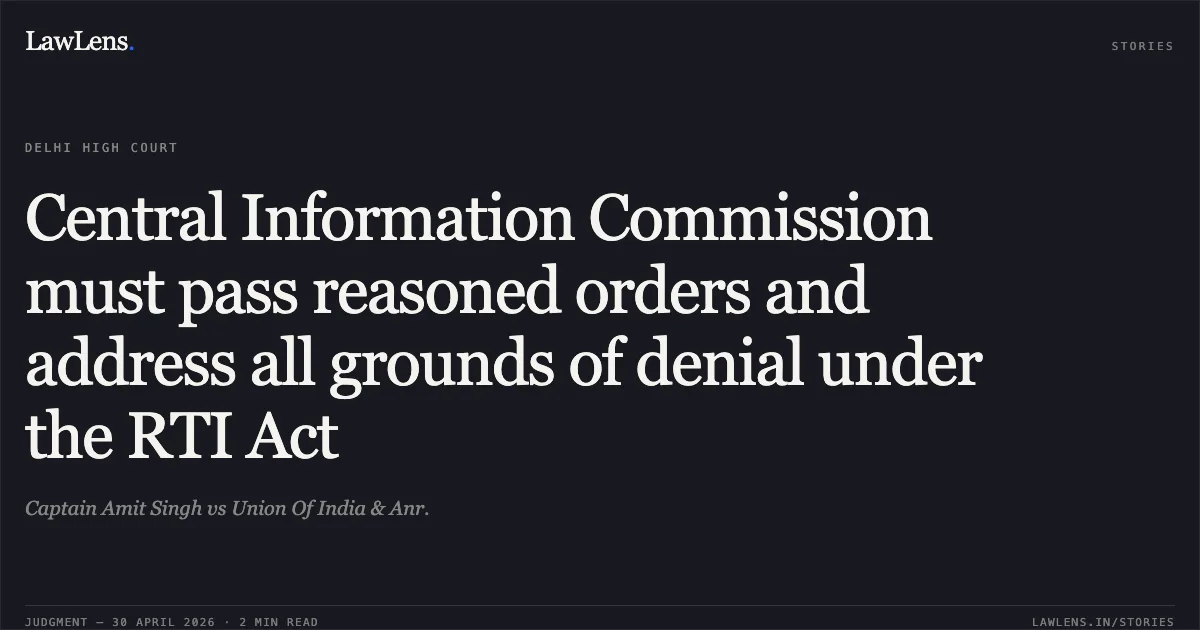
The Court held that the CIC failed to pass a reasoned order and neglected to address the specific legal grounds for the denial of information.
Consequently, the Court set aside the impugned order dated 22.09.2023 and remitted the matter back to the CIC for fresh consideration on merits.
Source reference: para. 13The CIC was directed to resolve the appeal with due expedition, ideally within four months.
Source reference: para. 14The writ petition was disposed of accordingly.
Source reference: para. 15Acts & Sections Cited
1 provisions across 1 statute referred to in this judgment. Each provision opens on LawLens.
Right to Information Act, 20051
Original Court PDF
Captain Amit SinghvsUnion Of India & Anr.
Click to open original judgment
Original judgment, available to read, download and summarize on LawLens.in