Facts
The appellant, a works-contract service provider, was alleged to have received service income during FY 2016–17 and the first quarter of FY 2017–18 without registering or paying service tax.
Source reference: pp. 2–5A show-cause notice proposed a demand of ₹1,07,86,840, with interest and penalties.
Source reference: pp. 2–5The first adjudication order confirmed a reduced demand and allowed cum-tax treatment, while holding certain receipts from Indian Railways exempt.
Source reference: pp. 2–5In a common order, the Commissioner (Appeals) remanded the matter for reconsideration of specified issues, including the nature of the works, applicable exemption and abatement, and recalculation of receipts.
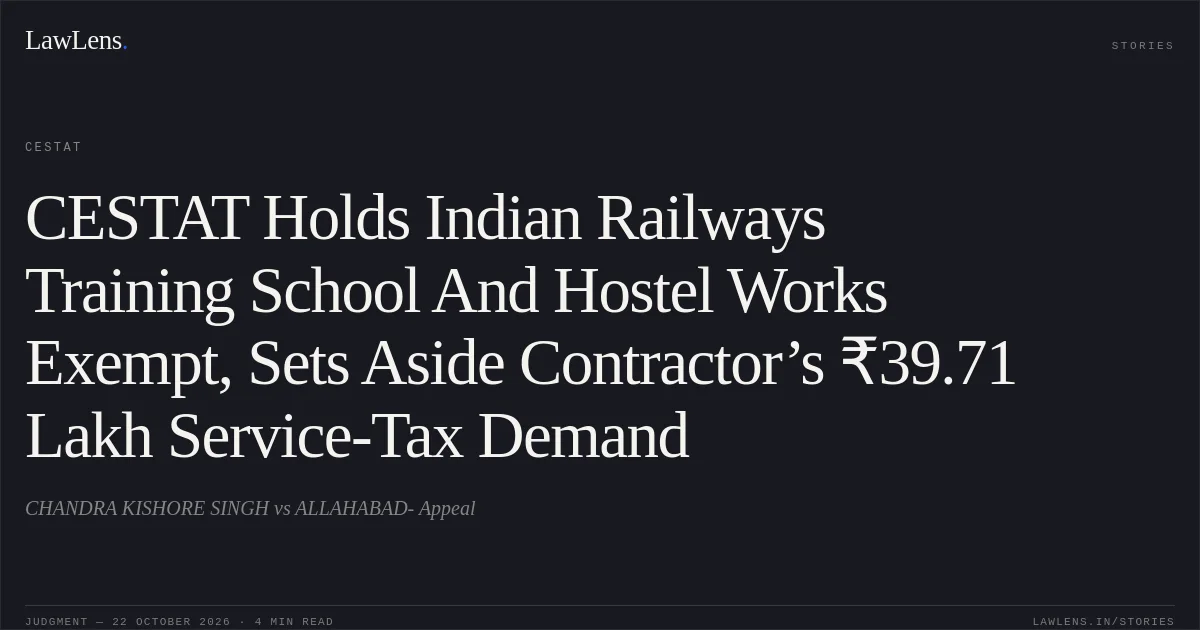
Source reference: pp. 2–5On de novo adjudication, the authority confirmed a demand of ₹39,71,959, including tax on railway receipts, and denied the appellant’s exemption and cum-tax claims.
Source reference: pp. 6–13The Commissioner (Appeals) upheld that order, leading to the present appeal.
Source reference: pp. 6–13Issues
1. Whether the appellant’s works-contract services for construction of a railway training school and hostel were exempt from service tax under Entry 14(a) of Notification No. 25/2012-ST, and whether the de novo authority could reopen the exemption finding made in the first order.
Source reference: pp. 14–172. Whether receipts under works contracts awarded before 1 March 2015 for construction of government buildings and clinical or educational establishments qualified for exemption under Entry 12A of Notification No. 25/2012-ST, read with Section 102 of the Finance Act, 1994.
Source reference: pp. 14, 18–223. Whether the appellant was entitled to cum-tax treatment under Section 67(2) of the Finance Act, 1994, particularly where that benefit had been allowed in the first adjudication order.
Source reference: pp. 14, 22–234. Whether the alleged difference between the appellant’s income-tax return and Form 26AS supported an additional service-tax demand.
Source reference: pp. 14, 23–255. Whether the appellant qualified for the threshold exemption under Notification No. 33/2012-ST.
Source reference: pp. 14, 25–266. Whether the extended limitation period and penalties were sustainable in the absence of wilful suppression or intent to evade tax.
Source reference: pp. 26–287. Whether failure to conduct pre-show-cause-notice consultation invalidated the proceedings.
Source reference: pp. 28–29Law Applied
Entry 14(a) of Notification No. 25/2012-ST exempts services by way of construction of original works pertaining to railways.
Source reference: no citationEntry 12A, read with Section 102 of the Finance Act, 1994, provides the relevant retrospective exemption for qualifying contracts entered into before 1 March 2015.
Source reference: no citationSection 67(2) requires service tax to be calculated on the gross amount where the consideration is treated as inclusive of tax.
Source reference: no citationNotification No. 33/2012-ST provides the applicable threshold exemption, subject to its conditions.
Source reference: no citationUnder Section 73(1), the extended limitation period requires the statutory grounds, including suppression or wilful misstatement with intent to evade tax.
Source reference: p. 27The Supreme Court decisions in CCE v. Chemphar Drugs & Liniments and Pushpam Pharmaceuticals Co. v. CCE were cited for the requirement of deliberate conduct.
Source reference: p. 27The Tribunal also relied on Commissioner, Central Excise & Service Tax, Patna v. Shapoorji Pallonji & Co. Pvt. Ltd. concerning interpretation of the exemption provisions.
Source reference: pp. 20–22In remand proceedings, an adjudicating authority must act within the scope of the appellate directions and cannot reopen an issue that has attained finality.
Source reference: pp. 16–17The Board’s instructions and circulars concerning pre-SCN consultation for demands exceeding ₹50 lakh were invoked by the appellant.
Source reference: pp. 28–29Reasoning
The Tribunal held that construction of the railway training school and hostel fell within the statutory meaning of railway-related works and was exempt under Entry 14(a).
Source reference: pp. 15–17It also found that the first adjudication order’s exemption finding had not been challenged by the Department and that the remand did not authorise the adjudicating authority to reopen it.
Source reference: pp. 15–17For receipts under pre-1 March 2015 contracts, the Tribunal found that the works concerned government buildings and clinical or educational establishments, and applied Entry 12A and Section 102 to allow exemption.
Source reference: pp. 18–22It held that cum-tax treatment had been granted in the first order, supported by evidence that tax was not separately collected, and could not be withdrawn in the de novo proceedings after the Department had not challenged that benefit.
Source reference: pp. 22–23On the alleged receipts discrepancy, the Tribunal relied on the income-tax return and the earlier appellate finding that gross service receipts were ₹5,43,76,184, rather than the ₹5,59,98,614 figure used in the later order; it therefore found the additional demand based on the alleged difference unsustainable.
Source reference: pp. 23–25The Tribunal also accepted the appellant’s claim to threshold exemption for FY 2016–17, noting that taxable services in the preceding year were stated to be nil.
Source reference: p. 26It found no adequate basis for invoking extended limitation or imposing penalties, given the bona fide dispute concerning the exemptions and the absence of demonstrated wilful suppression.
Source reference: pp. 26–28Holding
It held that the railway works were exempt; the qualifying pre-1 March 2015 contracts were covered by the exemption; the cum-tax benefit and threshold exemption were available; and the additional demand based on the asserted ITR/Form 26AS difference was unsupported.
The Tribunal also rejected the extended limitation and penalty basis on the facts and found that the de novo authority had improperly reopened the railway exemption issue.
Source reference: pp. 15–17, 26–29The Tribunal allowed the appeal and set aside the impugned order, granting consequential relief as per law.
Source reference: p. 29Acts & Sections Cited
1 provisions across 1 statute referred to in this judgment. Each provision opens on LawLens.
Railways Act, 19891
Original Court PDF
CHANDRA KISHORE SINGHvsALLAHABAD- Appeal
Click to open original judgment
Original judgment, available to read, download and summarize on LawLens.in