Facts
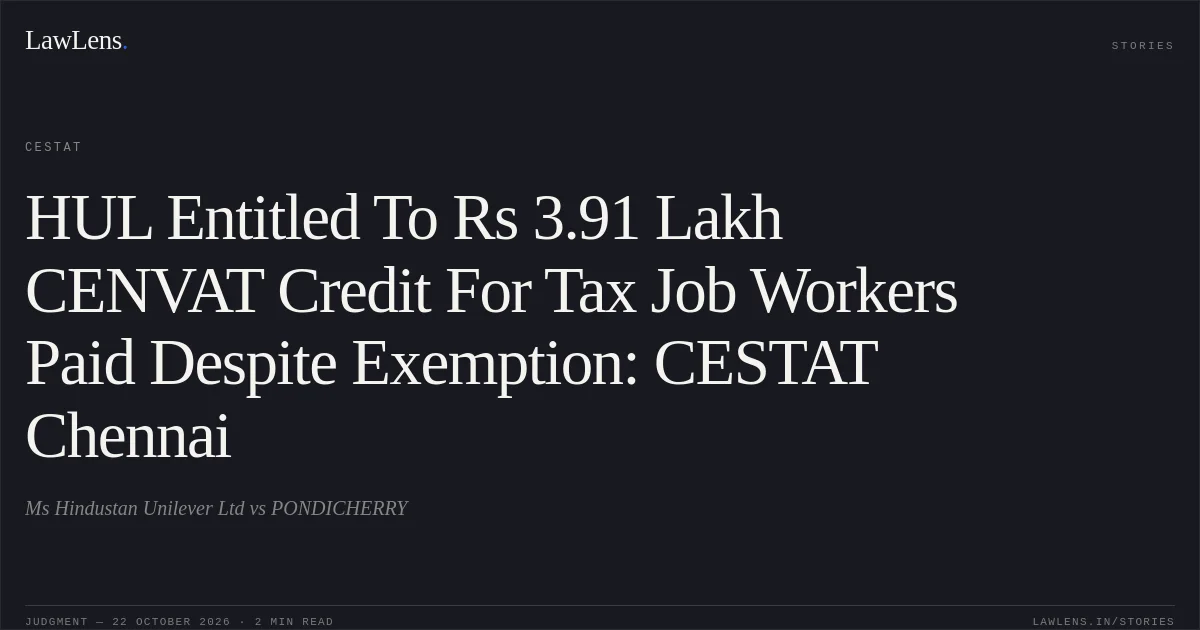
Hindustan Unilever Ltd. availed CENVAT credit of ₹3,91,207, including cesses, on service tax paid by job workers for services used in the manufacture of its final products during December 2012 to February 2013.
Source reference: para. 2The Department alleged that the job work was exempt under Notification No. 25/2012-ST and that the services therefore could not qualify as input services; the adjudicating authority confirmed recovery with interest and imposed a penalty, and the Commissioner (Appeals) upheld that decision.
Source reference: paras. 3–4HUL appealed to the CESTAT.
Source reference: para. 4Issues
1. Whether HUL could claim CENVAT credit of service tax paid by job workers where the services were otherwise exempt under Notification No. 25/2012-ST
Source reference: para. 82. Whether recovery of the credit, interest, and penalty could be sustained on the ground that the job workers ought to have availed the exemption
Source reference: paras. 8, 19Law Applied
Section 83 of the Finance Act, 1994 applies specified provisions of the Central Excise Act to service tax; it incorporates Section 5A(2A), but not Section 5A(1A), which prohibits payment of duty on goods absolutely exempt from excise duty. Accordingly, a service provider is not compelled by Section 5A(1A) to avail a service-tax exemption.
Source reference: para. 10Under Rule 2(l)(ii) of the CENVAT Credit Rules, 2004, an input service is assessed by its use in or in relation to the manufacture of final products; the definition does not make eligibility depend on whether the service is taxable in the provider’s hands.
Source reference: para. 15Rule 14 and Section 11A(1) provide for recovery of wrongly availed credit, while Rule 15(1) provides for penalty in respect of wrongly taken or utilised credit.
Source reference: paras. 1, 19The Tribunal relied on Gandhi Special Tubes Ltd. v. CCE and ST, Vadodara II, which held that a recipient could claim credit of service tax paid by job workers where the tax payment was not barred and the service was used in or in relation to manufacture.
Source reference: paras. 11–12The Tribunal relied on Balaji Multiflex Pvt. Ltd. v. CCE and ST, Rajkot, to similar effect.
Source reference: para. 13Reasoning
The show cause notice did not dispute that the job work was used in or in relation to the manufacture of HUL’s final products; its objection was that the services were exempt and therefore could not be input services.
Source reference: para. 15The Tribunal held that Section 5A(1A) did not apply to service tax, so the job workers were not legally barred from paying tax instead of claiming the exemption.
Source reference: paras. 9–10Because the services met the use-based test in Rule 2(l)(ii), and the tax paid by the job workers had not been challenged or refunded, the Department could not deny HUL credit of that tax.
Source reference: paras. 15–16The Tribunal found it unnecessary to decide whether the notification was conditional or absolute.
Source reference: para. 17Holding
The Tribunal held that HUL was entitled to CENVAT credit of ₹3,91,207; consequently, the recovery demand, interest, and penalty could not stand.
It set aside the Commissioner (Appeals)’ order and allowed the appeal with consequential relief in law, if any.
Source reference: para. 21Acts & Sections Cited
1 provisions across 1 statute referred to in this judgment. Each provision opens on LawLens.
Central Excise Act, 19441
Original Court PDF
Ms Hindustan Unilever LtdvsPONDICHERRY
Click to open original judgment
Original judgment, available to read, download and summarize on LawLens.in