Facts
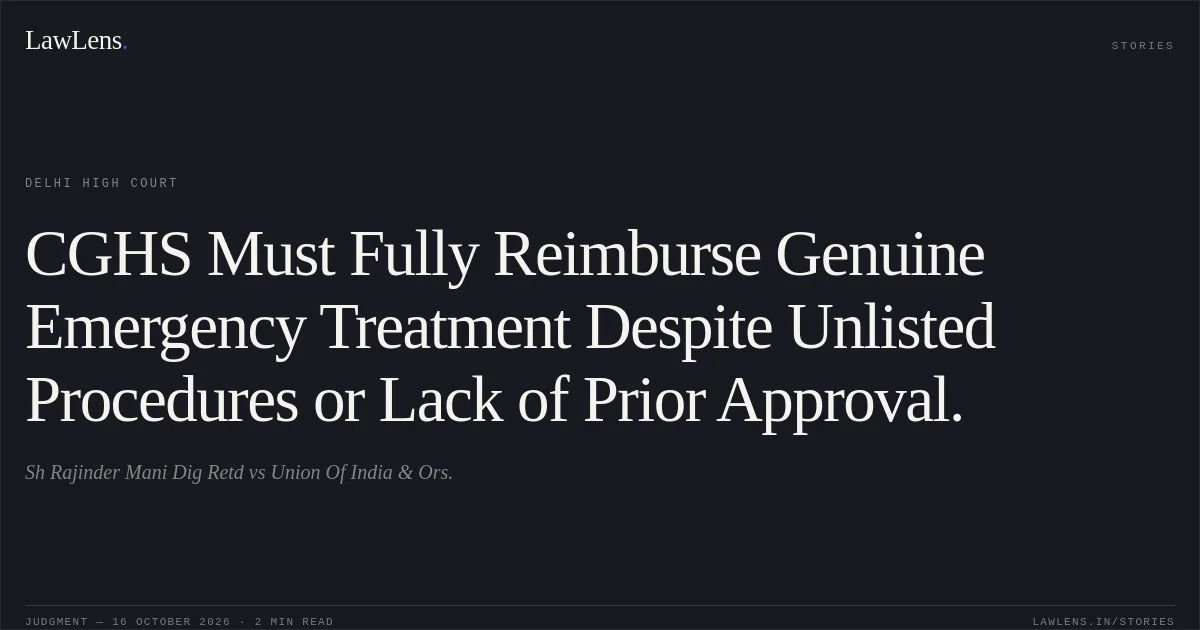
The petitioner, a retired BSF officer and CGHS beneficiary, was advised to undergo minimally invasive cardiovascular surgery (MICS).
Source reference: para. 2(b)–(f)After developing acute chest pain while in Bengaluru, he was admitted to CGHS-empanelled Apollo Hospital and underwent MICS.
Source reference: para. 2(b)–(f)He paid ₹7,81,698 and was reimbursed ₹2,00,090 at the CGHS package rate for conventional CABG.
Source reference: para. 2(b)–(f)His request for full reimbursement was rejected on the basis of a technical committee’s opinion and the CGHS Office Memorandum (OM) dated 6 June 2018.
Source reference: para. 2(g)After filing the writ petition, a further committee reviewed the case and questioned the justification for MICS and the absence of prior permission.
Source reference: para. 4(iv)The petitioner sought reimbursement of the balance amount.
Source reference: para. 1Issues
1. Whether the petitioner’s request for full reimbursement was required to be considered under the High Powered Committee (HPC) category for special circumstances under the OM dated 6 June 2018, rather than the Non-HPC categories.
Source reference: paras. 10–11, 17–192. Whether reimbursement could be denied because MICS was an unlisted procedure, prior permission had not been obtained, or the petitioner’s emergency admission and period of hospitalisation were disputed.
Source reference: paras. 17–21Law Applied
In Shiva Kant Jha v. Union of India, the Supreme Court held that a medical reimbursement claim cannot be denied on technical grounds once the fact of treatment is established by records certified by the treating doctors or hospital; in an emergency, prior permission cannot be insisted upon where survival is the primary consideration.
Source reference: para. 8The OM dated 6 June 2018 provides for consideration by an HPC of CGHS beneficiaries’ requests for full reimbursement under special circumstances and for relaxation of rules.
Source reference: para. 10Under Mohinder Singh Gill v. Chief Election Commissioner, the validity of an administrative order must be assessed on the reasons stated when it was made; fresh reasons cannot subsequently be added to sustain it.
Source reference: para. 21The Court also relied on Union of India v. Joginder Singh, which emphasised that genuine emergency treatment should not be denied reimbursement on technical grounds and that preservation of human life is paramount.
Source reference: para. 9Reasoning
Apollo Hospital was CGHS-empanelled, and the petitioner had a hospital-issued emergency certificate.
Source reference: paras. 17–20The Court held that the circumstances, including the treating surgeon’s choice of procedure, warranted consideration as a request for full reimbursement under the HPC’s special-circumstances category—not rejection under the Non-HPC criteria concerning treatment at a private unrecognised hospital.
Source reference: paras. 17–20The disputed length of hospitalisation and the petitioner’s stable or conscious condition did not displace the hospital’s emergency certificate; moreover, the OM did not define “prolonged period”.
Source reference: para. 18The Court further observed that the initial rejection relied on the OM’s Non-HPC category, while the objection to MICS was raised after the petition was filed. That subsequent justification could not cure the original decision under Mohinder Singh Gill.
Source reference: paras. 16, 21Holding
The Court allowed the petition, holding that the petitioner’s case fell for consideration under the HPC special-circumstances provision and that reimbursement could not be refused on the stated technical grounds.
It directed the respondents to pay the balance amount of ₹5,80,361 within four weeks.
Source reference: para. 22Original Court PDF
Sh Rajinder Mani Dig RetdvsUnion Of India & Ors.
Click to open original judgment
Original judgment, available to read, download and summarize on LawLens.in