Facts
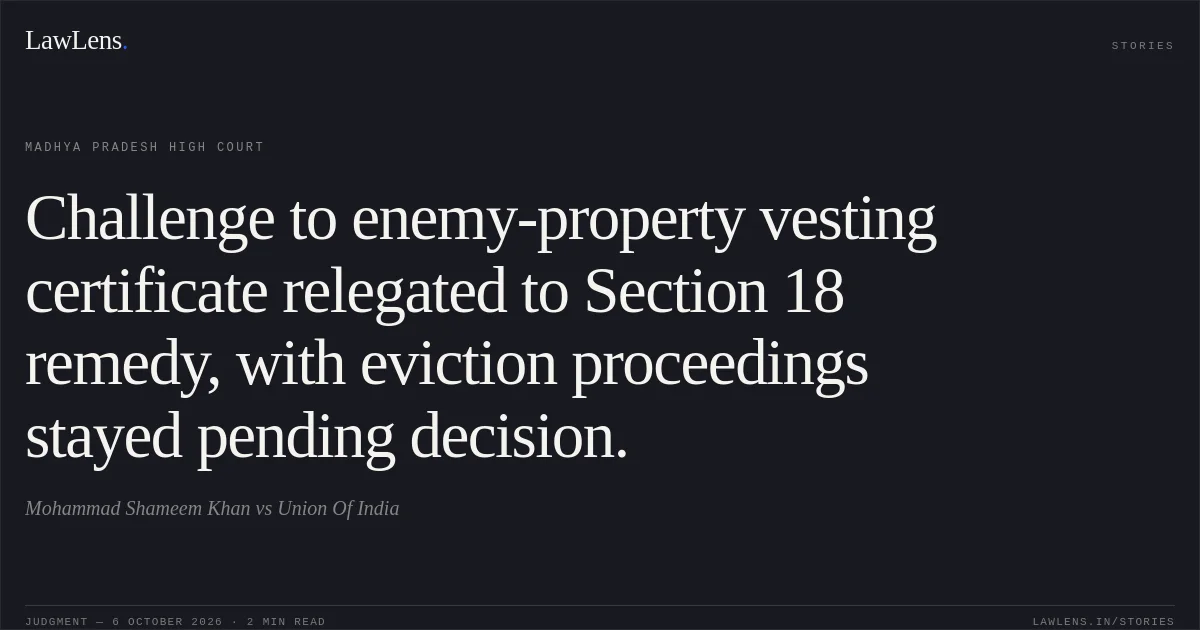
The petitioner challenged an eviction notice issued by the Sub-Divisional Officer concerning Plot No. C-4, Khasra No. 42/1/3, and the underlying certificate declaring the property to be enemy property under the Enemy Property Act, 1968.
Source reference: paras. 2–3, 6He alleged that the certificate had been issued without the notice and hearing required by the Enemy Property Rules, 2015, and that the eviction proceedings were therefore without jurisdiction.
Source reference: paras. 2–3, 6The respondents opposed the writ petition on the ground that the petitioner had not first pursued the representation remedy under Section 18 of the Act.
Source reference: paras. 2–3, 6The Court noted that another occupant of the same property had already filed a Section 18 representation, which was pending.
Source reference: paras. 2–3, 6Issues
Whether the petitioner should be permitted to pursue the writ petition without first availing the representation remedy under Section 18 of the Enemy Property Act, 1968.
Source reference: paras. 2–3, 6–7Whether the eviction proceedings should continue while the petitioner’s challenge to the vesting certificate is considered by the competent authority.
Source reference: paras. 6, 8–9Law Applied
Section 18 of the Enemy Property Act, 1968 provides a representation remedy against the relevant certificate, which the Court considered appropriate for the petitioner to pursue before seeking writ-court interference.
Source reference: paras. 2–3, 6The Court also directed that the representation be decided on its merits, after hearing the petitioner, and not rejected on limitation grounds.
Source reference: paras. 8, 11The petitioner relied on Shane Francisco Dias v. Union of India, 2019 SCC OnLine Bom 492, and alleged breaches of Rules 3 and 4 of the Enemy Property Rules, 2015; however, the Court did not determine those contentions on their merits.
Source reference: paras. 2–3, 6, 8, 11Reasoning
Because the eviction action was founded on the enemy-property certificate and a Section 18 representation concerning the same property was already pending, the Court considered it proper for the petitioner to pursue that statutory remedy as well.
Source reference: paras. 6–9It therefore declined to examine at that stage the petitioner’s challenges concerning notice, hearing, or the certificate’s validity.
Source reference: paras. 6–9To preserve the petitioner’s position while the representation was decided, the Court stayed the Sub-Divisional Officer’s proceedings and barred coercive action.
Source reference: paras. 6–9Holding
The Court disposed of the petition, relegating the petitioner to the Section 18 representation remedy.
If filed within 15 days, the representation was to be decided by the competent authority/Central Government within a further 60 days, by a reasoned order after giving the petitioner an opportunity of hearing; it could not be rejected on limitation grounds.
Source reference: paras. 7–12Until that decision, the eviction proceedings were to remain in abeyance and no coercive steps could be taken.
Source reference: paras. 7–12Any adverse order was not to be given effect for seven days after it was passed.
Source reference: paras. 7–12Acts & Sections Cited
2 provisions across 1 statute referred to in this judgment. Each provision opens on LawLens.
Enemy Property Act, 19682
Original Court PDF
Mohammad Shameem KhanvsUnion Of India
Click to open original judgment
Original judgment, available to read, download and summarize on LawLens.in