01Facts
Sandhya Saraswathi, a government schoolteacher, challenged disciplinary charge articles issued against her, contending that the Deputy Director of Public Instructions lacked authority because the Joint Director had appointed her.
pp. 5–8The Karnataka State Administrative Tribunal accepted her contention, quashed charge articles and directed consideration of her promotion; it also quashed a subsequent charge notice.
pp. 5–8The State challenged the Tribunal’s orders in these connected writ petitions.
pp. 5–8By the time of the High Court proceedings, Saraswathi had been promoted to Headmaster with effect from 9 September 2020, the date her juniors were promoted.
pp. 5–802Issues
i.Whether the Deputy Director of Public Instructions was competent under the Karnataka Civil Services (Classification, Control and Appeal) Rules, 1957, to institute disciplinary proceedings against Saraswathi.
pp. 9–15ii.Whether the Tribunal could assess the substance of the charges at the stage of challenge to the charge articles.
pp. 10, 15–16iii.Whether the challenge to the subsequent charge notice in W.P. No. 22238 of 2022 required determination after the decision in W.P. No. 18895 of 2021.
pp. 10–11, 16–1703Law Applied
Rule 10A of the Karnataka Civil Services (Classification, Control and Appeal) Rules, 1957, permits the Governor or an authority empowered by general or special order to institute disciplinary proceedings, and allows a disciplinary authority competent to impose specified minor penalties to institute proceedings for major penalties as well.
pp. 12–15Rule 11 governs the issue of charge articles for major penalties. Schedule II identifies the authorities competent to appoint, impose penalties and hear appeals; for the relevant category of Secondary School Assistant Teachers, the Deputy Director of Public Instructions was the appointing authority and was empowered to impose major penalties, while the Joint Director was the appellate authority.
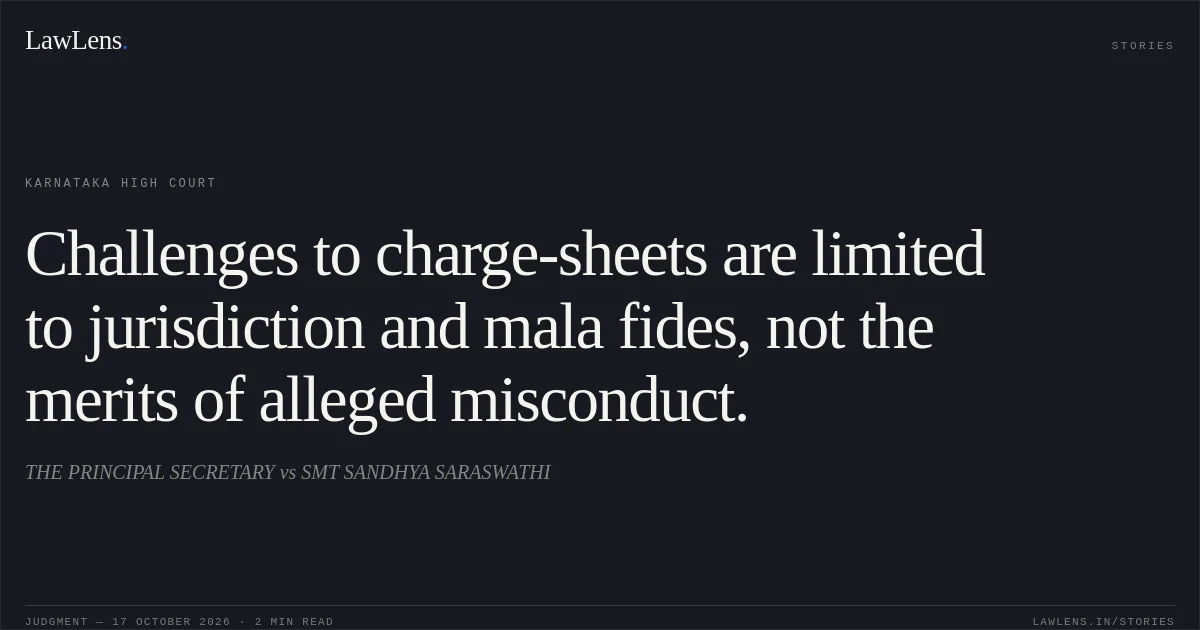
pp. 12–15At the charge stage, review is confined to jurisdictional questions and allegations of mala fides; the merits of the allegations are for the inquiry officer to determine on the evidence.
p. 1604Reasoning
The Tribunal erred by treating the Joint Director’s appointment of Saraswathi as determinative without applying Schedule II, which made the Deputy Director the competent appointing and disciplinary authority for her category. Rule 10A also supported the authority to institute proceedings.
pp. 13–16The Tribunal further exceeded the proper scope of review by assessing whether the alleged conduct amounted to misconduct or insubordination; those questions belonged to the inquiry process, absent a jurisdictional defect or mala fides.
pp. 13–16Because W.P. No. 18895 of 2021 was allowed, the Court considered the connected challenge to the later charge notice academic.
pp. 10–11, 16–1705Holding
The High Court allowed W.P. No. 18895 of 2021 and set aside the Tribunal’s order dated 16 March 2021.
pp. 16–17It directed that Saraswathi’s promotion not be disturbed until the inquiry under the specified charge articles is concluded, while making the promotion subject to the inquiry’s outcome.
pp. 16–17W.P. No. 22238 of 2022 was disposed of as raising no surviving issue in light of the decision in the first petition.
p. 17Original Court PDF
THE PRINCIPAL SECRETARYvsSMT SANDHYA SARASWATHI
Click to open original judgment
Original judgment, available to read, download and summarize on LawLens.in