01Facts
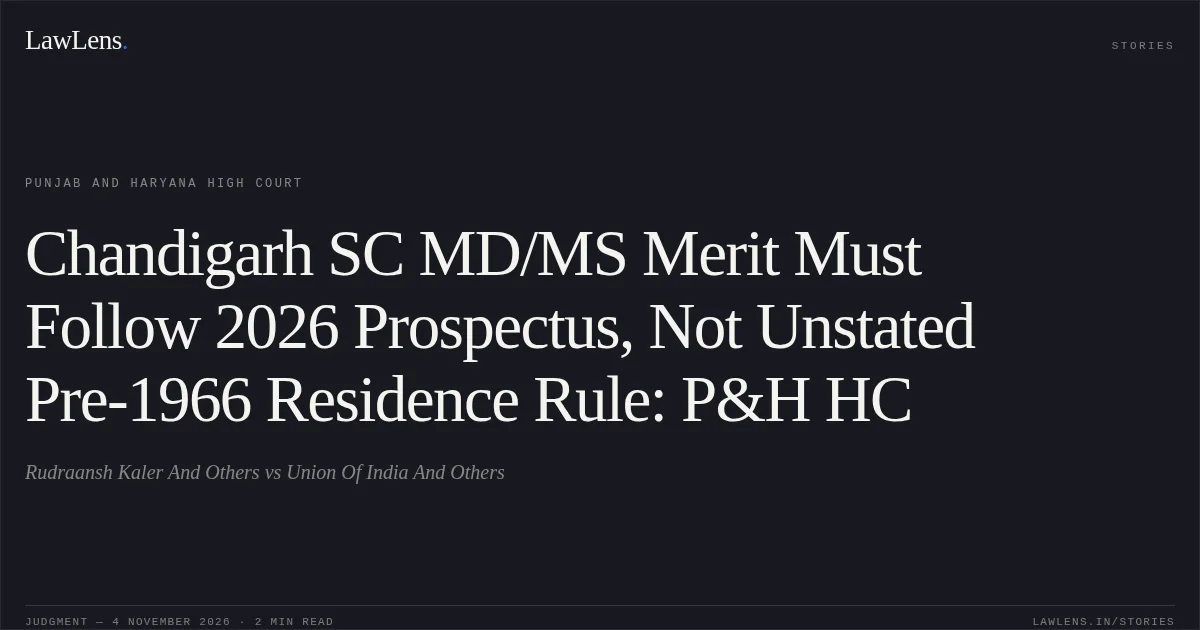
The petitioners, who claimed to be Chandigarh residents belonging to Scheduled Castes (SC) and to hold SC certificates issued by the competent Chandigarh authority, challenged the prospectus for MD/MS admissions for Session 2026.
pp. 1–2The prospectus reserved 15% of seats for “Bonafide” SC candidates and required applicants to hold a Bonafide SC certificate from UT Chandigarh.
pp. 1–2The respondents relied on Article 341 and government instructions to argue that SC reservation benefits are territorially limited and cannot be carried to a migrated State or Union Territory.
pp. 1–2The petitioners contended that the instructions could not add an eligibility requirement absent from the prospectus.
pp. 1–202Issues
i.1. Whether the respondents could read government instructions into the prospectus to impose an additional eligibility condition for SC-reserved MD/MS seats.
pp. 4–6ii.2. Whether the petitioners’ and other applicants’ eligibility and inter se merit were to be assessed under the conditions stated in the prospectus.
pp. 5–603Law Applied
Article 226 of the Constitution provides the High Court’s writ jurisdiction; Article 341 concerns the specification of Scheduled Castes.
pp. 3–4The court applied the principle that an admission prospectus binds both applicants and the admitting authority, and that admission must be governed by its stated criteria.
pp. 3–4It relied on Amardeep Singh Sahota v. State of Punjab, 1993 (2) PLR 212; Raj Singh v. Maharishi Dayanand University, 1994 (4) RSJ 289; Rahul Prabhakar v. Punjab Technical University, Jalandhar, 1997 (3) SCT 526; Indu Gupta v. Director of Sports, Punjab, Chandigarh, 1999 (4) SCT 113; Adarsh Dinkar Sontakke (minor) v. Navodaya Vidyalaya Samiti, Law Finder Doc ID #2961508; and Japuji Kaur Bains v. Union Territory of Chandigarh, Law Finder Doc ID #2982538.
pp. 3–4The governing rule is that an admitting authority cannot introduce an additional eligibility condition not contained in the applicable prospectus.
pp. 3–4Provisions in the judgment · 2
Companies (Prospectus and Allotment of Securities) Rules, 2014 BPG-4
04Reasoning
The prospectus required SC applicants to claim SC eligibility when applying for NEET (PG)-2026 and to obtain a Bonafide SC certificate from UT Chandigarh in the prescribed format.
pp. 4–6The court noted that neither the relevant prospectus clauses nor the certificate format required applicants to establish that their fathers or forefathers resided in Chandigarh on or before 1 November 1966.
pp. 4–6Because the respondents’ proposed reliance on government instructions dated 22 February 2018 would add a condition not stated in the prospectus, the court held that those instructions could not be read into it.
pp. 4–6The prospectus therefore governed the assessment, without the court deciding any applicant’s individual eligibility.
pp. 4–605Holding
The court allowed the petition to the extent of directing the respondents to prepare and publish the SC merit list for MD/MS admissions for Session 2026 in accordance with the relevant prospectus clauses and other applicable provisions, without adding further eligibility requirements.
p. 6The petitioners’ candidature was to be considered alongside that of other SC applicants, with eligibility assessed under the prescribed conditions and inter se merit determined accordingly.
p. 6The writ petition and pending miscellaneous applications were disposed of.
p. 6Original Court PDF
Rudraansh Kaler And OthersvsUnion Of India And Others
Click to open original judgment
Original judgment, available to read, download and summarize on LawLens.in