Facts
The petitioners sought admission to the Bachelor of Architecture (B.Arch.) course at Chandigarh College of Architecture (CCA) for the 2026–2027 academic session and approached the High Court under Articles 226/227 of the Constitution.
Source reference: p.2, para. 2In CWP-27070-2026, Lavanya, a General Category candidate, secured 98.17389 percentile and an All India Rank of 1311 in the 2026 Joint Entrance Examination.
Source reference: p.2, para. 3She participated in the counselling rounds, including the special spot counselling held on 18.08.2026, but was not allotted a seat.
Source reference: p.2, para. 3The Court was informed that seats had remained vacant after the counselling process, including seats affected by candidate withdrawals.
Source reference: p.2, para. 4Pursuant to the Court’s direction, the Joint Admission Committee (JAC) decided on 27.08.2026 not to conduct any further counselling, reasoning that the prescribed counselling rounds had concluded, the academic session had commenced, and the JAC brochure did not contemplate another round.
Source reference: pp.3–5, para. 5Issues
Whether the JAC was justified in refusing to conduct any further allotment or counselling despite seats remaining vacant in the B.Arch. course.
Source reference: pp.3–5, para. 5; p.5, paras. 6–8Whether the vacant seats could be filled from candidates who participated in the spot counselling and, thereafter, from other representationists on the basis of merit.
Source reference: p.6, para. 10Whether seats allotted to candidates who subsequently withdrew, or failed to report, could be treated as consumed so as to prevent admission of other meritorious candidates.
Source reference: p.5, para. 9Law Applied
The Court exercised its jurisdiction under Articles 226 and 227 of the Constitution to prevent arbitrary or unreasonable administrative action affecting access to professional education.
Source reference: p.2, para. 2It applied the principle that seats in recognised professional and higher-education institutions should not be allowed to remain vacant, as doing so results in wastage of public and institutional resources and denies deserving students an educational opportunity.
Source reference: pp.4–5, paras. 7–8Relying on Index Medical College, Hospital and Research Centre v. State of Madhya Pradesh , 2023 (11) SCC 570, the Court held that vacant seats in professional colleges constitute a national waste and that restrictions preventing their filling must bear a rational nexus with the objective sought to be achieved.
Source reference: p.4, para. 7It also relied on Federation of Self Financing Colleges of Education, Punjab v. State of Punjab , CWP-22628-2018, decided on 06.09.2018, and Sana Sawhney v. Chandigarh College of Architecture , CWP-26079-2018, decided on 22.10.2018, which recognised that vacant seats should ordinarily be filled where no useful purpose would be served by allowing them to remain vacant.
Source reference: p.4, para. 7The JAC brochure and its counselling provisions were considered, but they could not be applied hyper-technically to defeat admission of meritorious candidates against available seats.
Source reference: pp.3–5, paras. 5 and 9Reasoning
The Court found that the JAC’s decision was untenable because seats in a sought-after professional course remained vacant even after the conclusion of the prescribed counselling rounds.
Source reference: p.5, paras. 6–8Although the JAC relied on the completion of counselling, the commencement of the academic session, and the brochure’s provisions concerning conversion and withdrawal, those considerations did not justify allowing available educational seats to go to waste.
Source reference: no citationThe Court rejected the respondents’ contention that seats allotted to candidates who had deposited fees were necessarily “consumed,” holding that such a hyper-technical approach could not deprive more meritorious candidates of admission.
Source reference: p.5, para. 9Applying the principle against wastage of professional-education seats, the Court directed that the vacant seats be offered first to candidates who had participated in the spot counselling and, if seats still remained, to other representationists, strictly according to merit.
Source reference: p.6, para. 10Holding
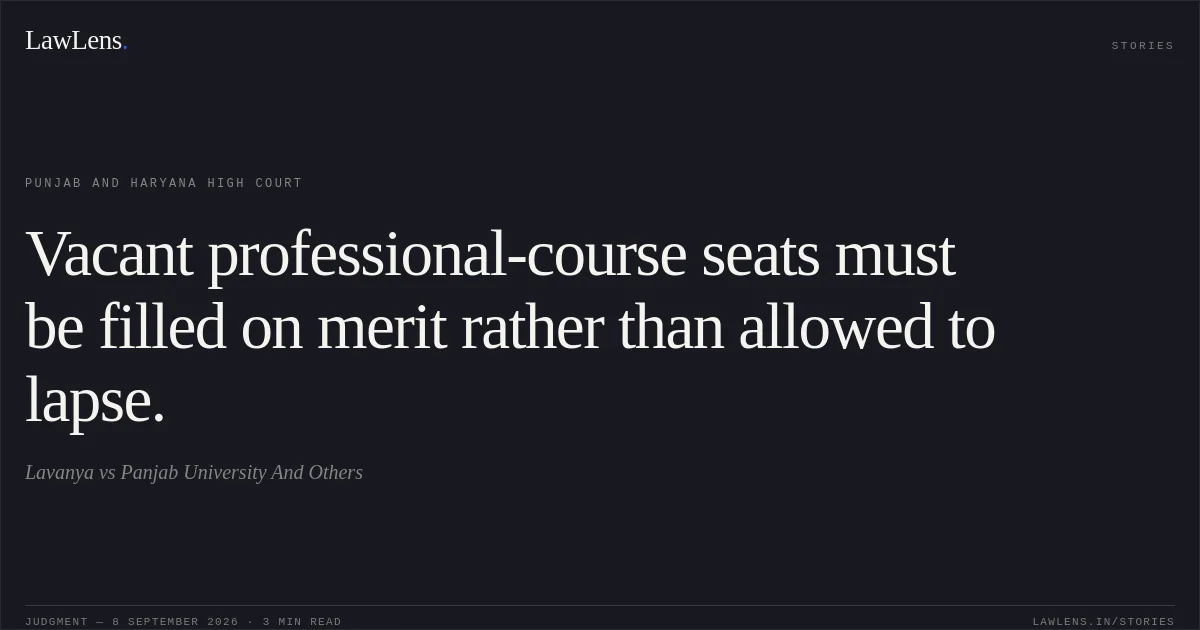
The Court held that the vacant B.Arch. seats were required to be filled and that the JAC could not refuse further allotment merely because the scheduled counselling process had concluded.
A writ of mandamus was issued directing the respondents to fill the vacant seats on the basis of merit, first from the spot-counselling participants and thereafter from the representationists.
Source reference: p.6, para. 10The exercise was directed to be completed within one week so that the selected students could join the ongoing classes.
Source reference: p.6, para. 10All three writ petitions were disposed of, and pending miscellaneous applications, if any, were also disposed of.
Source reference: p.6, paras. 11–12Original Court PDF
LavanyavsPanjab University And Others
Click to open original judgment
Original judgment, available to read, download and summarize on LawLens.in