01Facts
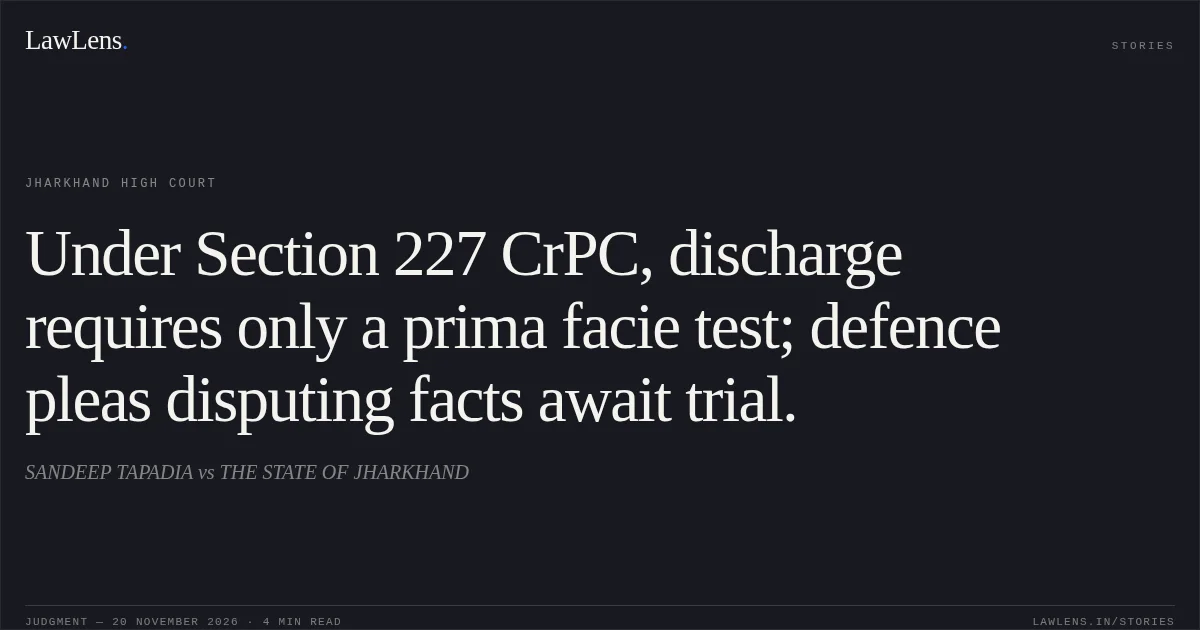
The petitioners (five members of the Yadav family) challenged the order dated 05.10.2023 of the Additional Sessions Judge-I, Sahibganj, in Misc. Criminal Application No. 391 of 2023 (S.T. No. 235 of 2022), rejecting their discharge application under Section 227 CrPC (now Section 250 BNSS).
pp. 1–2 · ¶ 2During the pendency of the revision, the petitioners were permitted to challenge the framing of charge by I.A. No. 10631 of 2026, allowed on 07.08.2026.
p. 2 · ¶ 3The FIR named eight accused. Police filed a chargesheet on 30.03.2019 against only three accused, and the remaining accused were not sent for trial for lack of evidence. The Judicial Magistrate nonetheless took cognizance of offences under Sections 147, 148, 149, 341, 343, 323, 307 and 504 read with 34 IPC and committed the case to Sessions.
p. 2 · ¶ 4The petitioners state that a prior cross-FIR (Sahibganj P.S. Case No. 68 of 2017) was lodged by petitioner Mithu Yadav against the informant's side, and that the present FIR was a counterblast.
p. 2 · ¶ 4The petitioners contend that: no Section 307 IPC offence is made out; the remaining offences are triable by a Magistrate, so the case should have been remitted under Section 228 CrPC (now Section 251 BNSS); there is no specific overt act against each petitioner and Section 149 IPC was applied mechanically; no incriminating articles were recovered; the injuries were simple; petitioners 4 and 5 are elderly and infirm; petitioner 3 was at her matrimonial home; and petitioners 1 and 2 are serving in the Army.
pp. 2–3 · ¶ 4 · p. 3 · ¶ 4The State and opposite party No. 2 contended that the case and counter-case involve the same parties, that the injuries to the complainant's side are grievous and on vital parts (head fractures confirmed by CT scans in respect of five injured persons), and that the petitioners' pleas are matters of defence for trial.
pp. 3–5 · ¶ 5The prosecution case is that a dispute over filling soil on land of informant Pushpa Devi escalated into abusive exchanges and armed assault, with damage to the house, assault on her husband and son, and robbery of Rs. 46,000 and gold ornaments.
p. 5 · ¶ 7The trial court relied on injuries to five injured persons, found prima facie material for Section 307 IPC and allied offences, and held that a detailed inquiry is not required at the charge stage.
pp. 5–6 · ¶ 702Issues
i.1. Whether the trial court erred in refusing discharge under Section 227 CrPC (Section 250 BNSS) by holding that a prima facie case under Section 307 IPC, along with allied offences, existed against the petitioners.
pp. 5–6 · ¶ 7 · pp. 6–8 · ¶ 8ii.2. Whether the offences were not exclusively triable by a Court of Session, so that the case ought to have been remitted to the CJM under Section 228 CrPC (Section 251 BNSS).
pp. 2–3 · ¶ 4 (petitioners' submission) · no express finding recordediii.3. Whether the petitioners' individual role and the invocation of Section 149 IPC, in the absence of specific overt acts, warranted discharge at the charge stage.
p. 3 · ¶ 4 · pp. 3–5 · ¶ 503Law Applied
The court relied on Sections 227 and 228 CrPC (corresponding to Sections 250 and 251 BNSS), which govern discharge and framing of charge, and on the settled principle that at the charge stage the court evaluates only the materials collected during investigation, without weighing probable defence or the truth of the allegations.
pp. 5–6 · ¶ 7The court applied the prima facie standard from State of Bihar v. Ramesh Singh (1977) 4 SCC 39, under which the truth and veracity of the prosecution evidence are not meticulously judged, strong suspicion may justify proceeding, and an order under Section 228 rather than Section 227 is ordinarily made where the scales are even at the initial stage.
pp. 6–8 · ¶ 8The judgment refers to Section 307 IPC (attempt to murder), which turns on the nature of injuries and intent, and Section 149 IPC (unlawful assembly liability), though the judgment does not quote their elements.
pp. 2–3 · ¶ 4 · pp. 5–6 · ¶ 7The court referred generally to "several citations" of the Supreme Court that it does not identify.
p. 6 · ¶ 7Provisions in the judgment · 14 · Linked ones open on LawLens
Code of Criminal Procedure, 1973 Section 227Section 228
Bharatiya Nagarik Suraksha Sanhita, 2023 Section 250Section 251
Indian Penal Code, 1860 10 provisions
Section 34Section 147Section 148Section 149Section 307Section 323Section 341Section 342Section 343Section 50404Reasoning
The court tested the impugned order against the prima facie standard. It noted that the trial judge had examined the injury reports of five injured persons, all of which involved head or nose injuries from hard or blunt objects, and had found material for Section 307 IPC.
pp. 5–6 · ¶ 7Applying Ramesh Singh, the court held that the petitioners' contentions (absence of overt acts, age and infirmity, absence from the scene, recoveries, simple nature of injuries, and the counter-FIR) are largely matters of probable defence to be tested at trial, not grounds for discharge.
p. 5 · ¶ 5 · pp. 6–8 · ¶ 8The court accepted that the trial judge had considered the injury material and had rightly rejected discharge.
p. 5 · ¶ 5 · p. 6 · ¶ 7The court did not separately address the petitioners' argument that Section 307 IPC was not made out on the medical evidence or that the case was exclusively triable by Sessions and should have been remitted under Section 228 CrPC. Its reasoning implicitly treats the Section 307 IPC material as sufficient to sustain Sessions-triable charges and therefore to refuse remission, but this is not stated expressly.
pp. 2–3 · ¶ 4The court did not analyse the individual role of each petitioner or the applicability of Section 149 IPC, and did not address the discrepancy between the chargesheet sections and the cognizance sections.
pp. 5–6 · ¶ 705Holding
The court found no valid reason to interfere with the impugned order rejecting discharge. Its holding is that, at the charge stage, the trial court was correct to find a prima facie case under Section 307 IPC and allied offences based on the injury reports and the materials on record, and that the petitioners' defences are for trial.
pp. 5–8 · ¶ 7–9The revision is dismissed, and pending interlocutory applications are disposed of accordingly. The trial court is directed to be informed of the order.
p. 8 · ¶ 9–11Original Court PDF
UTTAM YADAV ALIAS DARA ALIAS UTTAM KUMAR YADAV ALIAS UTTAMvsTHE STATE OF JHARKHAND
Click to open original judgment
Original judgment, available to read, download and summarize on LawLens.in