01Facts
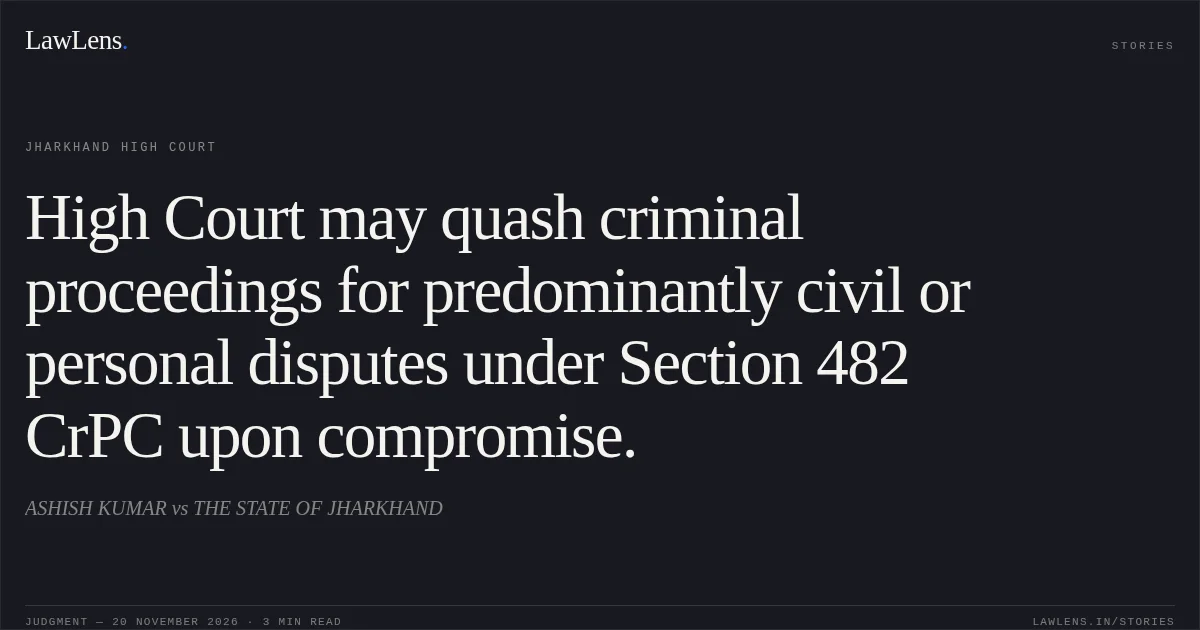
The petitioners, three brothers, sought quashing under Section 482 CrPC of Complaint Case No. 1646 of 2014, including the cognizance order dated 05.07.2019 passed by the Judicial Magistrate-1st Class, Ranchi.
p. 1 · ¶ 2Cognizance was taken for offences under Sections 406, 420, 323 and 120B IPC.
p. 1 · ¶ 2The case was next fixed for 01.12.2026, and charge had not been framed.
p. 2 · ¶ 3The petitioners and the opposite party No. 2 (complainant) jointly relied on I.A. No. 15965 of 2026, supported by affidavits, which recorded that the parties had entered into a compromise. The complainant no longer wished to proceed.
p. 2 · ¶ 4Counsel submitted that the dispute was personal, with a civil flavour.
p. 2 · ¶ 4The State Counsel stated that the State had no objection to quashing.
p. 3 · ¶ 502Issues
i.1. Whether the High Court, under Section 482 CrPC, may quash criminal proceedings for offences under Sections 406, 420, 323 and 120B IPC on the basis of a settlement between the accused and the complainant, where continuation would amount to abuse of process.
p. 2 · ¶ 4 · p. 3 · ¶ 6ii.2. Whether the nature and gravity of the offences, and the private or civil character of the dispute, justify quashing despite the absence of a conviction prospect being established on the record.
p. 5 · ¶ 7–803Law Applied
Section 482 CrPC preserves the High Court's inherent power to prevent abuse of process or secure the ends of justice.
p. 3 · ¶ 6The Court applied Parbatbhai Aahir v. State of Gujarat, (2017) 9 SCC 641, para. 11, which in turn adopted Gian Singh v. State of Punjab, (2012) 10 SCC 303, para. 61.
pp. 3–5 · ¶ 6Under Gian Singh, inherent power is distinct from compounding under Section 320 CrPC. Heinous or serious offences, offences against society, and offences under special statutes or by public servants cannot be quashed on compromise.
pp. 4–5 · ¶ 6Criminal cases with an overwhelmingly civil flavour, such as commercial, financial, partnership or family disputes where the wrong is private, may be quashed if the possibility of conviction is remote and bleak, continuation would cause oppression and extreme injustice, and quashing secures the ends of justice.
pp. 4–5 · ¶ 6The State's non-objection is relevant but not determinative.
Provisions in the judgment · 5 · Linked ones open on LawLens
Code of Criminal Procedure, 1973 Section 482Section 320
Indian Penal Code, 1860 Section 406Section 420Section 323
04Reasoning
The Court first examined the nature of the offences and found that they were not heinous and involved no serious mental depravity. It characterised the dispute as personal.
p. 5 · ¶ 7Applying the Gian Singh test, the Court held that the full settlement between the offender and the victim made conviction remote and bleak. It further held that continuing the prosecution would cause great oppression and prejudice to the petitioners, and that refusing quashing despite complete compromise would cause extreme injustice.
p. 5 · ¶ 8The Court took into account the joint stance of the petitioners and the complainant and the State's lack of objection.
pp. 2–3 · ¶ 4–5The judgment does not separately analyse whether each offence is compoundable or whether the settlement was verified as voluntary, and it rests the decision on the inherent-power framework.
05Holding
The Court held that this was a fit case for exercising inherent power under Section 482 CrPC.
p. 5 · ¶ 9The petition was allowed. The entire proceedings in Complaint Case No. 1646 of 2014, including the cognizance order dated 05.07.2019, were quashed and set aside as against the petitioners. I.A. No. 15965 of 2026 was disposed of accordingly.
p. 5 · ¶ 9 · p. 6 · ¶ 10–12Original Court PDF
ASHISH KUMARvsTHE STATE OF JHARKHAND
Click to open original judgment
Original judgment, available to read, download and summarize on LawLens.in