Facts
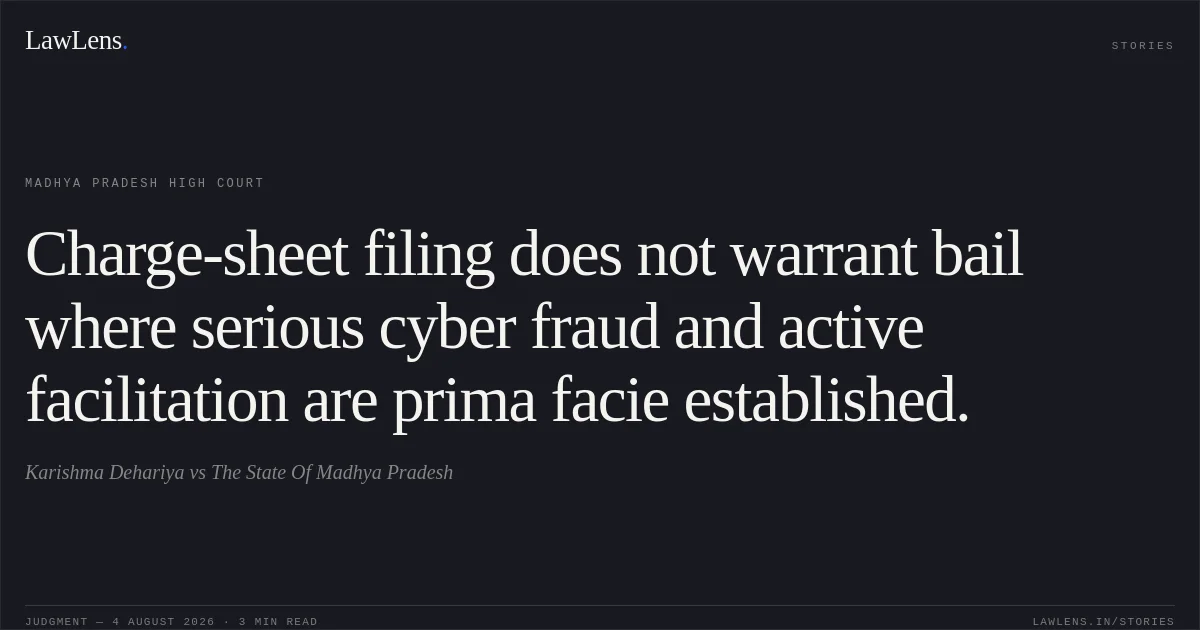
The applicant filed her first application under Section 483 of the Bharatiya Nagarik Suraksha Sanhita, 2023, seeking regular bail in connection with Crime No. 30/2026 registered at Police Station Bag Sevaniya, District Bhopal, for offences under Sections 318(4), 319(2), 316(2), 338, 336(3), 340(2), 111(2) and 61 of the Bharatiya Nyaya Sanhita, 2023, and Sections 66-C and 66-D of the Information Technology Act, 2000.
Source reference: para. 1The prosecution alleged that the complainant was induced through a WhatsApp group to invest in share trading and was defrauded of approximately ₹36,74,000.
Source reference: para. 2During investigation, the police arrested Amit Dhargawe, in whose account the alleged fraudulent amount had been transferred.
Source reference: para. 2The applicant contended that she had neither received nor retained the allegedly defrauded amount, that the case against her rested primarily on a memorandum statement, and that the charge-sheet had already been filed.
Source reference: para. 3The State opposed bail, alleging that the applicant had facilitated the provision of a corporate account used for transferring the fraudulent funds and had participated in an organised cyber-financial fraud.
Source reference: para. 4Issues
Whether the applicant was entitled to regular bail under Section 483 of the Bharatiya Nagarik Suraksha Sanhita, 2023, notwithstanding the filing of the charge-sheet?
Source reference: paras. 1, 6–8Whether the seriousness of the alleged cyber-fraud, the applicant’s alleged role in arranging a corporate account, and the material collected during investigation justified continued incarceration pending trial?
Source reference: paras. 4, 6–7Law Applied
The Court applied Section 483 of the Bharatiya Nagarik Suraksha Sanhita, 2023, governing the High Court’s power to grant regular bail.
Source reference: para. 1It considered the allegations under Sections 318(4), 319(2), 316(2), 338, 336(3), 340(2), 111(2) and 61 of the Bharatiya Nyaya Sanhita, 2023, and Sections 66-C and 66-D of the Information Technology Act, 2000, concerning cheating, fraudulent transactions, identity-related misuse, conspiracy/common participation, and cyber-related offences.
Source reference: para. 1The Court applied the established bail principle that, at the bail stage, it is not required to conduct a detailed evaluation of evidence or conclusively determine the accused’s defence; however, it must consider the nature and gravity of the allegations, the role attributed to the accused, the material collected during investigation, and the possibility of interference with the trial.
Source reference: paras. 6–7The filing of a charge-sheet does not automatically create an entitlement to bail, particularly in serious economic and cyber offences involving electronic and financial evidence.
Source reference: paras. 6–7Reasoning
The Court found that the prosecution material prima facie connected the applicant with the financial channel through which the alleged fraudulent transactions were conducted.
Source reference: para. 6Her contention that she merely arranged a corporate account and did not personally receive the cheated amount was treated as a matter of defence requiring consideration at trial, rather than a ground for bail at that stage.
Source reference: para. 6Given the alleged misuse of electronic records, identity-related information and online financial transactions, the Court adopted a cautious approach.
Source reference: para. 6It further held that the filing of the charge-sheet did not, by itself, justify release because the trial had not commenced and the electronic and financial evidence remained to be examined.
Source reference: para. 6On consideration of the gravity of the offences, the applicant’s alleged role and the investigation material, the Court declined to enlarge her on bail.
Source reference: para. 7Holding
The Court answered the bail issue against the applicant.
It held that the seriousness of the alleged cyber-financial fraud, the applicant’s prima facie connection with the relevant financial channel, and the pending evaluation of electronic and financial evidence warranted rejection of bail.
Source reference: paras. 7–8Accordingly, the applicant’s first application for regular bail under Section 483 of the Bharatiya Nagarik Suraksha Sanhita, 2023, was rejected.
Source reference: paras. 7–8Acts & Sections Cited
9 provisions across 2 statutes referred to in this judgment. Each provision opens on LawLens.
Bharatiya Nagarik Suraksha Sanhita, 20231
Bharatiya Nyaya Sanhita, 20238
Original Court PDF
Karishma DehariyavsThe State Of Madhya Pradesh
Click to open original judgment
Original judgment, available to read, download and summarize on LawLens.in