Facts
The extract concerns criminal proceedings arising from commercial transactions, including an alleged offer of distributorship, receipt of advance payments, non-supply of goods, and allegations of cheating under Section 318(4) of the Bharatiya Nyaya Sanhita (BNS) and criminal breach of trust under Section 316(2) BNS.
Source reference: paras. 17–18, 20, 23The Court also considered allegations involving a refundable security deposit paid under a Joint Development Agreement, an alleged false representation that property was free from encumbrances, and its subsequent sale to a third party.
Source reference: paras. 17–18, 20, 23Issues
Whether failure to supply goods after receiving advance payments pursuant to a commercial agreement constitutes cheating under Section 318(4) BNS in the absence of specific allegations establishing dishonest intention at the inception of the transaction.
Source reference: paras. 17, 23Whether receipt and subsequent non-refund of money paid as the price or advance price of goods constitutes criminal breach of trust under Section 316(2) BNS without entrustment of the money.
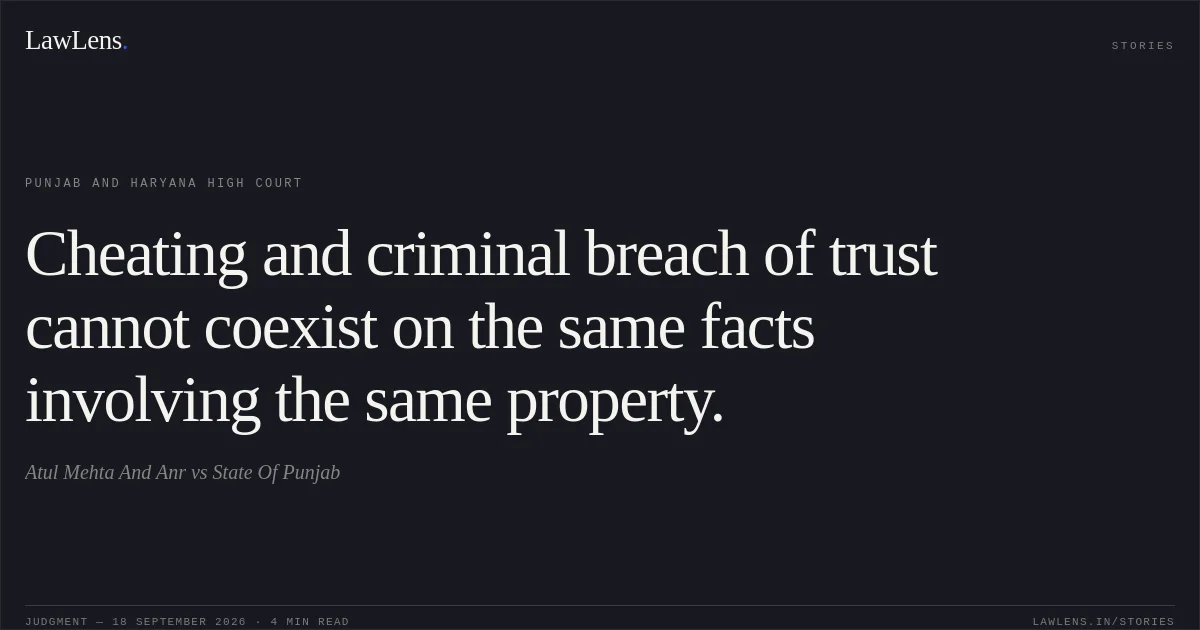
Source reference: para. 18Whether cheating and criminal breach of trust can simultaneously be alleged on the same property and on the same factual substratum where the amount is alleged both to have been dishonestly induced and lawfully entrusted.
Source reference: no citationWhether prosecution under Section 420 IPC is maintainable in addition to proceedings under Section 138 of the Negotiable Instruments Act, 1881, where the dishonoured cheque was allegedly issued with dishonest intention from the outset.
Source reference: paras. 12, 27Whether anticipatory bail should be granted in an economic offence involving a substantial amount, alleged deliberate conduct, transfer of property to a third party, and non-availability during investigation.
Source reference: para. 20Law Applied
Cheating under Section 318(4) BNS, corresponding to Section 420 IPC, requires deception and fraudulent or dishonest inducement at the inception of the transaction; a mere subsequent failure to perform a contract is insufficient.
Source reference: para. 18Criminal breach of trust under Section 316(2) BNS requires entrustment, meaning that the beneficial interest in the property remains with the person delivering it and the accused receives only custody or dominion for another’s benefit.
Source reference: para. 18Money paid to a supplier as consideration or advance consideration ordinarily becomes the supplier’s property and its non-refund or non-use for the agreed purpose generally gives rise to a civil contractual claim, not criminal breach of trust.
Source reference: para. 18Applying the principles governing quashing under State of Haryana v. Bhajan Lal, criminal proceedings may be quashed where the allegations, even if accepted in full, do not disclose the essential ingredients of the offence.
Source reference: para. 23Sections 138 of the Negotiable Instruments Act and 420 IPC create distinct offences: Section 138 does not require proof of dishonest intention at the time of issuance of the cheque, whereas Section 420 IPC does; therefore, both prosecutions may proceed if the complaint specifically alleges dishonest intention at the time of issuing the cheque.
Source reference: paras. 12, 27Reasoning
The Court found that the distributorship allegations disclosed, at most, non-performance of a written commercial arrangement.
Source reference: para. 17The absence of particulars identifying the alleged false representation, the person who made it, the time and place of its making, and any facts showing that the accused never intended to supply the goods meant that dishonest intention at inception could not be inferred.
Source reference: para. 17The claim under Section 316(2) BNS also failed because payments made as the price or advance price of goods were not alleged to have been entrusted for the complainant’s benefit; ownership of the money passed to the supplier subject to contractual obligations.
Source reference: para. 18Accordingly, continuation of the criminal case would improperly convert a contractual dispute into criminal proceedings and amount to abuse of process.
Source reference: para. 23In the refundable-security-deposit scenario, the allegations were internally inconsistent: if the deposit was lawfully entrusted and later misappropriated, it could not simultaneously be said that the accused obtained it through cheating on the same factual basis.
Source reference: no citationConversely, where a dishonoured cheque is specifically alleged to have been issued with dishonest intention from the beginning, Section 420 IPC may proceed independently of Section 138 proceedings because the two offences have different ingredients.
Source reference: paras. 12, 27Holding
The Court held that the allegations concerning the distributorship did not disclose cheating under Section 318(4) BNS because no dishonest or fraudulent intention at inception was pleaded, and did not disclose criminal breach of trust under Section 316(2) BNS because entrustment was absent.
The proceedings were therefore liable to be quashed as an abuse of process under the Bhajan Lal principles.
Source reference: para. 23It further held that cheating and criminal breach of trust cannot be sustained simultaneously on the same property and identical factual substratum where their foundational allegations are mutually inconsistent; the resulting dispute is essentially civil.
Source reference: no citationProceedings under Section 420 IPC remain maintainable alongside Section 138 of the Negotiable Instruments Act where dishonest intention at the time of issuing the cheque is specifically alleged.
Source reference: para. 27In the separate anticipatory-bail matter, relief was held unwarranted at that stage because of the substantial economic allegations, alleged deliberate conduct, and investigative requirements.
Source reference: para. 20Acts & Sections Cited
5 provisions across 4 statutes referred to in this judgment. Each provision opens on LawLens.
Bharatiya Nyaya Sanhita, 20232
Negotiable Instruments Act, 18811
Indian Penal Code, 18601
Code of Criminal Procedure, 19731
Original Court PDF
Atul Mehta And AnrvsState Of Punjab
Click to open original judgment
Original judgment, available to read, download and summarize on LawLens.in