01Facts
The respondent had initiated separate proceedings under Section 138 of the Negotiable Instruments Act, 1881, against the petitioners—mother and son—over cheques for ₹5,00,000 and ₹3,00,000 respectively.
pp. 3–6, 9–10 · ¶ 3–10The cases, instituted in 2005, were pending before the Magistrate when they were listed for recording the accused’s statements under Section 313 Cr.P.C.
pp. 3–6, 9–10 · ¶ 3–10The petitioners applied for discharge under Section 245(1) Cr.P.C., alleging that the cheques had been misused and that no legally enforceable liability existed; they also relied on a police charge sheet against the complainant.
pp. 3–6, 9–10 · ¶ 3–10The Magistrate rejected the applications, and the Revisional Court affirmed that decision.
pp. 3–6, 9–10 · ¶ 3–10The petitioners then invoked Section 482 Cr.P.C. to challenge those orders
pp. 3–6, 9–10 · ¶ 3–1002Issues
i.Whether the petitioners could seek discharge under Section 245(1) Cr.P.C. in proceedings for an offence under Section 138 of the Negotiable Instruments Act
pp. 7–9, 11–12 · ¶ 9, 11–12ii.Whether the allegations of cheque misuse, absence of legally enforceable liability, and the police case against the complainant justified discharge or interference under Section 482 Cr.P.C.
pp. 4–6, 11–13 · ¶ 4–7, 13iii.Whether the High Court should interfere with the concurrent orders rejecting discharge, and what directions were appropriate given the age and progress of the proceedings
pp. 12–15 · ¶ 12–1503Law Applied
Section 245 Cr.P.C. is located in Chapter XIX, which governs warrant cases tried by Magistrates; the Court held that it did not provide a basis for discharge in the petitioners’ proceedings under Section 138 of the Negotiable Instruments Act
pp. 8–9, 11–12 · ¶ 9, 12Section 143(1) of the Negotiable Instruments Act provides for summary trial of offences under the relevant Chapter, subject to the statutory procedure described there
pp. 7–8 · ¶ 9Allegations concerning cheque misuse and the existence of liability were matters to be considered on the merits, not grounds for discharge under the provision invoked; the separate criminal case against the complainant was immaterial to the Section 138 proceedings
pp. 11–13 · ¶ 13The Court also relied on Sunil Yadav v. Y.C. Manju, 2025 SCC OnLine Kar 16480, in directing that the trial court could dispense with recording the accused’s Section 313 statement if they failed to cooperate
p. 14 · ¶ 14Provisions in the judgment · 18 · Linked ones open on LawLens
Code of Criminal Procedure, 1973 10 provisions
Section 482Section 245Section 91Section 102Section 313Section 200Section 262Section 263Section 264Section 265Negotiable Instruments Act, 1881 Section 138Section 143
Indian Penal Code, 1860 Section 384Section 457Section 420Section 467Section 368Section 406
04Reasoning
The Court considered that the petitioners sought discharge under Section 245 when the Section 138 cases had reached the stage of recording statements under Section 313, and held that Section 245—applicable to warrant cases under Chapter XIX—was not available for these proceedings
pp. 8–9, 11–12 · ¶ 9, 12It treated the alleged cheque misuse and absence of liability as merits questions for trial, and found the charge sheet against the complainant irrelevant to the complaints under Section 138
pp. 11–13 · ¶ 13Given the proceedings’ pendency since 2005 and the repeated challenges, the Court found no legal infirmity in the concurrent orders and considered costs and a time-bound trial necessary
pp. 12–14 · ¶ 13–1405Holding
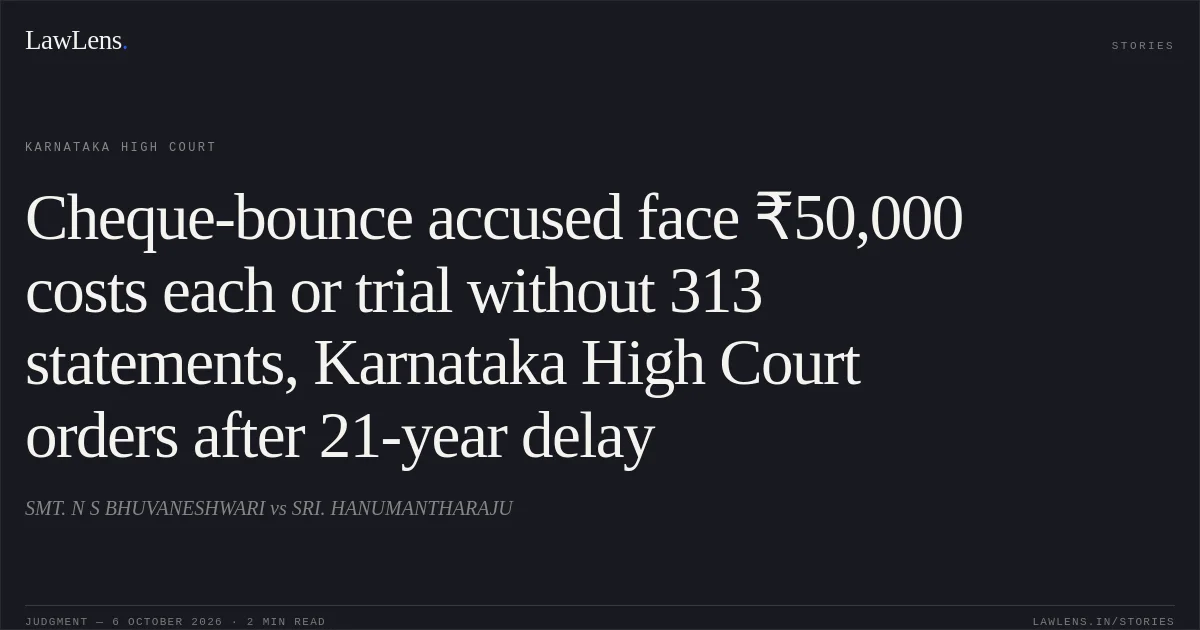
The High Court dismissed both petitions and upheld the orders rejecting discharge.
pp. 14–15 · ¶ 15It imposed costs of ₹50,000 on each petitioner, payable to the trial court within one week; if unpaid, the trial court was directed to dispense with recording the petitioners’ Section 313 statements, applying Sunil Yadav, and to include the costs while imposing the time and sentence. The trial court was directed to dispose of the cases within one month
pp. 14–15 · ¶ 15Original Court PDF
SMT. N S BHUVANESHWARIvsSRI. HANUMANTHARAJU
Click to open original judgment
Original judgment, available to read, download and summarize on LawLens.in