01Facts
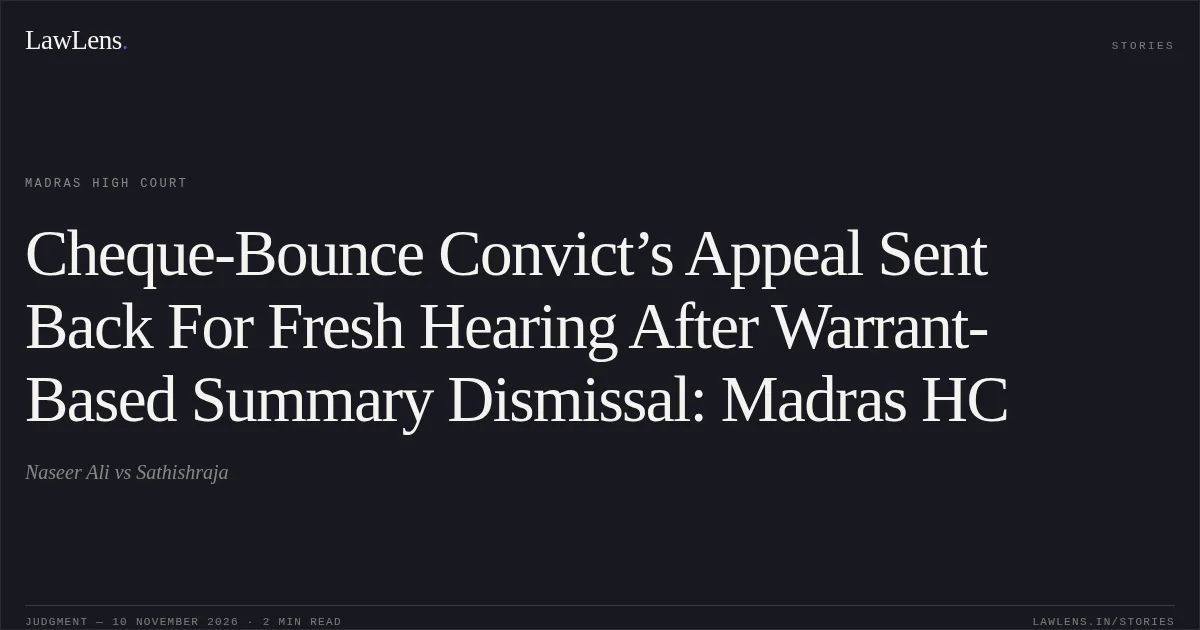
The respondent filed a complaint under Section 138 of the Negotiable Instruments Act, 1881, against the petitioner, who was convicted and sentenced by the Judicial Magistrate, Lalgudi, in STC No. 160 of 2020.
¶ 5 · p. 2The petitioner appealed in C.A. No. 170 of 2025. The appellate court dismissed the appeal, recording that the appellant was absent and referring to a High Court order directing the police to take steps to execute the trial court’s warrant; it did not state whether the dismissal was for non-prosecution, pursuant to that order, or summarily.
¶ 5, 11–12 · pp. 2–3The petitioner challenged the dismissal in revision.
¶ 6 · p. 302Issues
i.Whether the appellate court could dismiss the criminal appeal without deciding it on the merits or providing the hearing required by law.
¶ 10 · p. 3 · ¶ 13–16 · pp. 4–6ii.Whether the High Court’s direction to execute the trial court’s warrant justified dismissal of the appeal.
¶ 14 · p. 603Law Applied
Sections 423, 425 and 426 of the Bharatiya Nagarik Suraksha Sanhita, 2023, govern the filing, summary dismissal and hearing of criminal appeals; an appeal cannot be summarily dismissed without giving the appellant a reasonable opportunity of being heard, and an appeal admitted with notice served cannot be dismissed summarily under Section 425.
¶ 15 · p. 6Relying on Bani Singh v. State of U.P., (1996) 4 SCC 720, the Court stated that a criminal appeal is not to be dismissed for default or non-prosecution simpliciter, but must be considered on its merits after scrutiny of the record.
¶ 13(a), (d) · pp. 4–5It also relied on Madan Lal Kapoor v. Rajiv Thapar, (2007) 3 SCC (Cri) 437, for the principle that a criminal matter must be decided on the merits, and K.S. Panduranga v. State of Karnataka, (2013) 3 SCC 721, which affirms that an appellate court may decide an appeal on the record in the absence of the appellant, but cannot dismiss it for non-prosecution without examining the merits.
¶ 13(b)–(c) · pp. 5–6Provisions in the judgment · 5 · Linked ones open on LawLens
Bharatiya Nagarik Suraksha Sanhita, 2023 Section 438Section 442Section 385Section 386
Negotiable Instruments Act, 1881 Section 138
04Reasoning
The appellate court’s brief order did not disclose a merits assessment and left unclear the basis for dismissal.
¶ 11–12 · pp. 3–4If the appeal was dismissed for non-prosecution, that was inconsistent with the rule requiring consideration of the appeal on its merits.
¶ 14 · p. 6If it was dismissed because of the High Court’s warrant-execution direction, that direction concerned execution of the warrant and did not direct dismissal of the appeal; moreover, the petitioner was not a party to that proceeding.
¶ 14 · p. 6If it was a summary dismissal, the statutory requirement of a reasonable opportunity of hearing applied.
¶ 15 · p. 6The dismissal was therefore erroneous and perverse.
¶ 16 · p. 605Holding
The Court allowed the criminal revision, set aside the appellate court’s judgment dated 12 December 2025, and remanded C.A. No. 170 of 2025 to that court for disposal in accordance with law within three months of receipt of the order.
¶ 17 · p. 6The connected miscellaneous petitions were closed.
¶ 18 · p. 7Original Court PDF
Naseer AlivsSathishraja
Click to open original judgment
Original judgment, available to read, download and summarize on LawLens.in