01Facts
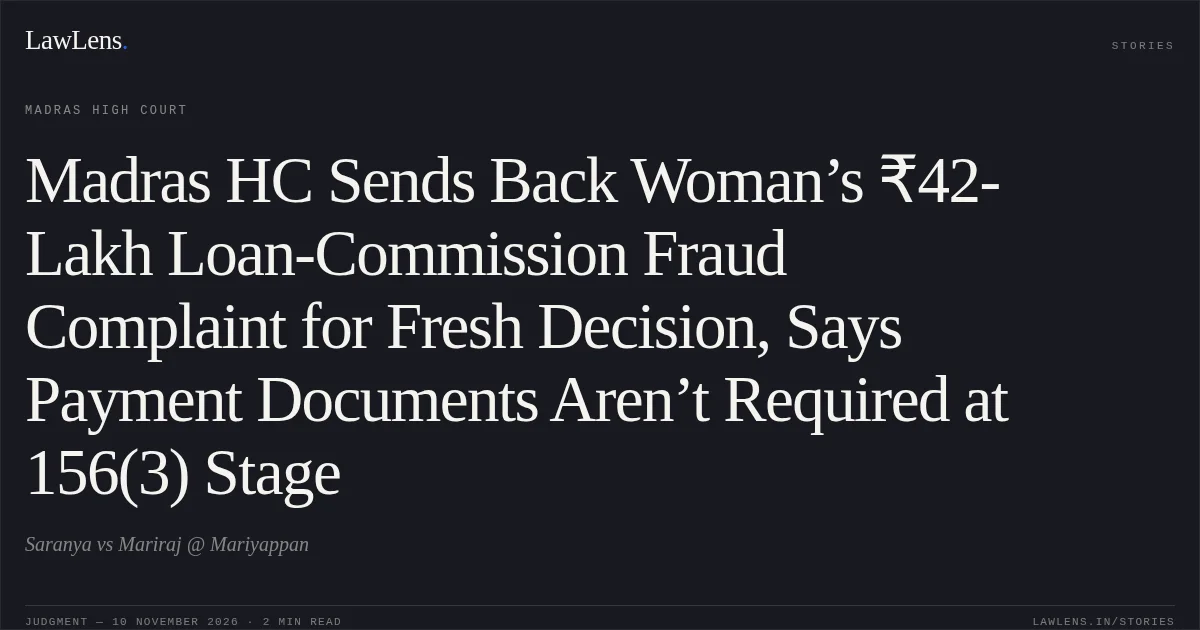
The petitioner alleged that respondents 1–5 had obtained ₹42 lakh from her as commission for arranging a ₹5 crore SBI loan to establish a textile industry, but did not arrange the loan; she further alleged that they threatened and abused her when she sought repayment.
pp. 2–4She applied to the Judicial Magistrate under Section 156(3) CrPC, alleging offences under Sections 120B, 420, 452, 294(b) and 506(i) IPC.
pp. 2–4Following an enquiry, the police recommended dismissal on the basis that the dispute was civil in nature. The Magistrate dismissed the application, citing the petitioner’s failure to produce documents showing payment and the pendency of a civil suit. The petitioner challenged that order in revision
pp. 2–4, 502Issues
i.1. Whether the Magistrate could dismiss the Section 156(3) CrPC application because the petitioner had not produced documentary evidence of the alleged ₹42 lakh payment
¶ 11, 12–13 · pp. 5–9ii.2. Whether the pending civil suit justified dismissing the application on the ground that the dispute was civil in nature
¶ 11, 12, 14 · p. 5, 9iii.3. Whether the Magistrate’s order, made after relying on the police report, warranted interference in revision
¶ 15–16 · p. 1003Law Applied
Section 154 CrPC requires information disclosing a cognizable offence to set the criminal law in motion; it does not require the informant to establish the allegation with documentary evidence at that stage.
¶ 13(1) · pp. 5–6Under Section 156(3) CrPC, a Magistrate may order police investigation before taking cognizance, and the application need only disclose a cognizable offence; investigation is the process of collecting evidence, as reflected in Section 2(h) CrPC.
¶ 13(2), (4)–(5) · p. 6, 8Relying on Madhao v. State of Maharashtra, (2013) 5 SCC 615, the Court stated that a Magistrate has discretion to refer a complaint for investigation under Section 156(3) where that course is conducive to justice, before taking cognizance.
¶ 13(3) · pp. 7–8Provisions in the judgment · 4 · Linked ones open on LawLens
Bharatiya Nagarik Suraksha Sanhita, 2023 Section 438Section 442
Code of Criminal Procedure, 1973 Section 156Section 190
04Reasoning
The Magistrate dismissed the application because the petitioner had not documented the alleged transfer and because a civil suit was pending.
¶ 12 · p. 5The High Court held that requiring documentary proof at the Section 156(3) stage was erroneous: the application sought an investigation to collect evidence and alleged cognizable offences.
¶ 13(5)–(6) · p. 8It also found that the civil suit was for an injunction concerning possession and alleged unlawful collection of money, not a money suit concerning the transactions alleged in the complaint; its pendency therefore did not justify dismissal.
¶ 14(1)–(3) · p. 9The Magistrate had, moreover, been unduly influenced by the police report rather than independently applying judicial mind.
¶ 15 · p. 1005Holding
The High Court allowed the revision, set aside the Magistrate’s order and remanded the Section 156(3) CrPC application for disposal in accordance with law.
¶ 16–17 · p. 10It directed the Magistrate to complete the exercise within three months of receiving the order and without being influenced by the High Court’s observations.
¶ 16–17 · p. 10Original Court PDF
SaranyavsMariraj @ Mariyappan
Click to open original judgment
Original judgment, available to read, download and summarize on LawLens.in