01Facts
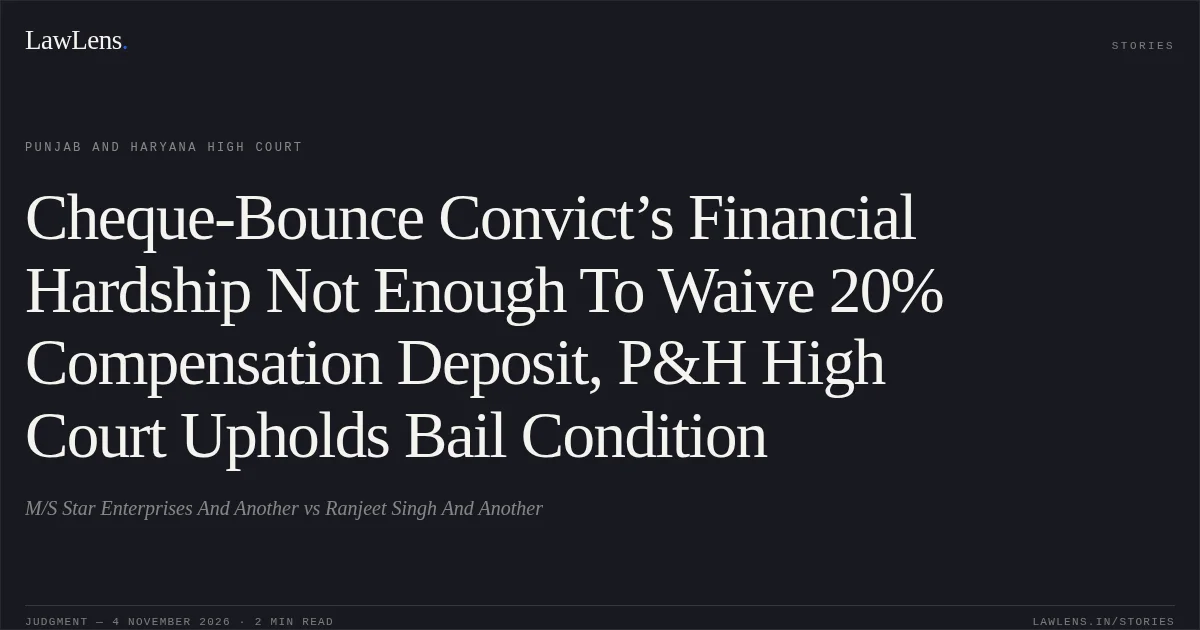
The petitioners challenged an order of the Additional Sessions Judge, Kurukshetra, dated 23 December 2025, directing the appellant-convict to deposit 20% of the trial court’s compensation award of ₹5,00,000 within 60 days under Section 148 of the Negotiable Instruments Act, 1881 (NI Act).
pp. 1–2The appellate court suspended the sentence and granted bail but declined to waive or reduce the deposit.
pp. 1–2Before the High Court, the petitioners relied on financial incapacity, disputed liability and alleged misuse of the cheque, and argued that the appellate court had not given specific reasons for rejecting an exception to the deposit requirement.
pp. 2–302Issues
i.Whether the petitioners established exceptional circumstances warranting waiver or reduction of the 20% deposit required under Section 148 of the NI Act.
pp. 2–3, 6–7ii.Whether the appellate court’s deposit condition warranted interference because it would cause undue hardship or effectively deprive the petitioners of their right to appeal.
p. 3, 703Law Applied
Section 148 of the NI Act empowers an appellate court hearing an appeal against conviction under Section 138 to direct the appellant to deposit at least 20% of the fine or compensation.
In Jamboo Bhandari v. M.P. State Industrial Development Corporation Ltd. & Ors., (2023) 10 SCC 446, the Supreme Court held that the deposit is ordinarily appropriate, but an exception may be made where it would be unjust or would effectively deprive the appellant of the right of appeal; the appellate court must record reasons for finding such exceptional circumstances.
pp. 4–5Muskan Enterprises & Anr. v. State of Punjab, 2024 INSC 1046, likewise recognises the appellate court’s discretion not to order a deposit in an exceptional case, for recorded reasons.
pp. 5–6The petition was brought under Section 528 of the Bharatiya Nagarik Suraksha Sanhita, 2023; the challenged appellate order referred to Section 430 BNSS in granting suspension of sentence.
pp. 1–2Provisions in the judgment · 6 · Linked ones open on LawLens
Bharatiya Nagarik Suraksha Sanhita, 2023 Section 528Section 430
Code of Criminal Procedure, 1973 Section 482Section 389
Negotiable Instruments Act, 1881 Section 148Section 138
04Reasoning
The High Court applied the Supreme Court authorities to conclude that waiver is exceptional and must be supported by cogent material.
pp. 6–7The petitioners’ asserted financial difficulty did not, by itself, establish exceptional circumstances; nor did the disputed liability and alleged cheque misuse demonstrate that requiring the deposit would be unjust or effectively extinguish the right of appeal.
pp. 6–7The Court therefore found no legal infirmity warranting interference with the appellate court’s order.
p. 705Holding
The High Court dismissed the petition and declined to quash or modify the direction to deposit 20% of the compensation amount.
p. 7Any pending applications were also disposed of, with the Court clarifying that its observations did not express an opinion on the merits of the pending appeal.
p. 7Original Court PDF
M/S Star Enterprises And AnothervsRanjeet Singh And Another
Click to open original judgment
Original judgment, available to read, download and summarize on LawLens.in