Facts
The petitioners, including Gopal Aromatic Private Limited, manufacture and sell chewing tobacco, including flavoured, scented or additive-containing products.
Source reference: paras. 1–3; pp. 1–4They challenged Notification No.2065/H&F.W. dated 21 January 2026 issued by the Health and Family Welfare Department, Odisha, which prohibited the manufacture, processing, packaging, storage, transportation, distribution and sale of food products containing tobacco or nicotine, including products described as gutkha, pan masala and flavoured or scented chewable products.
Source reference: paras. 1–3; pp. 1–4During the ensuing proceedings, GST authorities referred to the Notification and issued communications and show-cause notices concerning cancellation of GST registrations.
Source reference: para. 3(iv); p. 3Issues
Whether chewing tobacco falls within the statutory definition of “food” under Section 3(1)(j) of the FSSA?
Source reference: para. 7(i); pp. 29–36Whether Regulation 2.3.4 applies to chewing tobacco as an independent product, or is confined to tobacco or nicotine used as an ingredient in another food product?
Source reference: para. 7(ii); pp. 36–38Whether the Notification issued by invoking Section 30(2)(d) of the FSSA was within the statutory power of the Commissioner of Food Safety, and whether the one-year limitation under Section 30(2)(a) applied?
Source reference: para. 7(iii); pp. 38–41Whether regulation of chewing tobacco under COTPA excluded or restricted the application of the FSSA and Regulation 2.3.4?
Source reference: para. 7(iv); pp. 41–48Whether the Notification violated Articles 14, 19(1)(g) and 21 of the Constitution, or was vitiated by non-compliance with Section 18 of the FSSA and principles of natural justice?
Source reference: paras. 49–60; pp. 47–52Law Applied
Section 3(1)(j) of the FSSA defines “food” broadly as any substance intended for human consumption, and Section 3(1)(y) defines an “ingredient” as any substance used in the manufacture or preparation of food and present in the final product.
Source reference: paras. 8, 23; pp. 30, 36–37Regulation 2.3.4 prohibits tobacco and nicotine from being used as ingredients in any food product.
Source reference: paras. 21–25; pp. 36–38Section 30(2)(a) permits a public-health prohibition on an article of food for a period not exceeding one year, whereas Section 30(2)(d) authorises measures for efficient and uniform implementation of standards and other statutory requirements.
Source reference: paras. 28–33; pp. 38–40Section 89 of the FSSA gives the Act overriding effect over inconsistent laws, although concurrent operation with COTPA is preferred where reconciliation is possible.
Source reference: paras. 42–45; pp. 43–46The Court relied on Pyarali K. Tejani v. Mahadeo Ramchandra Dange, Godawat Pan Masala Products (P) Ltd. v. Union of India and State of T.N. v. R. Krishnamurthy for a broad statutory understanding of “food”.
Source reference: paras. 12–15; pp. 31–34The Court also applied Ram Nath v. State of Uttar Pradesh on the overriding effect of Section 89.
Source reference: para. 42; pp. 43–44Reasoning
The Court held that the expression “any substance intended for human consumption” in Section 3(1)(j) was wider than the ordinary nutritional meaning of food.
Source reference: paras. 10–20; pp. 30–36The express inclusion of chewing gum demonstrated that swallowing an article or deriving nutritive value from it was not essential; accordingly, chewing tobacco intended to be chewed and consumed orally was not excluded from “food”.
Source reference: paras. 10–20; pp. 30–36Applying Section 3(1)(y), the Court reasoned that tobacco used in manufacturing chewing tobacco and remaining in the final product was an “ingredient”, even if it constituted the predominant component.
Source reference: paras. 21–27; pp. 36–38Regulation 2.3.4 therefore applied to manufactured chewing tobacco itself.
Source reference: paras. 21–27; pp. 36–38The Notification did not create a fresh prohibition under Section 30(2)(a); it implemented the pre-existing prohibition in Regulation 2.3.4 through Section 30(2)(d).
Source reference: paras. 28–35; pp. 38–41COTPA and the FSSA were capable of substantial concurrent operation: COTPA regulates tobacco-control matters, while the FSSA governs food safety where its statutory conditions are met.
Source reference: paras. 36–48; pp. 41–47The distinction between smokeless tobacco intended for oral consumption and smoking products intended for combustion and inhalation was held rational for purposes of Regulation 2.3.4, and the public-health objective supported the restriction under Articles 14 and 19(6).
Source reference: paras. 49–57; pp. 47–51Since the Notification implemented an existing statutory regulation rather than formulated a new substantive prohibition, a separate pre-notification hearing or fresh risk assessment was not required, without prejudice to procedural safeguards in subsequent individual proceedings.
Source reference: paras. 59–60; pp. 51–52Holding
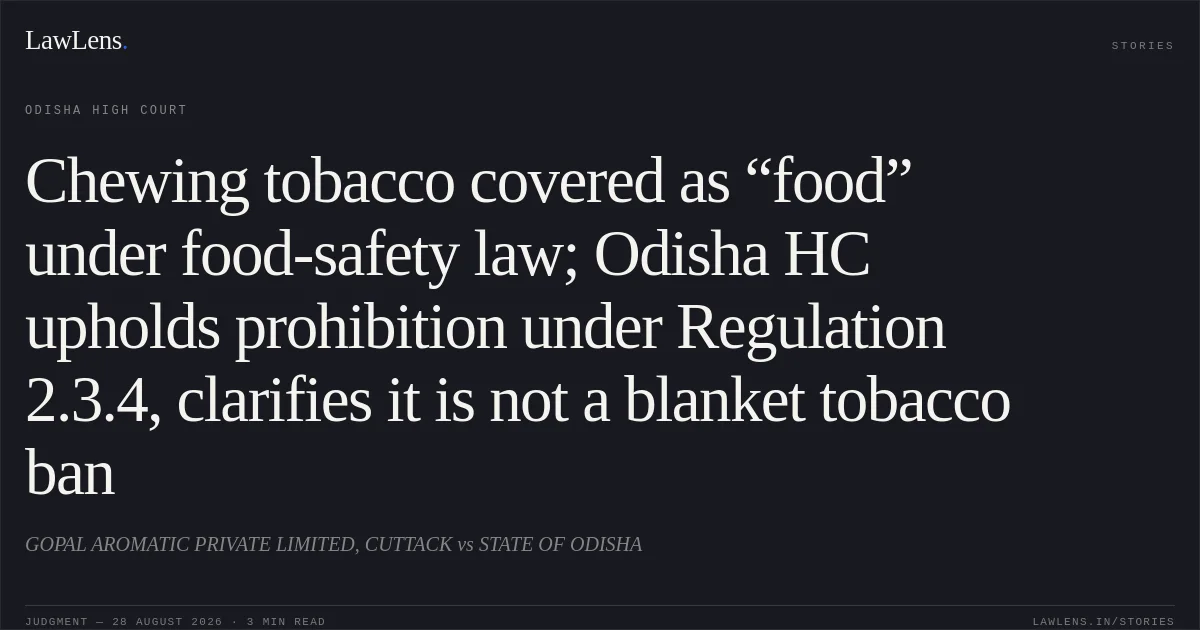
The Court upheld Notification No.2065/H&F.W. dated 21 January 2026 and dismissed all connected writ petitions.
It held that manufactured or processed chewing tobacco intended for human consumption falls within the FSSA definition of “food” and is subject to Regulation 2.3.4 as a product containing tobacco used as an ingredient.
Source reference: paras. 20, 27; pp. 36, 38However, the Notification was expressly confined to implementing Regulation 2.3.4 and could not be construed as an independent or general prohibition on tobacco or tobacco products dehors the FSSA.
Source reference: paras. 35, 65; pp. 40–54GST proceedings were left to be decided independently under the applicable GST laws, with all objections of the petitioners kept open; any interim order stood vacated.
Source reference: paras. 62, 66–68; pp. 52–54Acts & Sections Cited
21 provisions across 5 statutes referred to in this judgment. Each provision opens on LawLens.
Food Safety and Standards Act, 20068
Cigarettes and Other Tobacco Products (Prohibition of Advertisement and Regulation of Trade and Commerce, Production, Supply and Distribution) Act, 2003
Industries (Development and Regulation) Act, 19511
Central Sales Tax Act, 19561
Indian Penal Code, 18602
Original Court PDF
GOPAL AROMATIC PRIVATE LIMITED, CUTTACKvsSTATE OF ODISHA
Click to open original judgment
Original judgment, available to read, download and summarize on LawLens.in
![Courts will not interfere with transfers absent mala fides or violation of statutory rules.. M Ramya vs EMPLOYEES STATE INSURANCE CORPORATION (ESIC). CAT - ['Chennai']. LawLens](/stories/thumbnails/courts-will-not-interfere-with-transfers-absent-mala-fides-or-violation-of-statutory-rules-a6845e9ca6f548fca284c51c8351957f.webp)
![Courts cannot direct one-time recruitment age relaxation absent authority in the governing rules or advertisement.. UT OF PUDUCHERRY vs M ANDAL. CAT - ['Chennai']. LawLens](/stories/thumbnails/courts-cannot-direct-one-time-recruitment-age-relaxation-absent-authority-in-the-governing-895d78fde47143e2a8ed0207c4b6a44f.webp)
![A review cannot correct an allegedly erroneous decision absent an error apparent on the record.. Ajit Kumar Jha vs RAILWAY BOARD. CAT - ['Delhi']. LawLens](/stories/thumbnails/a-review-cannot-correct-an-allegedly-erroneous-decision-absent-an-error-apparent-on-the-re-8ac952fd4eba470c92f7da20af72a220.webp)