Facts
The petitioner was elected President of Nagar Panchayat, Bilaigarh, in February 2025.
Source reference: para. 2–8Following complaints that he and his wife had subdivided and sold agricultural land as residential plots without the required permissions, municipal and revenue authorities conducted inquiries.
Source reference: para. 2–8The State Government issued notices and, by order dated 4 July 2026 under Section 41-A of the Chhattisgarh Municipalities Act, 1961, removed the petitioner and disqualified him from holding the office for the next term.
Source reference: para. 2–8The petitioner also challenged a separate order dated 24 April 2026 imposing a monetary demand and penalty under Section 339(C).
Source reference: para. 2–8He argued, among other things, that the allegations concerned pre-election conduct and that the inquiry material had not been supplied to him.
Source reference: para. 2–8The State relied also on the petitioner’s alleged refusal, during his tenure, to permit a municipal agenda concerning consequential proceedings on the penalty order to proceed.
Source reference: para. 105–106Issues
Whether the State Government could consider antecedent conduct under Section 41-A, or whether doing so impermissibly amounted to questioning the petitioner’s election outside the election-petition procedure under Section 20.
Source reference: para. 35–42, 47–52Whether the petitioner received the reasonable and effective opportunity of hearing required by Section 41-A, including adequate notice of the case and access to relied-upon material.
Source reference: para. 40, 53–65Whether the removal order was otherwise invalid for non-compliance with the Rules of Business, and whether the challenge to the separate Section 339(C) order could be entertained despite the statutory appeal.
Source reference: para. 39–40, 78–80, 95Law Applied
Section 20 of the Chhattisgarh Municipalities Act, 1961 provides the prescribed procedure for calling an election or nomination into question; Section 41-A separately authorises removal where the State Government considers an office-bearer’s continuance undesirable in the public or Council’s interest, or where another statutory ground is established, and permits consequential disqualification for the next term, subject to a reasonable opportunity of hearing.
Source reference: para. 36–38Section 41-A cannot be used to annul an election in place of an election petition, but antecedent conduct may be considered if it has a legitimate nexus to a statutory ground for removal.
Source reference: para. 48–50Sharda Kailash Mittal v. State of M.P., (2010) 2 SCC 319, and Ravi Yashwant Bhoir v. District Collector, Raigad, (2012) 4 SCC 407, require strong reasons and strict procedural fairness when removing an elected representative; Tarlochan Dev Sharma v. State of Punjab, (2001) 6 SCC 260, cautions against removal for an isolated or minor lapse.
Source reference: para. 44–46, 70–72Oryx Fisheries Pvt. Ltd. v. Union of India, (2010) 13 SCC 427, and Gorkha Security Services v. Government (NCT of Delhi), (2014) 9 SCC 105, require notice that enables the affected person to understand and answer the case against them.
Source reference: para. 57–59The Court also considered the Rules of Business direction concerning Section 41-A removal cases and the principles in MRF Ltd. v. Manohar Parrikar, (2010) 11 SCC 374, on compliance with those Rules.
Source reference: para. 39, 78–80An alternative statutory appeal ordinarily should be pursued where disputed factual and monetary issues are involved.
Source reference: para. 76–77Reasoning
The Court held that the State had not purported to invalidate the petitioner’s election; it had acted on the question of his continuance in office under Section 41-A.
Source reference: para. 53–65, 68–69, 92–94Accordingly, the absence of an election petition did not bar consideration of antecedent conduct, provided that conduct was connected to a statutory removal ground.
Source reference: para. 53–65, 68–69, 92–94The Court found that the petitioner had received notices, submitted detailed replies, and attended personal hearings; his replies showed familiarity with the allegations and the Court found no specific consequential prejudice from the non-supply of every inquiry document.
Source reference: para. 53–65, 68–69, 92–94The Court also relied on material concerning the petitioner’s alleged involvement in the land transactions and his subsequent refusal to allow a related municipal agenda to proceed, treating the latter as conduct during his tenure relevant to the functioning of the Council.
Source reference: para. 73, 105–106It rejected the Rules of Business challenge because the petitioner had not established actual non-compliance, and declined to determine the disputed monetary demand under Section 339(C) in the absence of recourse to the statutory appeal.
Source reference: para. 78–80, 95Holding
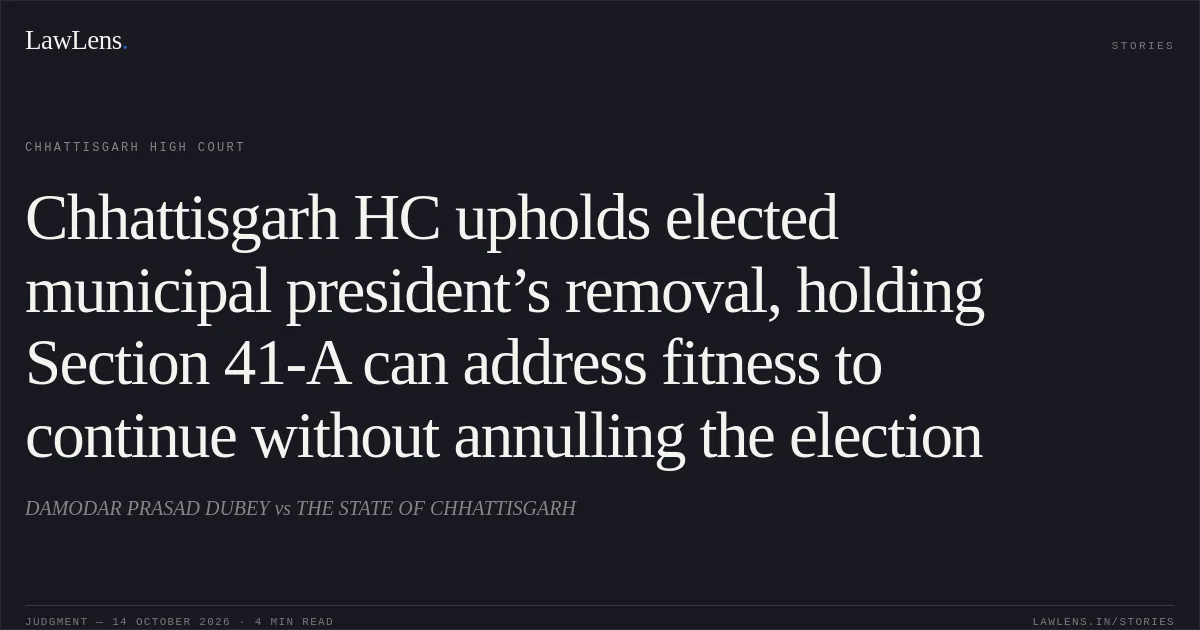
The Court held that the State Government’s order dated 4 July 2026 was not shown to be without jurisdiction, procedurally unfair, or an impermissible adjudication of the petitioner’s election.
It dismissed the writ petition and upheld the petitioner’s removal and disqualification for the next term under Section 41-A.
Source reference: para. 96, 107–108The challenge to the Section 339(C) order was not entertained; the petitioner was left at liberty to pursue the statutory appeal, which the appellate authority was directed to consider independently and in accordance with law.
Source reference: para. 109–110Acts & Sections Cited
2 provisions across 1 statute referred to in this judgment. Each provision opens on LawLens.
Chhattisgarh Municipalities Act 19612
Original Court PDF
DAMODAR PRASAD DUBEYvsTHE STATE OF CHHATTISGARH
Click to open original judgment
Original judgment, available to read, download and summarize on LawLens.in