Facts
The petitioners, residents of District Bemetara, sought admission for their children in Lower Kindergarten (LKG) classes at Swami Atmanand Excellent English Medium Schools.
Source reference: para. 1; pp. 3–4They alleged that, although LKG admissions were being conducted in other districts of Chhattisgarh, the authorities in Bemetara had not commenced LKG classes, thereby denying children in the district access to State-sponsored English-medium foundational education.
Source reference: para. 1; pp. 3–4The petitioners relied upon communications dated 27 February 2026 issued by the District Education Officer and 28 February 2026 issued by the concerned Headmaster/Principal, which indicated that LKG classes could not commence due to non-availability of infrastructure, sanctioned staff and budgetary allocation.
Source reference: para. 3; p. 7; para. 6; p. 10The State defended the position on the ground that the opening of LKG classes depended upon policy, local feasibility, staffing and available funds, and that Article 21-A and the Right of Children to Free and Compulsory Education Act, 2009 principally concerned elementary education for children aged six to fourteen years.
Source reference: para. 4; pp. 8–10Issues
Whether the State authorities could deny or fail to commence LKG classes in District Bemetara when comparable LKG facilities were being provided under the Swami Atmanand Scheme in other districts of Chhattisgarh?
Source reference: paras. 6–9; pp. 10–14Whether such district-wise denial of access to State-sponsored pre-primary English-medium education violated the constitutional guarantees of equality and the right to education under Articles 14 and 21 of the Constitution?
Source reference: paras. 1, 6–9; pp. 3–4, 10–14Whether the Court could issue a mandamus directing the State to commence LKG classes despite the State’s reliance on policy discretion, budgetary limitations and the absence of a specific statutory obligation to provide pre-primary education?
Source reference: paras. 4, 7, 9–10; pp. 8–10, 11–15Law Applied
The Court applied Article 14 of the Constitution, which prohibits arbitrary and discriminatory State action, together with Articles 21 and 21-A, which underpin the constitutional commitment to educational opportunity and free and compulsory education for children aged six to fourteen years.
Source reference: paras. 1, 6–9; pp. 3–4, 10–14It relied upon the Right of Children to Free and Compulsory Education Act, 2009, particularly Sections 3, 6, 7 and 8, concerning the right to free and compulsory elementary education, establishment of neighbourhood schools, financial responsibility and the State’s duty to ensure school availability.
Source reference: para. 8; pp. 11–13Section 11 was invoked in relation to the statutory recognition of early childhood care and pre-school education.
Source reference: para. 1; p. 4The Court further relied on Dinesh Biwaji Ashtikar v. State of Maharashtra, reported in (2026) 7 SCC 267, which emphasised that implementation of the constitutional and statutory right to education is a duty of the appropriate Government and local authorities, and that courts should facilitate effective access to educational remedies.
Source reference: para. 8; pp. 11–14The governing principle applied was that, once the State formulates and implements a beneficial educational policy across the State, it cannot arbitrarily withhold its benefits from a particular district or region.
Source reference: paras. 6–9; pp. 10–14Reasoning
The Court found that the respondents’ own communications established that LKG classes had not been commenced because of deficient infrastructure, staffing and budgetary allocation, rather than because of any distinct educational or administrative justification applicable to Bemetara.
Source reference: para. 6; p. 10Since LKG facilities under the Swami Atmanand Scheme were available in other districts, the selective non-implementation of the scheme in Bemetara amounted to territorial discrimination and unequal access to a State-sponsored educational benefit.
Source reference: paras. 6–7; pp. 10–11Although the State correctly contended that Article 21-A and the RTE Act primarily guarantee elementary education for children aged six to fourteen years, the Court held that the State’s voluntary decision to provide pre-primary education through its institutions had to be implemented uniformly and non-arbitrarily.
Source reference: paras. 4, 7, 9; pp. 8–10, 11–14Budgetary and staffing constraints could not justify denying the benefit of the State’s welfare scheme to an entire district, particularly where the State had already adopted a policy of providing English-medium education through Swami Atmanand Schools throughout Chhattisgarh.
Source reference: paras. 6, 9; pp. 10–14Holding
The writ petition was allowed.
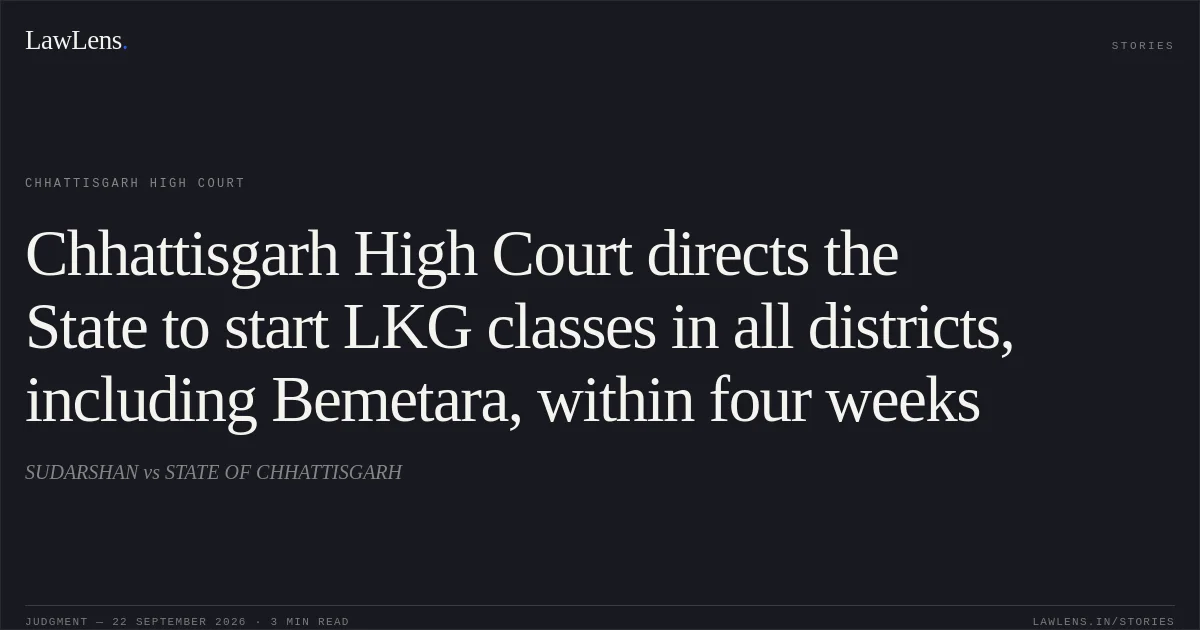
The Court directed the State Government and the concerned authorities to commence LKG classes throughout all districts of Chhattisgarh, specifically including District Bemetara and Swami Atmanand Excellent English Medium School, Rajamohgaon, Block Saja.
Source reference: para. 10(1); pp. 14–15The authorities were directed to complete the necessary infrastructure, staffing, arrangements and admissions within four weeks from receipt of the order so that the academic interests of the children were not adversely affected during the current academic session.
Source reference: para. 10(2); p. 15The Court further directed that students of Bemetara be placed on an equal footing with students of other districts in accessing State-sponsored pre-primary English-medium education, without discrimination.
Source reference: para. 10(3); p. 15Acts & Sections Cited
7 provisions across 1 statute referred to in this judgment. Each provision opens on LawLens.
Right of Children to Free and Compulsory Education Act, 20097
Original Court PDF
SUDARSHANvsSTATE OF CHHATTISGARH
Click to open original judgment
Original judgment, available to read, download and summarize on LawLens.in