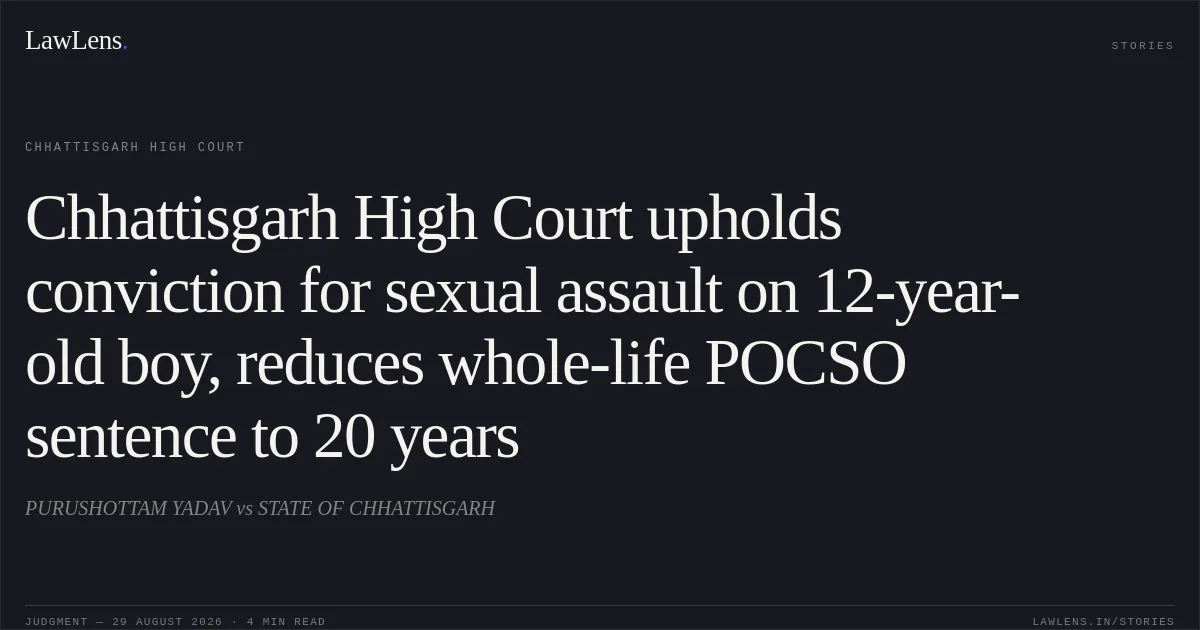
Facts
On 15 October 2019, the minor male victim, aged approximately 12 years and 11 months, alleged that the appellant took him near a cremation ground, removed his clothes, inserted his penis into the victim’s mouth, assaulted him, and threatened to kill him if he disclosed the incident.
Source reference: para. 2The victim informed his parents the following day, following which the FIR was registered for offences under Sections 377 and 506 IPC and Section 4 of the POCSO Act.
Source reference: para. 2The victim’s medical examination revealed an abrasion on his right forearm, while the appellant was found capable of performing sexual intercourse.
Source reference: para. 2The prosecution relied, inter alia, on the victim’s statements, the Section 164 CrPC statement, school records showing his date of birth as 22 October 2006, medical evidence, and seized clothing.
Source reference: paras. 2–4The Trial Court convicted the appellant under Sections 377, 323 and 506 IPC and Section 4 of the POCSO Act, sentencing him to life imprisonment under Sections 377 IPC and 4 POCSO, with the sentences to run concurrently.
Source reference: paras. 1, 4–6The appellant challenged both his conviction and sentence in appeal.
Source reference: no citationIssues
1. Whether the prosecution proved that the victim was below 18 years of age, and specifically below 16 years of age, on the date of the incident so as to attract the POCSO Act and Section 4(2) thereof
Source reference: paras. 10–14, 242. Whether the testimony of the victim, supported by the surrounding evidence, established the commission of penetrative sexual assault and the offence under Section 377 IPC beyond reasonable doubt
Source reference: paras. 15–253. Whether the evidence established the offences under Sections 323 and 506 IPC
Source reference: para. 264. Whether the life sentences imposed under Section 377 IPC and Section 4 of the POCSO Act were legally and proportionately appropriate in the circumstances of the case
Source reference: paras. 28–30Law Applied
The Court applied Section 377 IPC, which criminalises voluntary carnal intercourse against the order of nature and treats penetration as sufficient to constitute the offence.
Source reference: para. 22It applied Sections 3 and 4 of the POCSO Act: Section 3 includes penetration of the penis, to any extent, into a child’s mouth, while Section 4(2) prescribes a minimum sentence of twenty years where penetrative sexual assault is committed against a child below sixteen years of age.
Source reference: para. 24The Court relied on Jarnail Singh v. State of Haryana, (2013) 7 SCC 263, for the principle that a child’s age may be determined primarily from reliable school or equivalent records, with medical evidence considered only in their absence.
Source reference: para. 14It further relied on Childline India Foundation v. Allan John Waters, (2011) 6 SCC 261, for the ingredients of Section 377 IPC—carnal intercourse and conduct against the order of nature—and on Santosh Prasad v. State of Bihar, (2020) 3 SCC 443, concerning reliance on the consistent testimony of a “sterling witness”.
Source reference: paras. 16, 23For sentencing, the Court applied the proportionality principles stated in Raj Bala v. State of Haryana, (2016) 1 SCC 463, including the requirement that punishment be just, proportionate, and based on the facts and circumstances of the offence.
Source reference: paras. 29–30Reasoning
The Court accepted the school record and primary school certificate recording the victim’s date of birth as 22 October 2006, noting that the entries pre-dated the incident and that the defence did not effectively challenge their correctness; the victim’s and his parents’ unrebutted evidence regarding his age further corroborated the records.
Source reference: paras. 11–13On the substantive offence, the Court found the victim’s account consistent in the FIR, his Section 164 CrPC statement, and his deposition.
Source reference: para. 15His explanation that he attempted to escape, was caught and dragged, shouted for help, sustained an abrasion, and later disclosed the incident due to fear was not materially shaken in cross-examination.
Source reference: para. 15The Court treated the victim as a reliable or “sterling” witness and held that his testimony did not require further corroboration, although it was supported by the parents’ evidence and the medical finding of injury.
Source reference: paras. 16–20The absence of semen or spermatozoa on the seized underwear did not undermine the prosecution case because the alleged act involved oral penetration and the victim had stated that he escaped from the spot.
Source reference: para. 21The Court therefore held that the ingredients of Section 377 IPC and penetrative sexual assault under Section 3 read with Section 4 of the POCSO Act were proved.
Source reference: para. 25The abrasion supported the conviction under Section 323 IPC, while the appellant’s threat to kill the victim if he disclosed the incident established Section 506 IPC.
Source reference: paras. 25–26However, considering the statutory sentencing framework and the proportionality principle, the Court found it appropriate to substitute the life sentences with fixed terms of imprisonment.
Source reference: paras. 28–30Holding
The appeal was partly allowed.
The convictions under Sections 377, 323 and 506 IPC were affirmed, and the conviction under the POCSO Act was modified to Section 4(2).
Source reference: paras. 27, 30The sentence under Section 377 IPC was reduced from life imprisonment to rigorous imprisonment for ten years with a fine of ₹1,000, and the sentence under Section 4(2) of the POCSO Act was fixed at rigorous imprisonment for twenty years with a fine of ₹1,000.
Source reference: para. 30The sentences under Sections 323 and 506 IPC—six months’ imprisonment and fines of ₹100 each—were maintained.
Source reference: para. 30All sentences were directed to run concurrently, subject to the applicable default sentences.
Source reference: para. 30The appellant, who had been in custody since 17 October 2019, was directed to serve the modified sentence, and the Registry was directed to communicate the judgment to the Jail Superintendent and return the records to the Trial Court.
Source reference: paras. 31–33Acts & Sections Cited
11 provisions across 3 statutes referred to in this judgment. Each provision opens on LawLens.
Code of Criminal Procedure, 19734
Indian Penal Code, 18603
Original Court PDF
PURUSHOTTAM YADAVvsSTATE OF CHHATTISGARH
Click to open original judgment
Original judgment, available to read, download and summarize on LawLens.in
![A police constable cannot be removed for unauthorized absence without a Rule 359-compliant inquiry.. Mohammad Sidiq Khan vs D/o Home Ut Of Jammu & Kashmir. CAT - ['Srinagar']. LawLens](/stories/thumbnails/a-police-constable-cannot-be-removed-for-unauthorized-absence-without-a-rule-359-compliant-7b43fc316bd94f22a62676153bbc9d54.webp)
![A Review DPC lacks authority to determine or alter inter se seniority.. SAURABH KUMAR vs REVENUE. CAT - ['Patna']. LawLens](/stories/thumbnails/a-review-dpc-lacks-authority-to-determine-or-alter-inter-se-seniority-4b21640f20af46fcabdfc8273d2ce959.webp)