01Facts
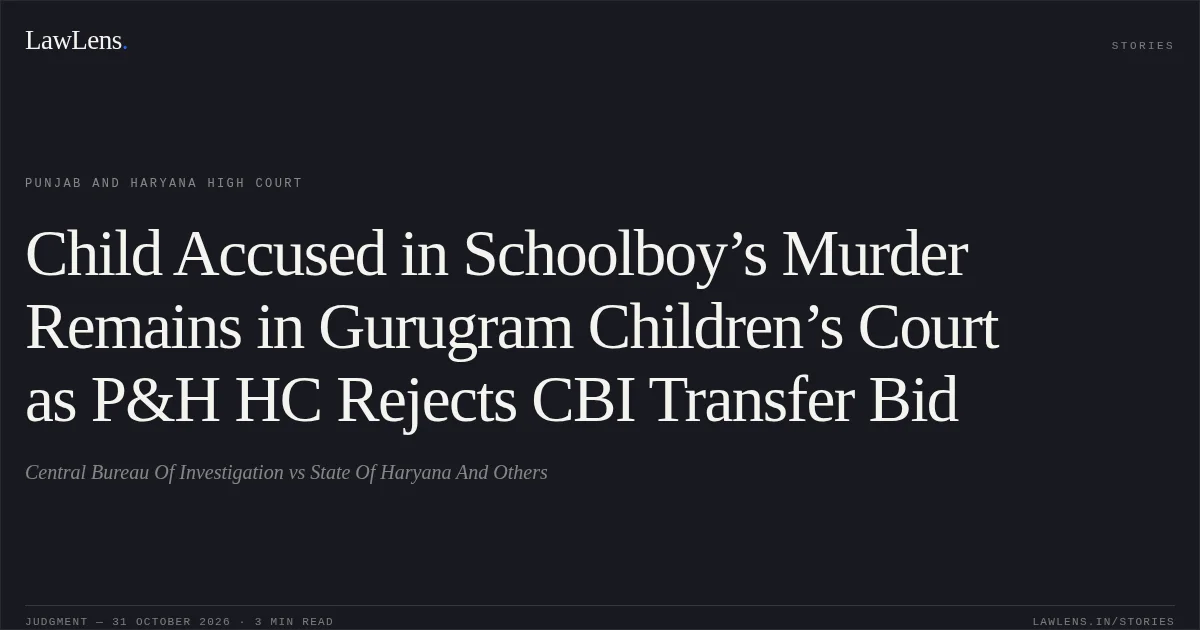
The case arose from the 2017 murder of a seven-year-old student in Gurugram.
¶ 2–8The CBI took over the investigation and charged respondent No. 2, who was under eighteen at the time of the alleged offence, under Section 302 IPC. Following a preliminary assessment under the Juvenile Justice (Care and Protection of Children) Act, 2015 (JJ Act), he was directed to be tried as an adult; the trial proceeded before the Children’s Court at Gurugram.
¶ 2–8The CBI sought transfer to the Special Judge, CBI, Panchkula, arguing that the case had been investigated by the CBI and that related proceedings against adult accused were pending there. In the alternative, it sought transfer to a Children’s Court at Panchkula. The trial court proceedings had continued for several years.
¶ 2–8, 1702Issues
i.Whether the trial of a child in conflict with law, directed to be tried as an adult, could be transferred to the Special Judge, CBI, Panchkula merely because the CBI investigated the case.
¶ 17ii.Whether grounds existed under Section 407 Cr.P.C. to transfer the trial to a Children’s Court at Panchkula.
¶ 1703Law Applied
Section 18(3), read with Section 1(4) of the JJ Act, requires the trial of a child directed to be tried as an adult to be conducted by the Children’s Court having jurisdiction; the JJ Act’s provisions concerning children in conflict with law prevail over inconsistent general laws.
¶ 26–27Sections 19 and 23 respectively require the Children’s Court to apply the specified child-related safeguards and prohibit joint proceedings with an adult accused.
¶ 26–27Sections 5 and 6 of the Delhi Special Police Establishment Act concern investigative authority, not the forum of trial; the notification appointing the CBI Special Judge at Panchkula applied to specified Prevention of Corruption Act offences, not an IPC murder charge.
¶ 19–24Under Section 407 Cr.P.C., transfer requires a statutory ground, such as the inability to obtain a fair trial, general convenience, or the ends of justice; transfer cannot displace a statutory requirement that trial be before a particular class of court.
¶ 45–50The Court relied on Gurcharan Dass Chadha v. State of Rajasthan on statutory trial forums and transfer, Abdul Nazar Madani v. State of Tamil Nadu and Nahar Singh Yadav v. Union of India on the transfer test, and Thirumoorthy v. State on the mandatory nature of the JJ Act procedure.
¶ 30–37, 46–52Provisions in the judgment · 37 · Linked ones open on LawLens
Code of Criminal Procedure, 1973 13 provisions
Section 177Section 178Section 179Section 180Section 181Section 182Section 183Section 184Section 185Section 223Section 406Section 407Section 482Indian Penal Code, 1860 Section 34Section 302
Arms Act, 1959 Section 25Section 54Section 59
Protection of Children from Sexual Offences Act, 2012 Section 12Section 28
Juvenile Justice (Care and Protection of Children) Act, 2015. 10 provisions
Section 1Section 2Section 15Section 18Section 19Section 21Section 23Section 24Section 25Section 75Delhi Special Police Establishment Act, 1946 Section 5Section 6
Commissions for Protection of Child Rights Act, 2005 Section 25
Prevention of Corruption Act, 1988 Section 3Section 4
Bharatiya Nagarik Suraksha Sanhita, 2023 Section 531
National Investigation Agency Act, 2008 Section 13
04Reasoning
The CBI’s notifications authorised investigation in Haryana but did not confer trial jurisdiction on the Special Judge, CBI. The relevant appointment notification confined that Judge’s jurisdiction to specified corruption offences, whereas respondent No. 2 faced only a charge under Section 302 IPC.
¶ 21–25Because respondent No. 2 remained a child in conflict with law, the JJ Act required trial by a Children’s Court, with the statutory safeguards under Section 19; the CBI Court could not be substituted merely because it was also a court presided over by a Sessions Judge or because the CBI prosecuted the case.
¶ 27, 33, 43–47As to the alternative request, there was no material showing that a fair trial could not be held at Gurugram. The occurrence, parties, family and school were located there, and the trial had substantially progressed.
¶ 53–57The inconvenience of moving records or witnesses, and the pendency of proceedings against adult accused at Panchkula, did not justify transfer; joint proceedings were in any event barred by Section 23 of the JJ Act.
¶ 53–5705Holding
The Court held that the Special Judge, CBI, Panchkula had no exclusive jurisdiction to try the IPC murder charge merely because the CBI investigated it, and that no sufficient ground existed to transfer the trial to a Children’s Court at Panchkula.
¶ 58–59The petition was dismissed.
¶ 59The Children’s Court at Gurugram was directed to endeavour to conclude the trial within six months, subject to the parties’ cooperation; the CBI was directed to ensure the attendance of its witnesses, and the trial court was permitted to use video conferencing for official and outstation witnesses in accordance with applicable rules.
¶ 59Original Court PDF
Central Bureau Of InvestigationvsState Of Haryana And Others
Click to open original judgment
Original judgment, available to read, download and summarize on LawLens.in