Facts
On 26 June 2006, a police party allegedly received secret information that five persons were assembled in an abandoned octroi building near Nirwana and were planning to loot a Haryana Roadways bus.
Source reference: paras. 1–4, pp. 1–4The police surrounded the building and allegedly overheard the accused assigning specific roles for committing the dacoity.
Source reference: paras. 1–4, pp. 1–4The appellant Ramesh was apprehended after emerging from the building, and a loaded .315-bore country-made pistol and a live cartridge were allegedly recovered from him.
Source reference: paras. 1–4, pp. 1–4Weapons were also allegedly recovered from co-accused Balinder, Shishpal and others.
Source reference: paras. 1–4, pp. 1–4The appellant was prosecuted under Sections 399 and 402 IPC and Section 25 of the Arms Act.
Source reference: paras. 1–4, pp. 1–4The Sessions Court convicted him and awarded three years’ rigorous imprisonment under Sections 399 and 402 IPC and two years’ rigorous imprisonment under Section 25 of the Arms Act, with fines; the sentences were to run concurrently.
Source reference: paras. 1–4, pp. 1–4The appeal challenged the conviction and sentence.
Source reference: para. 8, p. 6Issues
Whether the prosecution proved beyond reasonable doubt that the appellant had made preparation to commit dacoity, thereby attracting Section 399 IPC.
Source reference: paras. 10–12, pp. 6–7Whether the prosecution proved that five or more persons had assembled for the purpose of committing dacoity, thereby attracting Section 402 IPC.
Source reference: para. 56, p. 22Whether the alleged recovery of the .315-bore pistol and live cartridge from the appellant was reliable and sufficient to sustain his conviction under Section 25 of the Arms Act.
Source reference: paras. 57–63, pp. 22–25Whether the non-examination of certain police officials, non-joining of independent witnesses, contradictions in the prosecution evidence, and alleged non-compliance with Section 100(4) Cr.P.C. created a reasonable doubt regarding the prosecution case.
Source reference: paras. 14–49, pp. 7–20Whether the sentence imposed on the appellant required reduction on account of the prolonged pendency of the proceedings and his medical condition.
Source reference: paras. 65–67, pp. 25–26Law Applied
The Court applied Section 399 IPC, under which the prosecution must establish not merely an intention but an act or acts amounting to preparation to commit dacoity.
Source reference: para. 10, p. 6Section 402 IPC requires proof that five or more persons assembled for the purpose of committing dacoity.
Source reference: para. 56, p. 22Section 25 of the Arms Act was applied to the alleged possession of an operational firearm without lawful authority, subject to proof of recovery and the requisite statutory sanction.
Source reference: paras. 57–63, pp. 22–25The Court held that the testimony of police witnesses is not legally inadmissible merely because independent witnesses were not joined or all members of a raiding party were not examined; reliability depends on the quality of the evidence.
Source reference: paras. 16–22, pp. 8–11Section 100(4) Cr.P.C. applies to a search of premises, but the Court held that it was not attracted where the accused came out of the building and the relevant recoveries were made from their persons.
Source reference: paras. 46–49, pp. 18–20The Court distinguished Jasbir Singh @ Javri @ Jabbar Singh v. State of Haryana, observing that absence of resistance by an accused does not invariably discredit a recovery case and must be assessed on the facts of each case.
Source reference: paras. 35–38, pp. 15–16Reasoning
The Court found the testimony of PW-5, the complainant-investigating officer, and PW-7, a recovery witness, materially consistent regarding the accused’s presence in the octroi building, their apprehension, and the recoveries.
Source reference: paras. 16–22, pp. 8–11The non-examination of other police officials and the absence of independent witnesses were treated as non-fatal because the examined witnesses were found reliable and the defence showed no basis for false implication.
Source reference: paras. 16–22, pp. 8–11Variations concerning cartridge markings, the number of windows, the lighting arrangements, the time spent at the spot, and attempts to join independent witnesses were held to relate to peripheral matters and not to the core occurrence.
Source reference: paras. 23–28, 39–45, pp. 11–18The Court relied particularly on PW-5’s unchallenged evidence that he overheard the accused discussing the proposed dacoity and assigning specific roles, treating that conversation, the assembly of five persons, and the recovery of weapons as circumstances demonstrating preparation beyond mere intention.
Source reference: paras. 29–34, 55–56, pp. 13–15, 21–22The alleged .315-bore pistol and cartridge were supported by the recovery evidence, the armourer’s examination showing that the pistol was in working order, the chain of custody, and the requisite sanction.
Source reference: paras. 57–63, pp. 22–25The Court therefore rejected the challenges to the conviction but considered the appellant’s prolonged incarceration and the approximately two-decade pendency of the proceedings relevant to sentence.
Source reference: paras. 65–67, pp. 25–26Holding
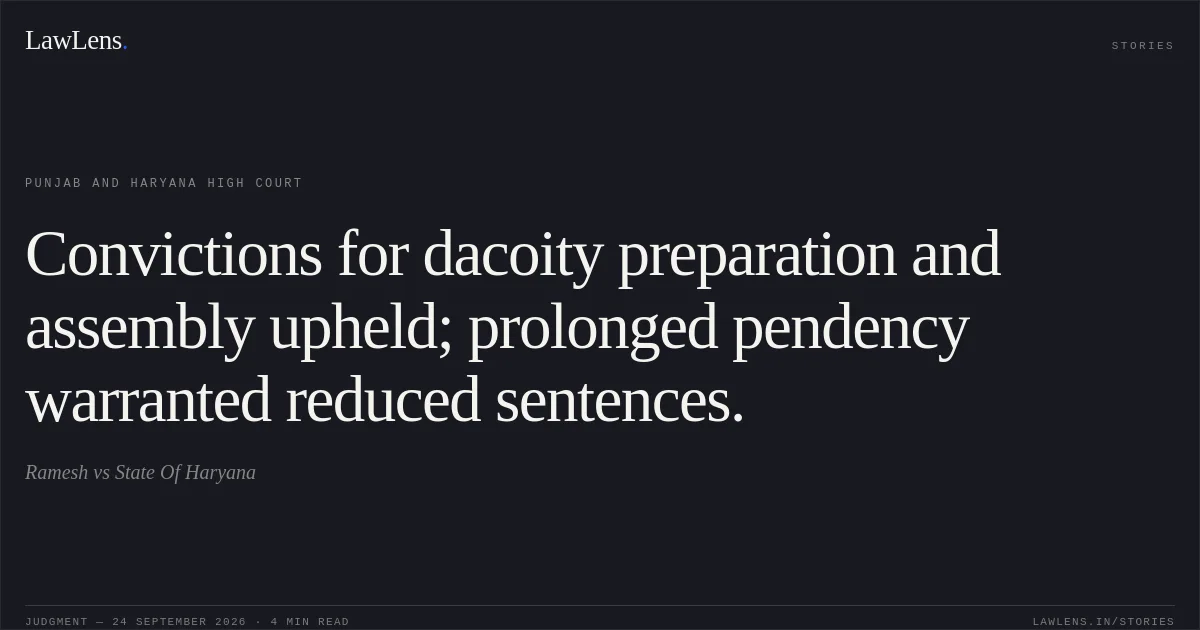
The appeal was dismissed insofar as it challenged the conviction under Sections 399 and 402 IPC and Section 25 of the Arms Act; the convictions were upheld.
However, the sentences under Sections 399 and 402 IPC were reduced from three years’ rigorous imprisonment to two years’ rigorous imprisonment, while the fines, default sentences, and the sentence under Section 25 of the Arms Act remained unchanged.
Source reference: paras. 67–68, p. 26All substantive sentences were directed to run concurrently, and the period already undergone was ordered to be set off in accordance with law.
Source reference: paras. 67–68, p. 26Acts & Sections Cited
6 provisions across 3 statutes referred to in this judgment. Each provision opens on LawLens.
Indian Penal Code, 18602
Arms Act, 19591
Code of Criminal Procedure, 19733
Original Court PDF
RameshvsState Of Haryana
Click to open original judgment
Original judgment, available to read, download and summarize on LawLens.in