Facts
The petitioners sought quashing of FIR No. 151/2015 registered at Police Station Kirti Nagar for offences under Sections 323 and 374 IPC, Section 23 of the Juvenile Justice Act, and Sections 3/14 of the Child Labour (Prohibition and Regulation) Act, on the ground that the alleged victim child had compromised the dispute with them.
Source reference: p.1, para.1Charges had already been framed, the charge order had not been challenged, and the trial had commenced with the victim’s testimony being recorded as PW1.
Source reference: pp.1–2, paras.2, 5The petitioners also contended that the victim was not a minor at the time of the alleged offence; however, the Court declined to examine that contention in a petition for quashing, as doing so would require a mini-trial.
Source reference: p.2, para.4Issues
Whether the High Court should exercise its inherent jurisdiction to quash the criminal proceedings on the basis of a compromise between the petitioners and the victim child.
Source reference: pp.1–2, paras.1–3Whether the petitioners’ contention that the victim was not a minor at the time of the alleged offence could be adjudicated in a quashing petition after charges had been framed.
Source reference: p.2, para.4Whether quashing was appropriate when the alleged offences involved child labour and child exploitation having serious social ramifications, and prosecution evidence had already commenced.
Source reference: pp.2–4, paras.5–8Law Applied
The Court applied the High Court’s inherent jurisdiction under Section 482 of the Code of Criminal Procedure, noting that quashing of criminal proceedings is an exception to the ordinary rule that prosecution should continue to trial.
Source reference: pp.2–3, paras.5–6It relied on Narinder Singh v. State of Punjab, (2014) 6 SCC 466, which holds that the timing of a settlement is material: the Court may be liberal where settlement occurs during investigation, may in appropriate cases show benevolence after charges but before evidence, but should ordinarily refrain from quashing once prosecution evidence has commenced; offences involving special statutes or serious impact on society ordinarily cannot be quashed merely because the parties have compromised.
Source reference: pp.3–4, paras.6–7The Court also relied on Sachin Sharma v. State, 2024:DHC:8932, involving allegations of child exploitation, where a similar quashing petition was dismissed.
Source reference: p.3, para.5The relevant charges arose under Sections 323/374 IPC, Section 23 of the Juvenile Justice Act, and Sections 3/14 of the Child Labour (Prohibition and Regulation) Act.
Source reference: p.1, para.1Reasoning
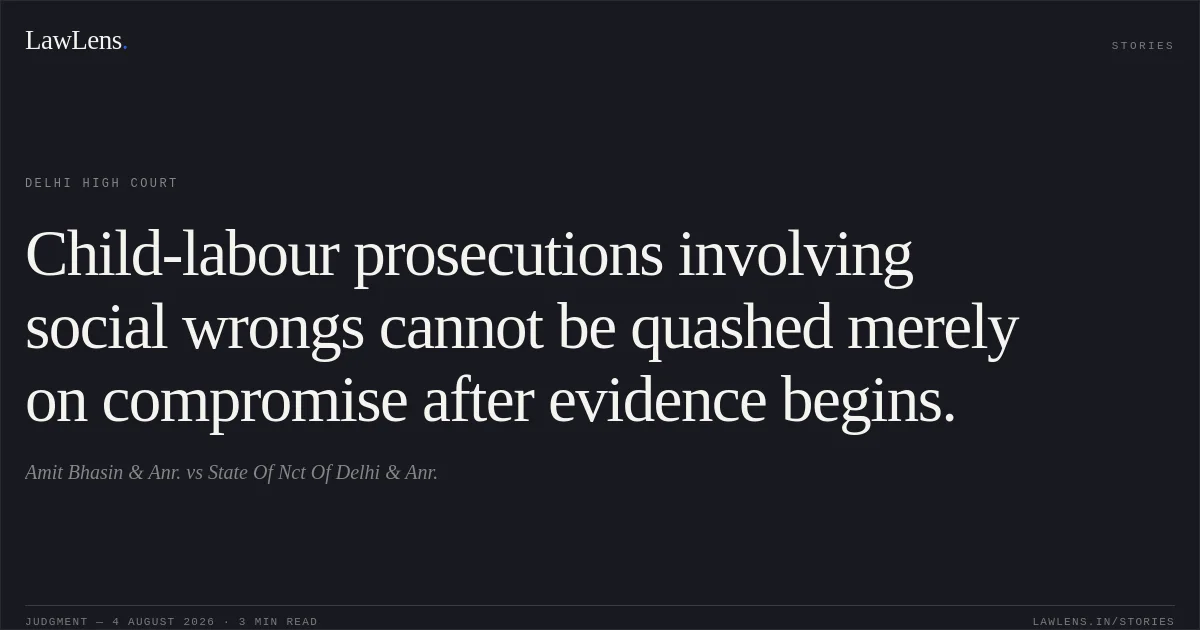
The Court held that the alleged child labour and child exploitation offences were not merely private disputes but wrongs affecting society at large.
Source reference: pp.2–4, paras.3, 7–8Consequently, a private compromise could not by itself justify terminating the prosecution.
Source reference: pp.2–4, paras.3, 7–8The timing of the compromise also weighed decisively against quashing: charges had been framed, the charge order remained unchallenged, and the victim had already been examined as PW1, placing the matter at the stage where the trial court could determine the case on merits.
Source reference: pp.1–3, paras.2, 5–6Applying Narinder Singh, the Court found that quashing after commencement of prosecution evidence was ordinarily impermissible.
Source reference: pp.1–3, paras.2, 5–6It further held that deciding whether the victim was a minor would require evaluation of evidence and therefore could not be undertaken as a mini-trial in the present proceedings.
Source reference: p.2, para.4Holding
The Court answered the issues against the petitioners.
It held that the alleged offences had serious social ramifications and that, because the trial had commenced and the victim’s testimony had already been recorded, the case was not fit for exercise of inherent powers on the basis of compromise.
Source reference: p.4, para.8The petition was dismissed as devoid of merit and frivolous, and the accompanying application was also disposed of.
Source reference: p.4, paras.9–10Original Court PDF
Amit Bhasin & Anr.vsState Of Nct Of Delhi & Anr.
Click to open original judgment
Original judgment, available to read, download and summarize on LawLens.in