Facts
The prosecution alleged that the appellant sexually assaulted PW1, who was under 18, at her home on 3 August 2021 and in a bathroom on 24 September 2021, and that the assaults resulted in her pregnancy
Source reference: paras. 3, 8–9; pp. 2, 11–14The Special Court convicted him under Sections 450, 342, 376(2)(n), and 506(ii) IPC and Sections 3(a) read with 4, 5(j)(ii) read with 6, and 5(l) read with 6 of the POCSO Act; it imposed, among other sentences, 20 years’ rigorous imprisonment for each aggravated POCSO offence, to run concurrently
Source reference: para. 4; pp. 3–5On appeal, the appellant challenged the proof of two separate assaults and the reliability of the DNA evidence identifying him as the foetus’s biological father.
Source reference: paras. 5, 7; pp. 5–11Issues
Whether the medical history recorded by PW10, which did not mention two separate assaults, materially undermined PW1’s evidence and the finding of repeated sexual assault under Section 5(l) read with Section 6 of the POCSO Act
Source reference: paras. 5, 7, 11; pp. 5–7, 10–17Whether the DNA evidence was reliable despite the appellant’s challenge to the collection, preservation, and transportation of the samples, and established the offence under Section 5(j)(ii) read with Section 6 of the POCSO Act
Source reference: paras. 5–7, 12–13; pp. 6–10, 18–19Whether the evidence otherwise supported the convictions under the IPC and POCSO Act, and whether the convictions or sentences required appellate interference
Source reference: paras. 7, 14–15; pp. 10–11, 19–20Law Applied
The Court considered Sections 450, 342, 376(2)(n), and 506(ii) IPC and Sections 3(a), 4, 5(j)(ii), 5(l), and 6 of the POCSO Act.
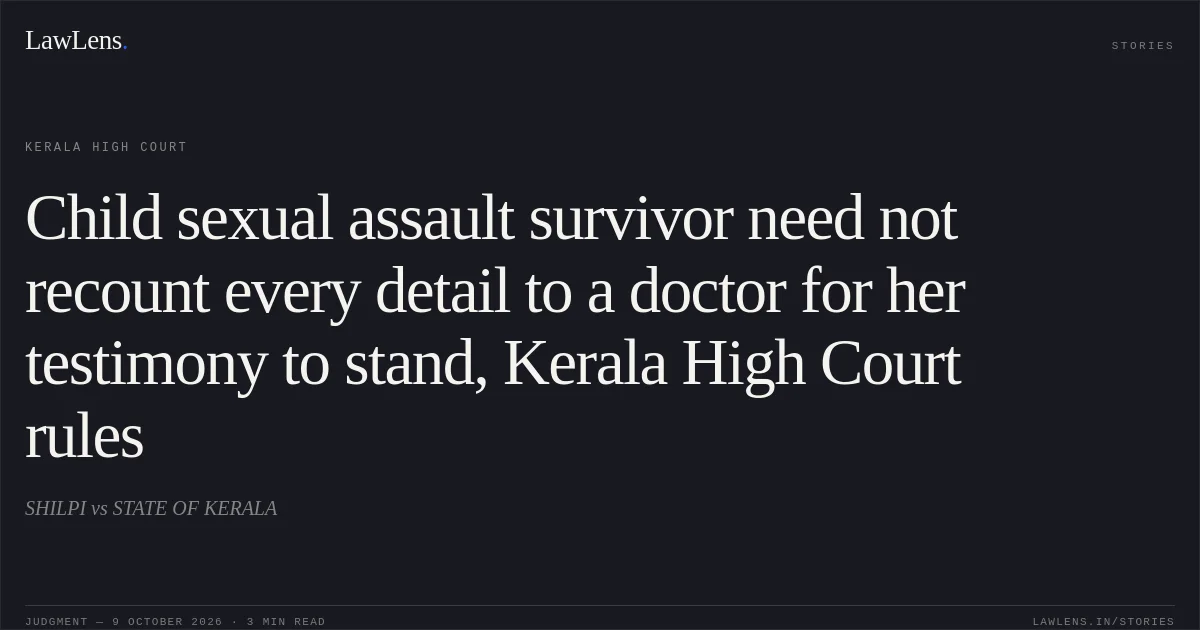
Source reference: paras. 3–4, 7; pp. 2–5, 10–11It held that a doctor’s record of a sexual-assault victim’s history is ordinarily made for diagnosis and treatment; the victim is not required to provide the doctor with a complete account in the detail expected in a police or magistrate’s statement, and omissions from that medical history do not, without more, constitute material contradictions.
Source reference: para. 11; pp. 14–17DNA evidence may be relied upon where the evidence supports the integrity of the sample collection and forwarding process; on the facts, the Court found no deficiency warranting rejection of the DNA report.
Source reference: paras. 12–13; pp. 18–19The Court also treated 20 years as the statutory minimum sentence for the offences under Sections 5(j)(ii) and 5(l) read with Section 6 of the POCSO Act.
Source reference: para. 15; p. 20The appellant cited Mehtab v. State of Uttarakhand and Prakash Nishad @ Kewat Zinak Nishad v. State of Maharashtra on DNA procedure; the judgment records those authorities as part of his submissions.
Source reference: para. 5; pp. 7–8Reasoning
The Court accepted PW1’s account of two assaults and held that the absence of both incidents from the medical history recorded by PW10 did not discredit her testimony: the history was taken for medical purposes, not as a formal evidentiary statement, and a victim should not be expected to repeat every detail to the doctor.
Source reference: paras. 9–11; pp. 12–17As to paternity, the Court relied on the evidence of the doctors and investigating officer, the sample-collection mahazar, and the DNA report, finding that the samples had been handled in a tamper-proof manner and that no demonstrated procedural deficiency justified rejecting the report.
Source reference: paras. 12–13; pp. 18–19On reappreciation of the evidence, it found the convictions proved and declined to reduce the POCSO sentences because they were already at the statutory minimum.
Source reference: paras. 14–15; pp. 19–20Holding
The High Court rejected the appellant’s challenges, affirmed the convictions and sentences imposed by the Special Court, and dismissed the appeal.
Acts & Sections Cited
12 provisions across 3 statutes referred to in this judgment. Each provision opens on LawLens.
Indian Penal Code, 18604
Protection of Children from Sexual Offences Act, 20127
Code of Criminal Procedure, 19731
Original Court PDF
SHILPIvsSTATE OF KERALA
Click to open original judgment
Original judgment, available to read, download and summarize on LawLens.in