01Facts
On 20.02.2016, at about 9:30 p.m. near Basava Nagar, Manjari village, the claimant, a six-year-old student, and her parents were walking on the left side of the road when a motorcycle (KA-23/EC-8659) driven at high speed and in a rash and negligent manner struck her
¶ 3She sustained grievous injuries, including fracture of the left tibia and fibula, and was treated as an indoor patient for four days
¶ 3 · ¶ 13Her guardian claimed permanent disability and medical expenses in MVC No. 778/2016 before the VII Additional District Judge and Additional MACT, Belagavi, sitting at Chikkodi
¶ 4The Insurance Company (respondent No. 2 before the Tribunal) contested quantum but led no evidence
¶ 5–6The doctor (PW-2) assessed disability at 28% to the particular limb
¶ 9 · ¶ 13The Tribunal awarded ₹4,54,050 under three heads: ₹4,00,000 for attendant charges, nourishment, pain and suffering, and loss of amenities; ₹29,050 for medical expenses; and ₹25,000 for parents' loss during hospitalisation. It fixed whole-body disability at 14% and granted interest at 6% per annum
¶ 7The Insurance Company appealed under Section 173(1) of the Motor Vehicles Act, 1988, challenging quantum only
¶ 1, 8–902Issues
i.1. Whether the Insurance Company proves that the compensation awarded by the Tribunal deserves to be modified.
¶ 11(i)ii.2. Whether the Tribunal correctly assessed the disability at 14% to the whole body, given the doctor's evidence of 28% to the limb and the claimant's fast recovery.
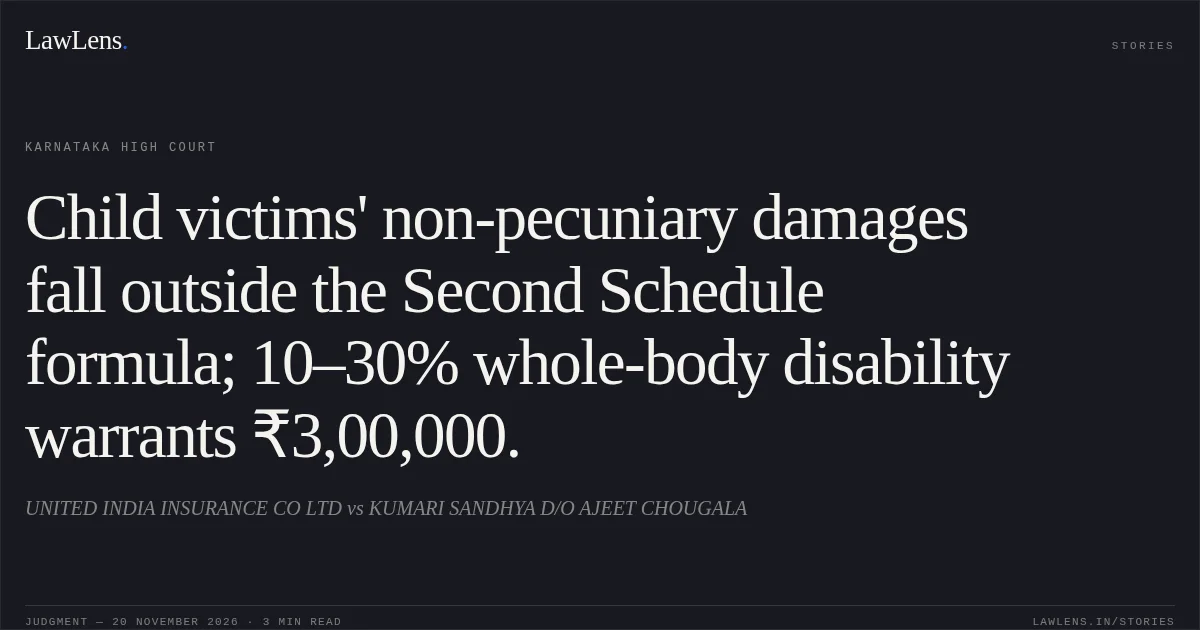
¶ 13iii.3. Whether the non-pecuniary compensation of ₹4,00,000 must be reassessed in light of Master Mallikarjun for child victims.
¶ 14–1503Law Applied
The Court applied Section 173(1) of the Motor Vehicles Act, 1988, as the statutory basis for appellate review of quantum.
¶ 1Master Mallikarjun v. Divisional Manager, National Insurance Co. Ltd., 2014 (14) SCC 396, holds that the structured formula in the Second Schedule of the Motor Vehicles Act is unsuitable for child victims because children have no income and cannot be equated with notional non-earning persons.
¶ 14Compensation for a child victim must be assessed under non-pecuniary heads (pain, shock, frustration, deprivation of ordinary pleasures, and loss of amenities), together with actual treatment, attendant, and transport costs.
¶ 14The Court drew on R.D. Hattangadi v. M/s Pest Control (India) Pvt. Ltd. for the non-pecuniary heads, as quoted in Master Mallikarjun.
¶ 14The Court adopted the tier that awards ₹3,00,000 where whole-body disability lies between 10% and 30%.
¶ 15Provisions in the judgment · 2 · Linked ones open on LawLens
Motor Vehicles Act, 1988 Section 173Section 2
04Reasoning
Although the doctor rated disability at 28% to the limb, cross-examination established a shortening of more than ½ inch, equating to 4% disability of the limb.
¶ 13The Court accepted that the child's faster recovery at age six mitigated, but did not remove, the permanent residual disability, and it upheld the Tribunal's 14% whole-body assessment.
¶ 13The Court found that the Tribunal had not applied the child-specific non-pecuniary approach mandated by Master Mallikarjun.
¶ 14Because the 14% whole-body disability falls within the 10%–30% band, the Court reduced the non-pecuniary award from ₹4,00,000 to ₹3,00,000.
¶ 15The medical expenses (₹29,050) and parental loss (₹25,000) heads were supported by the record and left undisturbed.
¶ 1605Holding
The Court answered Point (i) partly in the affirmative. It held that the 14% whole-body disability finding stands, but the non-pecuniary award must be reduced to ₹3,00,000 under the Master Mallikarjun framework.
¶ 12, 13, 15, 18The total compensation is ₹3,54,050 (₹3,00,000 + ₹29,050 + ₹25,000).
¶ 17The appeal is allowed in part, and the award is modified to ₹3,54,050 from ₹4,54,050.
¶ 19, Order (i)–(ii)The Court directed that interest at 6% per annum run from the date of petition until payment.
Order (iii)Respondent No. 2 must deposit the amount with accrued interest before the Tribunal within six weeks of receiving the certified copy, and a modified award is to be drawn accordingly.
Order (iv)–(v)Any excess deposit is to be transmitted to the Tribunal with the records.
Order (vi)Original Court PDF
UNITED INDIA INSURANCE CO LTDvsKUMARI SANDHYA D/O AJEET CHOUGALA
Click to open original judgment
Original judgment, available to read, download and summarize on LawLens.in