01Facts
The plaintiffs filed a suit for partition and separate possession of the suit properties, and sought declarations that certain sale and release deeds were not binding on them.
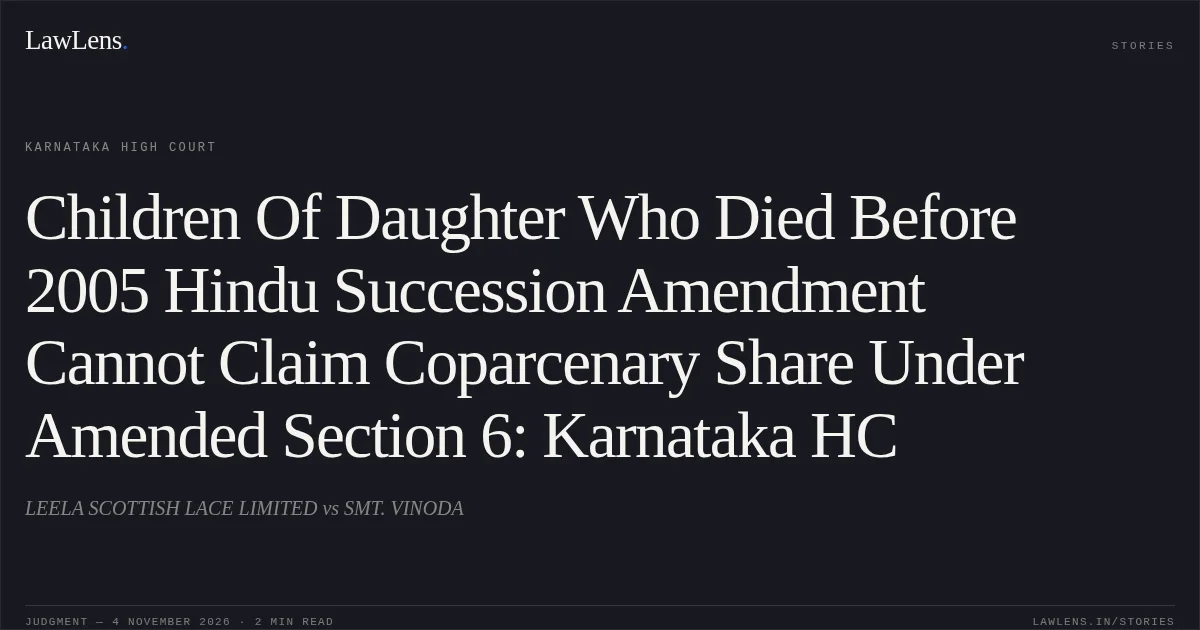
pp. 4–6They claimed through their mother, a daughter of the family, who died on 24 June 2005—before amended Section 6 of the Hindu Succession Act, 1956 came into force on 9 September 2005.
pp. 4–6 · p. 26Defendants 4 and 5 sought rejection of the plaint under Order VII Rule 11(a) and (d) CPC. The trial court dismissed that application, holding that the plaintiffs’ entitlement and limitation required evidence. The defendants challenged that order in revision.
pp. 5–702Issues
i.Whether the children and grandchildren of a daughter who died before 9 September 2005 could claim coparcenary rights under amended Section 6 of the Hindu Succession Act, 1956
p. 27 · ¶ 15ii.Whether the plaint disclosed a cause of action or was liable to rejection under Order VII Rule 11 CPC on its own averments
pp. 36–37 · ¶ 2103Law Applied
Section 6 of the Hindu Succession Act, 1956, as amended in 2005, confers coparcenary status on a daughter by birth, with the same rights and liabilities as a son; the amendment operates from 9 September 2005.
pp. 32–34 · ¶ 16–18The Court read Vineeta Sharma v. Rakesh Sharma, (2020) 9 SCC 1, particularly paragraph 80, as rejecting the requirement that the father be alive on that date, while retaining the requirement that the daughter be living on that date.
pp. 32–35 · ¶ 16–19Under Article 141 of the Constitution, the Supreme Court’s declaration of law binds the High Court; a contrary interpretation in Channabasappa v. Parvatevva alias Kasturevva could not prevail.
pp. 34–35 · ¶ 19Under Order VII Rule 11 CPC, the court determines from the plaint whether it discloses a cause of action or is barred by law.
p. 36 · ¶ 21Provisions in the judgment · 6 · Linked ones open on LawLens
Code of Civil Procedure, 1908 Section 115Section 97Section 152Section 7
04Reasoning
The plaintiffs’ claim under amended Section 6 depended on their mother having acquired a coparcenary interest that could devolve upon them. Because she died before the amendment commenced, the Court held that no right under the substituted Section 6 had vested in her during her lifetime.
pp. 35–36 · ¶ 20It interpreted Vineeta Sharma as distinguishing the father’s survival—which is unnecessary—from the daughter’s survival, which it considered required on 9 September 2005.
pp. 33–35 · ¶ 17–19Since the plaint itself showed that the mother predeceased that date, the Court found no enforceable claim to partition under the amendment. It therefore considered examination of the challenged alienations unnecessary and held that the plaint was liable to rejection.
pp. 36–37 · ¶ 20–2105Holding
The Court held that the plaintiffs could not claim coparcenary rights under amended Section 6 through their mother, who died before the amendment came into force.
p. 38 · OrderIt set aside the trial court’s order, allowed the defendants’ application under Order VII Rule 11 CPC, rejected the plaint, and allowed the civil revision petition.
p. 38 · OrderOriginal Court PDF
LEELA SCOTTISH LACE LIMITEDvsSMT. VINODA
Click to open original judgment
Original judgment, available to read, download and summarize on LawLens.in