01Facts
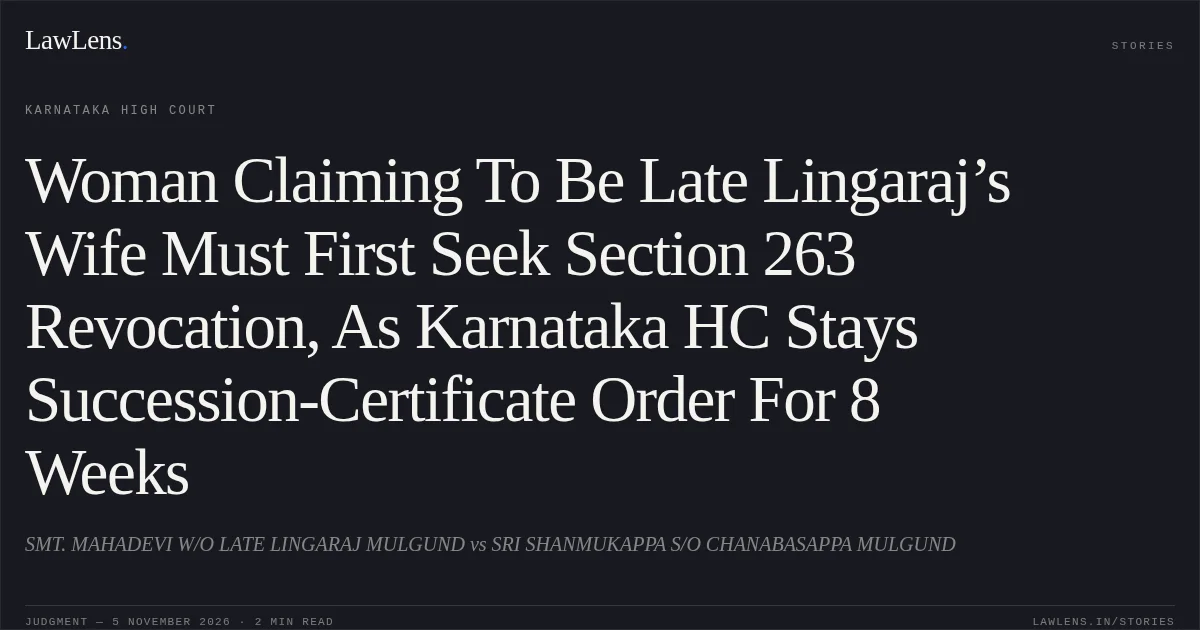
The appellant challenged the order dated 22 November 2022 in P&SC No. 32/2022, stating that she was the legally wedded wife of the deceased, Lingaraj, and that the respondent had obtained the order without bringing that fact to the court’s attention.
p. 2 · ¶ 3The appeal was brought under Section 384 of the Indian Succession Act, 1925.
p. 2 · ¶ 2During the appeal, Bailhongal Urban Co-operative Bank Limited sought impleadment, stating that the succession certificate concerned funds held by the bank in the deceased’s name.
p. 5 · ¶ 602Issues
i.1. Whether the appellant could challenge the order in P&SC No. 32/2022 by appeal without first seeking revocation under Section 263 of the Indian Succession Act, 1925.
pp. 5–6 · ¶ 5ii.2. Whether the bank’s impleadment application should be decided in the appeal or left to be pursued before the court hearing any Section 263 proceedings.
p. 5 · ¶ 603Law Applied
Section 384 of the Indian Succession Act, 1925, provides for an appeal concerning orders granting, refusing, or revoking succession certificates; Section 263 provides for revocation or annulment of a grant on grounds recognised by that provision.
pp. 3–5 · ¶ 4–4.2, 5–7Relying on Sri Sheshappa and Others v. Sri Praveen, which followed Sri N. Girish Singh v. Sri Prem Khatri and Others, the Court applied the rule that a party challenging a grant on the grounds raised must first pursue the remedy under Section 263; an appeal filed without doing so is not maintainable.
pp. 3–5 · ¶ 4–4.2, 5–7The Court also noted that T. Gopalaraju v. Lakshminarasaraju did not decide that specific question, while Mary D’souza v. Monty Furtado concerned a different issue arising in an injunction suit.
pp. 3–5 · ¶ 4–4.2, 5–7Provisions in the judgment · 3 · Linked ones open on LawLens
Indian Succession Act, 1925 Section 384Section 263Section 273
04Reasoning
The appellant’s challenge was based on her asserted status as the deceased’s wife and the respondent’s alleged failure to disclose that fact.
pp. 5–6 · ¶ 5Applying the approach in N. Girish Singh, the Court held that the appropriate first recourse was an application under Section 263, rather than this appeal.
pp. 5–6 · ¶ 5It therefore did not determine the merits of the appellant’s claim or the validity of the order granting the certificate.
p. 7 · ¶ 2As the bank’s concern related to the proposed Section 263 proceedings, the Court considered it appropriate for the bank to seek impleadment before the court hearing those proceedings.
p. 5 · ¶ 605Holding
The appeal was disposed of with liberty to the appellant to initiate proceedings under Section 263.
pp. 6–8 · ¶ 6–7The trial court was directed to decide any such proceedings in accordance with law and without being influenced by the High Court’s observations; the impugned order was stayed for eight weeks, and the appellant was permitted to seek a further stay in the Section 263 proceedings.
pp. 6–8 · ¶ 6–7The respondents retained the right to contest those proceedings and any interim applications.
pp. 6–8 · ¶ 6–7The bank’s impleadment application was disposed of with liberty to approach the appropriate court.
pp. 6–8 · ¶ 6–7Original Court PDF
SMT. MAHADEVI W/O LATE LINGARAJ MULGUNDvsSRI SHANMUKAPPA S/O CHANABASAPPA MULGUND
Click to open original judgment
Original judgment, available to read, download and summarize on LawLens.in