01Facts
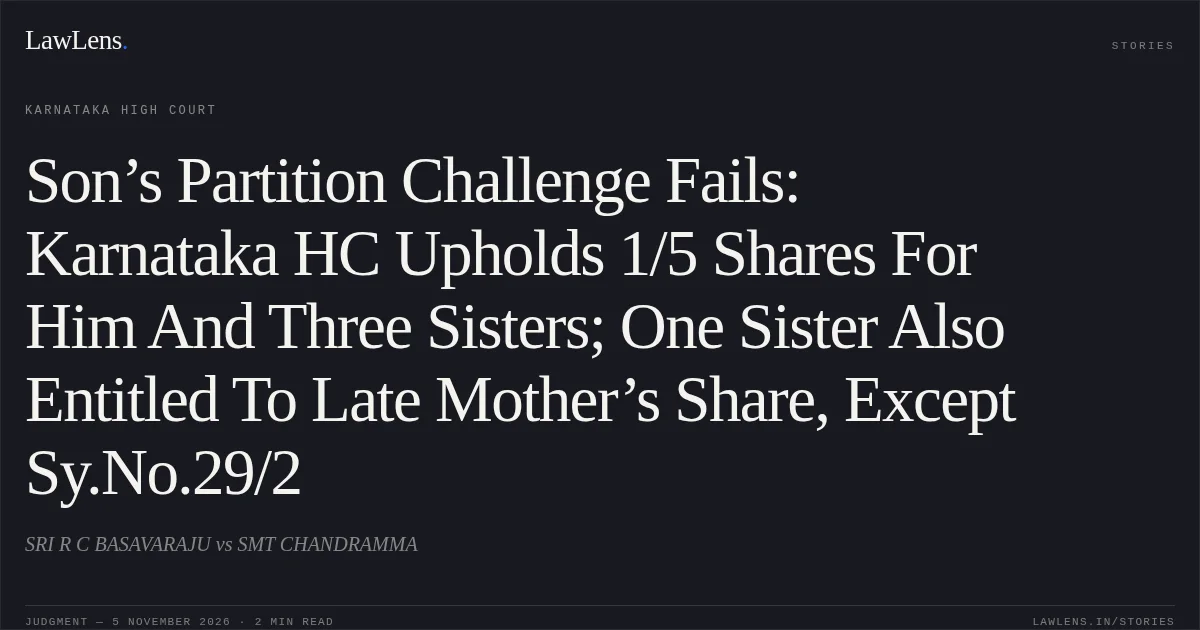
The plaintiffs, comprising the deceased Channabasappa’s wife and daughters, sued for partition of properties, claiming that they and his son, the appellant, were entitled to shares.
pp. 4–5, 14–16, 26–28The trial court found the properties to be Channabasappa’s separate or self-acquired properties, except Sy.No. 29/2, and decreed shares in the remaining properties.
pp. 4–5, 14–16, 26–28The First Appellate Court dismissed the son’s appeal and, having found that the mother’s registered Will in favour of plaintiff No. 4 was proved, awarded her 2/5 and plaintiffs Nos. 2 and 3 and the appellant 1/5 each.
pp. 4–5, 14–16, 26–28The appellant challenged those decisions in this second appeal.
pp. 4–5, 14–16, 26–2802Issues
i.1. Whether the suit properties were ancestral or joint-family properties, rather than Channabasappa’s separate or self-acquired properties, and whether the appellant’s claim to a half-share was sustainable
pp. 5–6, 28–32ii.2. Whether plaintiff No. 4 proved the registered Will by which plaintiff No. 1 bequeathed her share to her
pp. 5, 23–26, 32–33iii.3. Whether the concurrent findings or decree raised a substantial question of law warranting interference under Section 100 CPC
pp. 28–3303Law Applied
Section 8 of the Hindu Succession Act, 1956 governs intestate succession to an individual’s separate property, with the deceased’s Class I heirs succeeding to it.
pp. 29–31The Court also relied on Section 6 as amended and Vineeta Sharma v. Rakesh Sharma, (2020) 9 SCC 1, concerning daughters’ equal coparcenary rights and the application of amended Section 6 in pending proceedings.
pp. 29–31A Will must be proved in accordance with Section 63 of the Indian Succession Act and Section 68 of the Evidence Act; registration alone does not dispense with proof.
pp. 25–26, 32–33In a second appeal, concurrent factual findings supported by evidence do not warrant interference absent a substantial question of law.
p. 33Provisions in the judgment · 6 · Linked ones open on LawLens
Code of Civil Procedure, 1908 Section 100
Hindu Succession Act, 1956 Section 6Section 8Section 15Section 1
Indian Succession Act, 1925 Section 63
04Reasoning
The High Court found that both lower courts had assessed the documentary and oral evidence and concluded that the appellant had not established that the suit properties were ancestral or joint-family property, or that marriage expenses, gifts, or other payments had satisfied the plaintiffs’ shares.
pp. 28–29, 32It rejected the appellant’s challenge to the shares, also relying on Vineeta Sharma in addressing the claim based on the properties’ alleged coparcenary character.
pp. 29–32The First Appellate Court had examined the attesting witnesses and other evidence relating to the Will and found it duly proved; the High Court held that finding was neither perverse nor legally infirm.
pp. 23–26, 32–33The concurrent findings disclosed no substantial question of law.
p. 3305Holding
The appeal was dismissed at the admission stage.
p. 28, 33The Court declined to interfere with the decree: plaintiff No. 4 was entitled to 2/5, and plaintiffs Nos. 2 and 3 and the appellant to 1/5 each, in the suit properties, excluding Sy.No. 29/2; partition and separate possession were to follow accordingly.
p. 28, 33Original Court PDF
SRI R C BASAVARAJUvsSMT CHANDRAMMA
Click to open original judgment
Original judgment, available to read, download and summarize on LawLens.in