01Facts
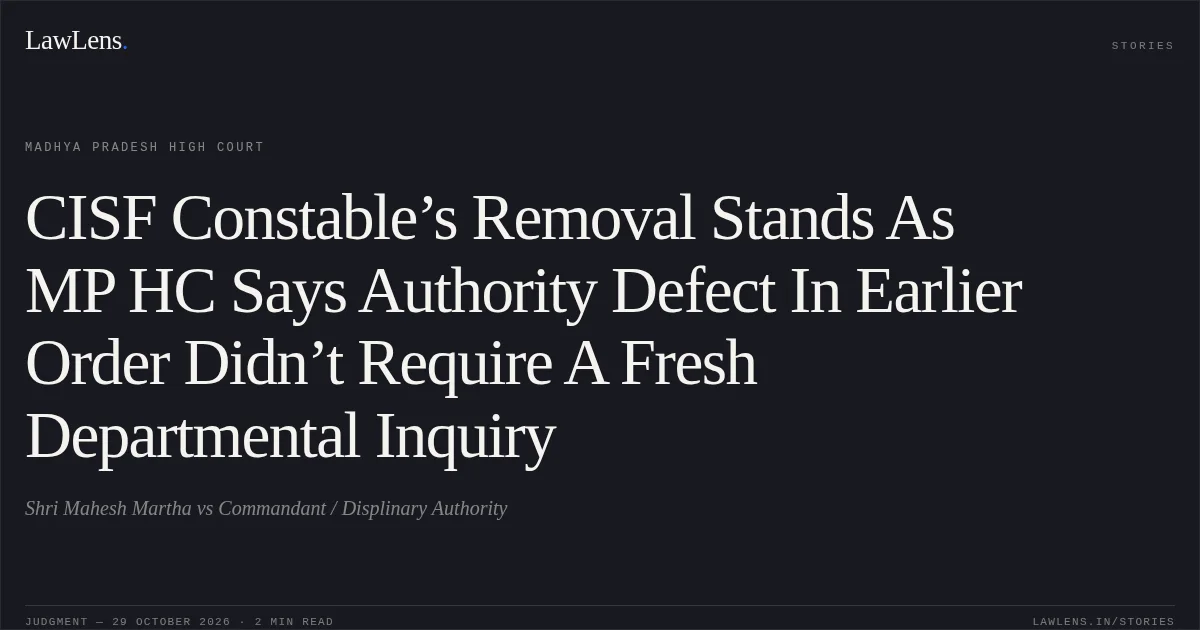
The petitioner, a CISF Constable/GD, was removed from service by order dated 12 June 2021.
¶ 2–3On appeal, the Deputy Inspector General set aside that order because it had been made by an authority lacking competence, directed the petitioner’s reinstatement, and remitted the matter to the Senior Commandant to pass a fresh final order, with a direction to impose the same penalty. The petitioner rejoined on 26 November 2021, and the Senior Commandant again ordered his removal on 4 December 2021. The petitioner challenged that order, contending that the proceedings should have recommenced de novo and that the appellate authority could not dictate the penalty
¶ 2–302Issues
i.1. Whether, after setting aside the original removal order for an authority-competence defect, the appellate authority was required to direct a de novo enquiry from the stage of a fresh charge memorandum.
¶ 3, 6ii.2. Whether the appellate authority could remit the matter to another authority with a direction to impose the same penalty, and whether the fresh removal order warranted interference under Article 226.
¶ 3, 7–1003Law Applied
Rule 52(2)(c) of the CISF Rules, 2001 empowers an appellate authority, when considering an appeal against a penalty, to confirm, enhance, reduce, or set aside the penalty, or remit the case to the original or another authority with such directions as it considers appropriate.
¶ 8–9The Court also applied the principles governing judicial review of disciplinary proceedings under Articles 226 and 227: a High Court does not sit as an appellate court over disciplinary findings, and interference is warranted for grounds such as want of jurisdiction, procedural or natural-justice violations, reliance on irrelevant considerations, or findings that are perverse or unsupported by evidence [*Union of India v. P. Gunasekaran*, (2015) 2 SCC 610; *State of Karnataka v. N. Gangraj*, (2020) 3 SCC 423].
¶ 11The petitioner also relied on Rule 27(2) of the CCS (CCA) Rules, 1965 and Article 14; the judgment records these as part of his challenge.
¶ 304Reasoning
The Court accepted that the departmental enquiry had been conducted under Rule 36 of the CISF Rules and that no procedural infirmity in the enquiry had been identified. Since the petitioner did not establish that the enquiry itself had been annulled or that a fresh enquiry had been ordered, setting aside the original penalty order did not make a de novo enquiry legally necessary.
¶ 6Rule 52(2)(c) expressly authorized remittal to another authority with directions, and the Court found no demonstrated basis to conclude that the fresh order was made without jurisdiction or that the petitioner was denied a required opportunity. The Court therefore found no established illegality warranting judicial review.
¶ 9–1205Holding
The Court held that the petitioner had not shown sufficient grounds to interfere with the removal order dated 4 December 2021.
¶ 13–15The writ petition was dismissed as devoid of merit, with no order as to costs.
¶ 13–15Original Court PDF
Shri Mahesh MarthavsCommandant / Displinary Authority
Click to open original judgment
Original judgment, available to read, download and summarize on LawLens.in