Facts
The petitioner, a steel trader, had a long-standing commercial relationship with Respondent No. 2 since 2020.
Source reference: para. 2The petitioner supplied steel goods worth crores under valid tax invoices, E-way bills, and ledger accounts; however, disputes arose regarding outstanding dues.
Source reference: para. 2, 9Following legal action initiated by the petitioner for non-payment, Respondent No. 2 lodged an FIR (Crime No. 253/2023) at P.S. Lahar, Bhind, alleging that the petitioner dishonestly induced payment but failed to deliver goods, thereby committing cheating under Section 420 IPC.
Source reference: para. 2The petitioner sought quashment of the FIR and subsequent charge-sheet under Section 482 Cr.P.C. (now Section 528 BNSS), contending the dispute was purely civil/commercial.
Source reference: para. 1, 3Issues
1. Whether the allegations contained in the FIR and charge-sheet disclose the essential ingredients of Section 420 IPC?
Source reference: para. 8(i)2. Whether the dispute between the parties is predominantly civil or commercial in nature?
Source reference: para. 8(ii)3. Whether the continuation of criminal proceedings would amount to an abuse of the process of the Court?
Source reference: para. 8(iii)Law Applied
The Court applied Section 420 and 415 of the Indian Penal Code (IPC), which require proof of deception, fraudulent inducement, and dishonest intention existing at the very inception of the transaction.
Source reference: para. 12, 15, 18State of Haryana v. Bhajan Lal [1992 Supp (1) SCC 335] regarding the categories where criminal proceedings can be quashed to prevent abuse of process.
Source reference: para. 21Principles from Hridaya Ranjan Prasad Verma v. State of Bihar [(2000) 4 SCC 168] and Uma Shankar Gopalika v. State of Bihar [(2005) 10 SCC 336], establishing that a mere breach of contract does not amount to cheating unless the fraudulent intention existed from the beginning.
Source reference: para. 13, 12 (bis)Indian Oil Corporation v. NEPC India Ltd. [(2006) 6 SCC 736] was cited to emphasize that criminal law should not be used as an instrument to settle civil disputes.
Source reference: para. 11Reasoning
The Court observed that the relationship between the parties originated from documented commercial transactions including invoices and E-way bills, which indicated actual supply of goods.
Source reference: para. 9The Court reasoned that since business dealings had been ongoing for a considerable period, the element of "dishonest intention at the inception" was conspicuously absent.
Source reference: para. 13It noted that the controversy revolved around payment adjustments and performance of contractual obligations, which are matters of civil adjudication rather than criminal liability.
Source reference: para. 9, 24The Court found that the criminal machinery was likely invoked as a "counterblast" to the petitioner's own complaints against Respondent No. 2, who also faced multiple cases from other traders.
Source reference: para. 2, 20Consequently, the allegations, even if taken at face value, failed to constitute a criminal offence under the Bhajan Lal guidelines.
Source reference: para. 21-22Holding
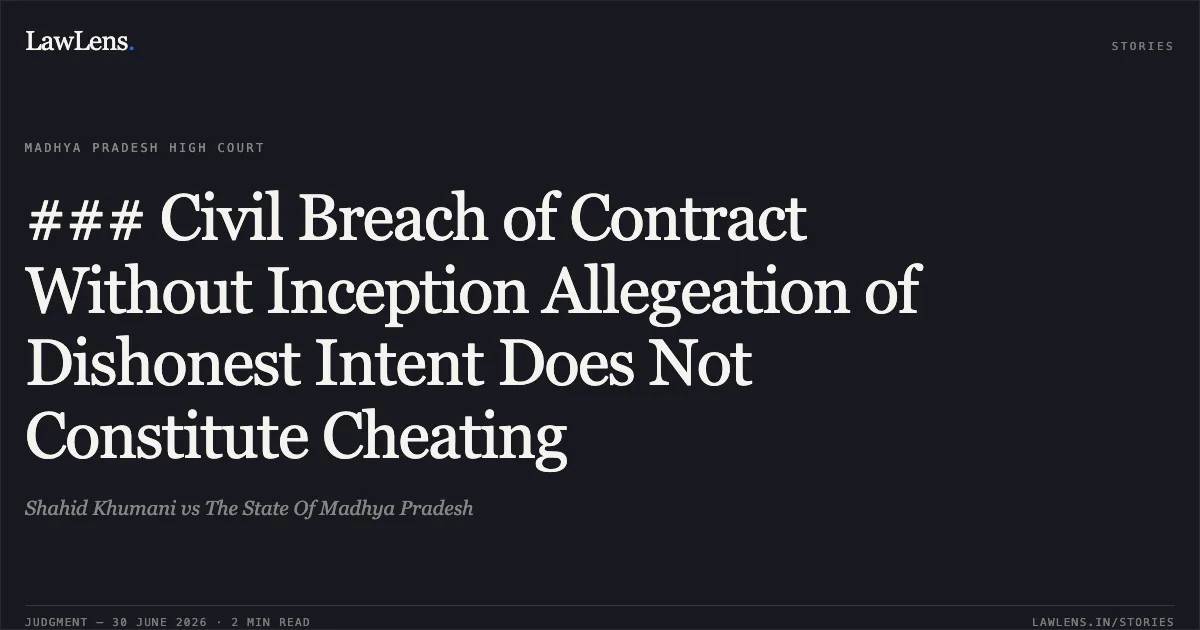
The Court answered the issues in the affirmative for the petitioner, holding that the dispute is essentially civil and the ingredients of Section 420 IPC are not met.
The Court allowed the petition and quashed FIR No. 253/2023 at P.S. Lahar, the resulting charge-sheet, and all consequential proceedings. The petitioner was discharged, as the Court concluded that continuing the prosecution would constitute an abuse of the process of law.
Source reference: para. 24, 26Acts & Sections Cited
4 provisions across 3 statutes referred to in this judgment. Each provision opens on LawLens.
Code of Criminal Procedure, 19731
Bharatiya Nagarik Suraksha Sanhita, 20231
Indian Penal Code, 18602
Original Court PDF
Shahid KhumanivsThe State Of Madhya Pradesh
Click to open original judgment
Original judgment, available to read, download and summarize on LawLens.in