01Facts
The petitioner, appearing in person, filed a petition under Article 215 of the Constitution read with Sections 10 and 12 of the Contempt of Courts Act, 1971, seeking initiation of civil contempt proceedings against Respondent Nos. 1 to 30 for alleged wilful disobedience of judicial orders.
¶ 1He relied on the District and Sessions Judge, Ludhiana's communication dated 21.11.2025 advising him to apply directly to the concerned Court, and on a Section 340 Cr.P.C. order in CRM-2567 of 2025.
¶ 1.1 · pp. 1–2The petitioner alleged procedural irregularities in FIR No. 133 dated 20.09.2015 (PS Division No. 2, Ludhiana) and FIR No. 185 dated 04.11.2015 (PS Sadar, Ludhiana), citing non-compliance with CrPC ss. 154(1), 161 and 164 and their BNSS equivalents.
¶ 1.2 · p. 2He alleged that Respondent No. 26 failed to appear for recording of her s.164 statement despite the order dated 21.07.2017.
¶ 1.3 · p. 2He also challenged the conduct of examination of prosecution witnesses, including Respondent Nos. 27, 28, 29 and 12.
¶ 1.4 · pp. 2–3He relied on Easwaranathan v. State of Madras and Mukesh Singh v. State of U.P. (SLP No. 8905 of 2022) regarding conduct of trials and examination of witnesses under s. 309 Cr.P.C.
¶ 1.5 · p. 3He further alleged threats and assaults against himself and his family between 2020 and 2025, attributing them to Respondent Nos. 1–29 and several named non-parties.
¶ 1.6 · pp. 3–4He apprehended harm to himself and family members and sought ₹10 crore compensation under BNSS s. 396 and CrPC s. 357-A.
¶ 1.7 · p. 4 · ¶ 1.8 · pp. 4–502Issues
i.1. Whether the petition discloses the essential ingredients of civil contempt under s. 2(b) of the Contempt of Courts Act, 1971, by identifying a specific judicial order, direction or undertaking wilfully disobeyed or breached.
¶ 2 · p. 5 · ¶ 2.1 · p. 5ii.2. Whether, on the pleadings as framed, the Court should issue notice to the respondents and proceed with contempt jurisdiction under Article 215.
¶ 2.2 · p. 5 · ¶ 2.3 · pp. 5–603Law Applied
The Court relied on Article 215 of the Constitution and Sections 10 and 12 of the Contempt of Courts Act, 1971, which confer contempt jurisdiction on the High Court.
¶ 1 · p. 1The Court applied the definition of "civil contempt" in s. 2(b), namely wilful disobedience of any judgment, decree, direction, order, writ or other process of a Court, or wilful breach of an undertaking given to a Court.
¶ 1 · p. 1 · ¶ 2.1 · p. 5The principle that contempt proceedings require pleaded, specific allegations of wilful disobedience before notice may issue was applied implicitly.
¶ 2.2 · p. 5The Court referred to, but did not decide, the CrPC/BNSS provisions on investigation, statements and trial (ss. 154, 161, 164, 309; BNSS equivalents ss. 173, 180, 183), the compensation provisions (CrPC s. 357-A; BNSS s. 396), and the authorities cited by the petitioner.
¶ 1.2 · p. 2 · ¶ 1.5 · p. 3 · ¶ 1.7 · p. 4Provisions in the judgment · 18 · Linked ones open on LawLens
Contempt of Courts Act, 1971 Section 2Section 10Section 12
Code of Criminal Procedure, 1973 Section 154Section 161Section 164Section 309Section 340
Bharatiya Nagarik Suraksha Sanhita, 2023 Section 173Section 180Section 183Section 396
Indian Penal Code, 1860 Section 148Section 149Section 323Section 427Section 452Section 506
04Reasoning
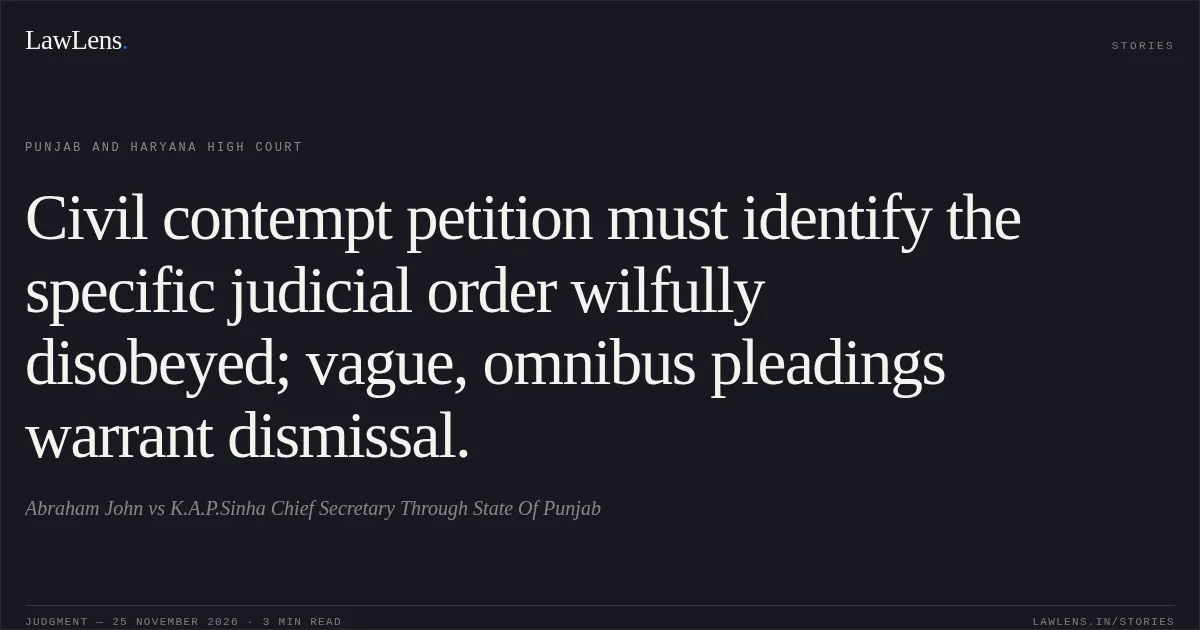
The Court examined the petition in full and found that, although the petitioner was dissatisfied with the conduct of criminal proceedings and alleged misconduct by the prosecution, defence counsel, court staff and Presiding Officer, the pleadings did not identify any specific judgment, order, direction or undertaking allegedly disobeyed.
¶ 2 · p. 5 · ¶ 2.1 · p. 5No instance of wilful disobedience within s. 2(b) was distinctly pleaded or supported by a judicial command.
¶ 2.1 · p. 5The grievances were, in the Court's view, vague and omnibus, and the precise cause of action and relief were not articulated.
¶ 2.1 · p. 5Because the essential ingredients of contempt were absent, the Court held that there was no basis to proceed further or issue notice.
¶ 2.2 · p. 5The Court's reasoning confines contempt jurisdiction to identifiable judicial directions and does not treat general dissatisfaction with the course of criminal trials or allegations against non-judicial actors as sufficient.
¶ 2 · p. 5 · ¶ 2.1 · p. 5The alleged threats and the compensation claim were not examined on merits, and the Court left them to be pursued before the appropriate forum.
¶ 2.5 · p. 605Holding
The petition is dismissed as misconceived and lacking requisite pleadings and particulars, with no notice issued to the respondents.
¶ 2.2–2.3 · pp. 5–6The petitioner has liberty to file afresh by specifying the judicial order allegedly violated, the act of wilful disobedience, and precise reliefs. He was advised to engage a competent legal practitioner before refiling.
¶ 2.3 · p. 6 · ¶ 2.4 · p. 6The Court expressly expressed no opinion on the merits of the underlying allegations, which remain open before the appropriate forum. All pending miscellaneous applications are disposed of.
¶ 2.5 · p. 6 · ¶ 3 · p. 6Original Court PDF
Abraham JohnvsK.A.P.Sinha Chief Secretary Through State Of Punjab
Click to open original judgment
Original judgment, available to read, download and summarize on LawLens.in