01Facts
The appeals challenge the judgment dated 03.05.2024 of a learned Single Judge in CWP-4445-2024 (Jeet Singh v. State of Haryana) and connected writs, which issued directions to cooperative sugar mills concerning the age of retirement of their employees.
¶ 2 · p. 2The Single Judge had proceeded without fully considering the facts and circumstances of the cases.
¶ 2Delays of 121 to 148 days in filing the appeals were condoned.
¶ 1 · p. 3The Bench noted that the same issue was decided in Kulwinder Singh v. State of Haryana (CWP-8116-2016, decided 28.11.2019), which held, relying on General Manager, Kisan Sahkari Chini Mills Ltd. v. Satrughan Nishad (2003) 8 SCC 639, that a cooperative society that is not an instrumentality of the State under Article 12 is not amenable to writ jurisdiction.
¶ 3 · pp. 3-4The Bench also relied on Ravinder Kumar v. State of Haryana (LPA-1606-2026, decided 29.09.2026), which applied the same principle to salary-reduction and recovery disputes between cooperative sugar mills and their employees.
¶ 4 · pp. 4-502Issues
i.1. Whether a writ petition under Article 226 is maintainable against a cooperative sugar mill that is not a "State" or instrumentality of the State under Article 12.
¶ 3 · p. 3 · ¶ 4 · pp. 4-5 · ¶ 12ii.2. Whether directions on the retirement age of employees, a matter governed by the terms of the employment relationship and the parties' agreement, can be issued in writ jurisdiction against a cooperative society.
¶ 5 · p. 10iii.3. Whether state supervisory powers over cooperative societies, or state financial aid to them, render such societies amenable to writ jurisdiction.
¶ 12 · p. 9 · ¶ 14-15 · p. 903Law Applied
Article 12 of the Constitution defines "State" and thus determines the reach of writ jurisdiction under Article 226.
¶ 4 · pp. 4-5 · ¶ 5General Manager, Kisan Sahkari Chini Mills Ltd. v. Satrughan Nishad (2003) 8 SCC 639 held that a cooperative sugar mill is not an instrumentality of the State where it lacks deep and pervasive state control, monopoly status, or a public function, and that the form of the body (society or company) is not decisive. The tests from Ajay Hasia and R.D. Shetty were applied cumulatively, and mere financial assistance or partial state shareholding does not suffice.
¶ 4 · pp. 4-8, quoting Ravinder Kumar · ¶ 10 and quoted Satrughan Nishad · ¶ 8Under VST Industries Ltd. v. VST Industries Workers' Union (2001) 1 SCC 298 and Andi Mukta Sadguru Shree Muktajee Vandas Swami Suvarna Jayanti Mahotsav Smarak Trust v. V.R. Rudani (1989) 2 SCC 691, mandamus lies against a private body only where it discharges a public function or public duty.
¶ 4 · pp. 7-8, quoting Satrughan Nishad · ¶ 9Ram Chandra Choudhary v. Roop Nagar Dugdh Utpadak Sahakari Samiti Ltd. (Civil Appeal No. 4352 of 2026, SC, decided 10.04.2026) held that statutory regulation or supervision by the Registrar does not alter the independent character of a cooperative society or make it an instrumentality of the State.
¶ 4 · pp. 8-9, quoting Ram Chandra Choudhary · ¶ 14.8-14.9 · ¶ 15The Division Bench decision in Raj Narain Yadav v. State of Haryana (2008 (5) SLR 492) cannot be applied in view of the binding Supreme Court position.
¶ 13 · p. 904Reasoning
The controlling question was settled. The sugar mills are not instrumentalities of the State, and the appellants did not establish deep and pervasive state control: they could not point to any fact before the Single Judge showing executive or financial control.
¶ 14 · p. 9State financial aid was insufficient, following Satrughan Nishad, where the State had provided roughly 70% of finances and the mill still was not treated as State. Regulatory supervision and revisional powers under the cooperative statute, including those exercised by the Registrar, did not change the essential character of the society.
¶ 15 · p. 9The appellants' reliance on Raj Narain Yadav failed because the Supreme Court's view prevails and counsel conceded this.
¶ 13 · p. 9No perversity or misreading of law was shown in the Single Judge's reasoning.
¶ 16-17 · pp. 9-10The directions on retirement age concerned the terms and conditions of the employment relationship, which depend on the agreement between the parties, so the Single Judge's directions could not be sustained on that ground either.
¶ 5 · p. 1005Holding
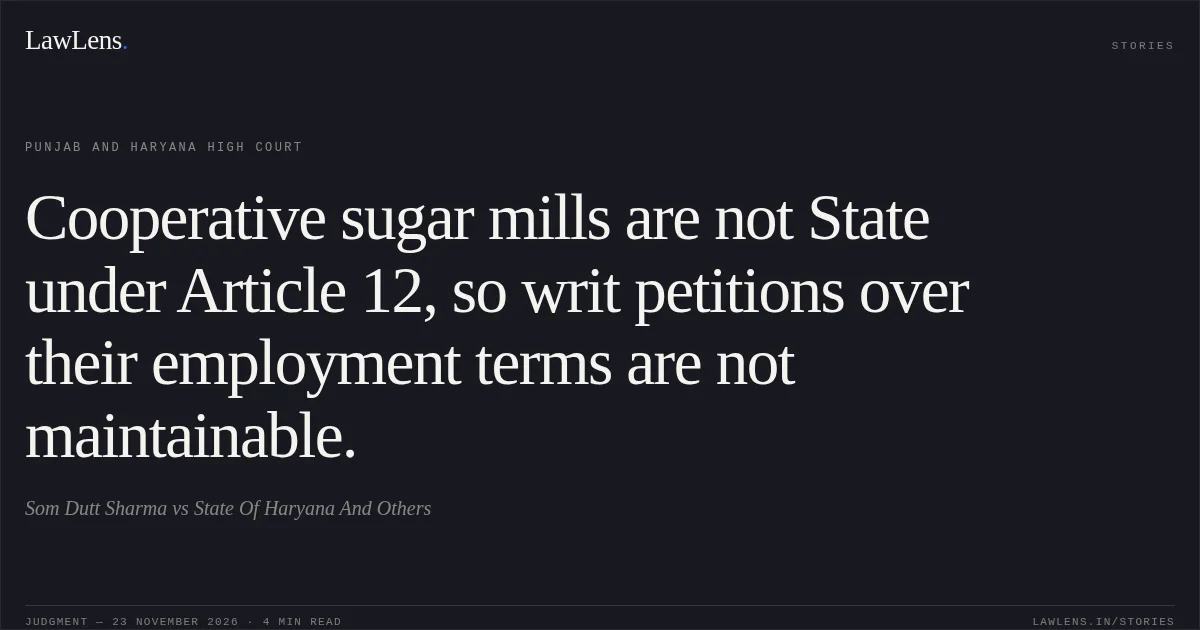
A writ petition is not maintainable against the cooperative sugar mills, which are not "State" or instrumentalities of the State under Article 12, and the Single Judge's directions on retirement age could not stand.
¶ 5 · p. 10The appeals were allowed and the order dated 03.05.2024 in CWP-4445-2024 and connected matters was set aside in terms of Ravinder Kumar. The respondents are at liberty to pursue their appropriate remedy before the competent forum in accordance with law.
¶ 5 · p. 10Nothing in the order expresses an opinion on the merits of any claim. Pending applications were disposed of.
¶ 7-8 · p. 11Original Court PDF
Som Dutt SharmavsState Of Haryana And Others
Click to open original judgment
Original judgment, available to read, download and summarize on LawLens.in